Underground World
2200+ Year
By the year 2200, humanity reaches a level of technological advancement that seemed impossible only a few centuries ago. Biotechnologies allow for life extension, the first self-sustaining settlements appear on Mars, and production gradually moves beyond Earth. However, access to these capabilities remains uneven: core technologies are controlled by large corporations and wealthy elites, for whom space is merely an extension of familiar living.
Most of the population continues to reside on Earth, where industry is steadily consuming more space. Cities sprawl, natural territories shrink, and available land becomes scarcer. People unable to compete for space within megacities begin searching for territories that industry has not yet claimed.
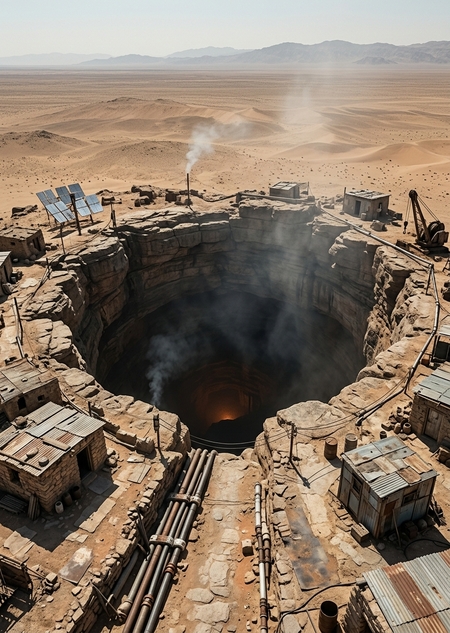
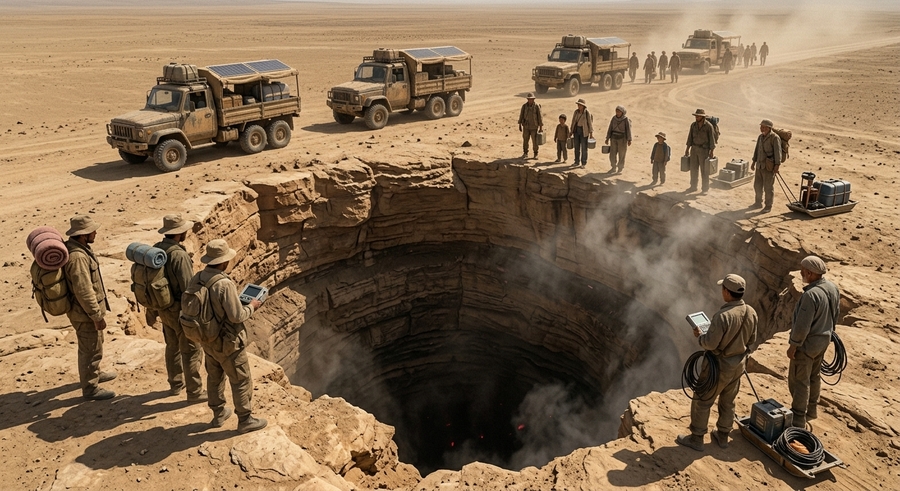
Central Asia becomes one such territory. Here, a group of settlers discovers a massive natural crater from which hot steam and gas emanate. Utilizing available nanotechnology, the people begin studying the rock and gradually descend underground. The deeper they go, the clearer it becomes that there is a space beneath the surface capable of housing an entire settlement.
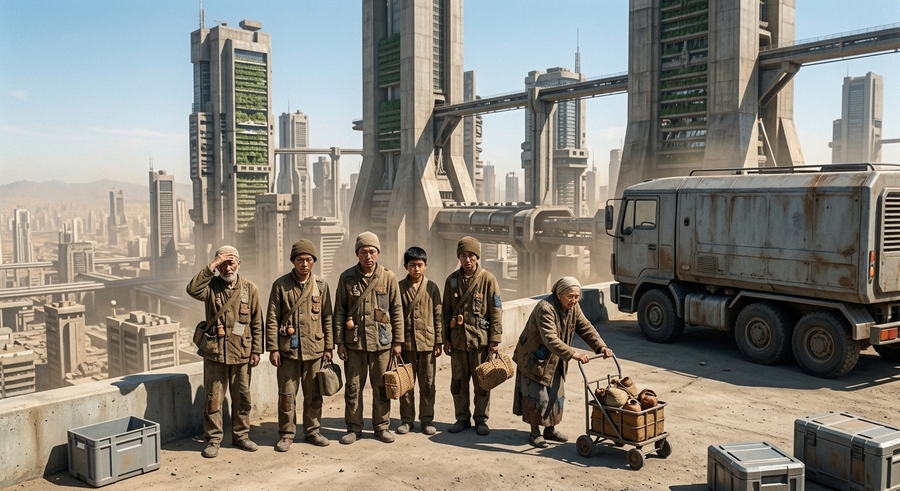
First Settlements
Exploring Depth
The first years underground prove to be a struggle not so much with the unknown, but with the physical conditions of the environment. There is no sunlight here; the temperature is significantly higher than accustomed, and the air contains high levels of carbon dioxide and combustion byproducts. Living in such a space without additional infrastructure is impossible. The primary task becomes air purification. People create a system of filtration and ventilation, utilizing local rock formations, accessible materials, and technologies brought down from the surface. Heat and gas, initially perceived as threats, gradually become resources. The first living quarters, workshops, and technical zones emerge around the heat sources. Gradually, the temporary shelter transforms into a permanent settlement. People begin carving rooms directly into the rock, connecting them with tunnels, and building simple infrastructure. The subterranean space ceases to be a place to wait out danger and becomes a new home.
Creating the environment
2022–2030
The next stage involves creating a self-sustaining ecosystem. Along with the people underground go plants, originally engineered for Martian conditions. They prove better adapted to the lack of light and the harsh environment, gradually becoming the foundation of subterranean agriculture.
The plants are grown under artificial lighting, and water is purified and recycled. The earth’s heat helps maintain necessary conditions even where conventional farming is impossible. Over time, individual farms emerge, and food production becomes integrated into the settlement’s architecture.
Animals also begin to adapt to the new environment. Over generations, certain species see changes in their respiratory systems and behaviors. Humans observe these transformations and gradually realize that the underground world is not just allowing them to survive—it is beginning to change every living thing within it.
People of Depth
2023–2025
Across several generations, the underground settlement ceases to be perceived as a temporary colony. Children are born here who have never seen the surface and know no other world. The space that the first settlers considered hostile gradually becomes a familiar part of daily life.
The architecture evolves in tandem with society. Housing, workshops, farms, and communal spaces merge into a multi-level system of tunnels and halls. Stone, ceramics, and recycled metal become the primary materials. Artificial light replaces the sun, and air filtration systems become as essential to the home as water or heating.
A distinct culture gradually forms. People begin to perceive the depths not as an absence of surface, but as an autonomous world with its own set of rules. For new generations, the surface becomes an almost mythical place, connected to the stories of the elders and the memories of those who still experienced life above ground.
Munash
Arrival of the senior
Among the first generations of inhabitants appears a person named Munash. Before the underground settlement, he wandered for many years and managed to live in different parts of the world. He arrives in Central Asia around the time when the first groups begin searching for a new place to live.Munash does not become a religious leader, nor does he claim to possess special knowledge. His value lies elsewhere: he remembers a world that has already become history for most of the inhabitants. He knows how to build with clay, work with heat, organize daily life in isolation, and conserve resources where they are scarce.Gradually, he begins to be seen as an elder. Life-extending technologies that existed on the surface before the settlement’s arrival allow him to live significantly longer than an ordinary person. For several generations of the deep-dwellers, Munash becomes the link between the past and the present. Over time, the actual details of his life merge with retellings, and the man transforms into a figure that is perceived almost as an immortal ancestor.
Culture of Fire
2250–2270
Fire occupies a special place in the life of this underground society. It is connected not only to warmth and energy production but also to the very existence of the settlement. People live near heat sources, utilize gas and geothermal energy, and artificial light substitutes for sunlight.
Under these conditions, elements of ancient Central Asian religious beliefs are gradually reappearing. Zoroastrian heritage, in particular, becomes vital, viewing fire as a significant symbol. However, the residents of the depths do not literally restore the historical religion. Old beliefs are evolving under the influence of the new lifestyle, transforming into their own system of traditions.
Fire becomes part of daily rituals, architecture, and communal life. It reminds the residents that even in an artificially created environment, humans still require symbols to connect them to the surrounding world.
Underground Economy
2027–2029
Over time, the inhabitants discover that the underground environment possesses resources essential to the surface. Gas becomes one of the most significant. Its extraction allows the settlement’s infrastructure to be maintained, and surpluses are traded with the people above.
Thus, a peculiar subterranean economy arises. Through intermediaries, the residents acquire medicines, tools, materials, and technologies that they cannot produce on their own. In return, they provide gas and other resources. Despite the isolation, the settlement gradually becomes connected to the outside world.
This creates a contradiction that becomes a part of the society’s life. The people initially went underground precisely to escape dependence on the industrial system. Now, their own survival begins to rely on exchange with it. The underground world turns out not to be a separate civilization, but rather another component of the existing economic system.