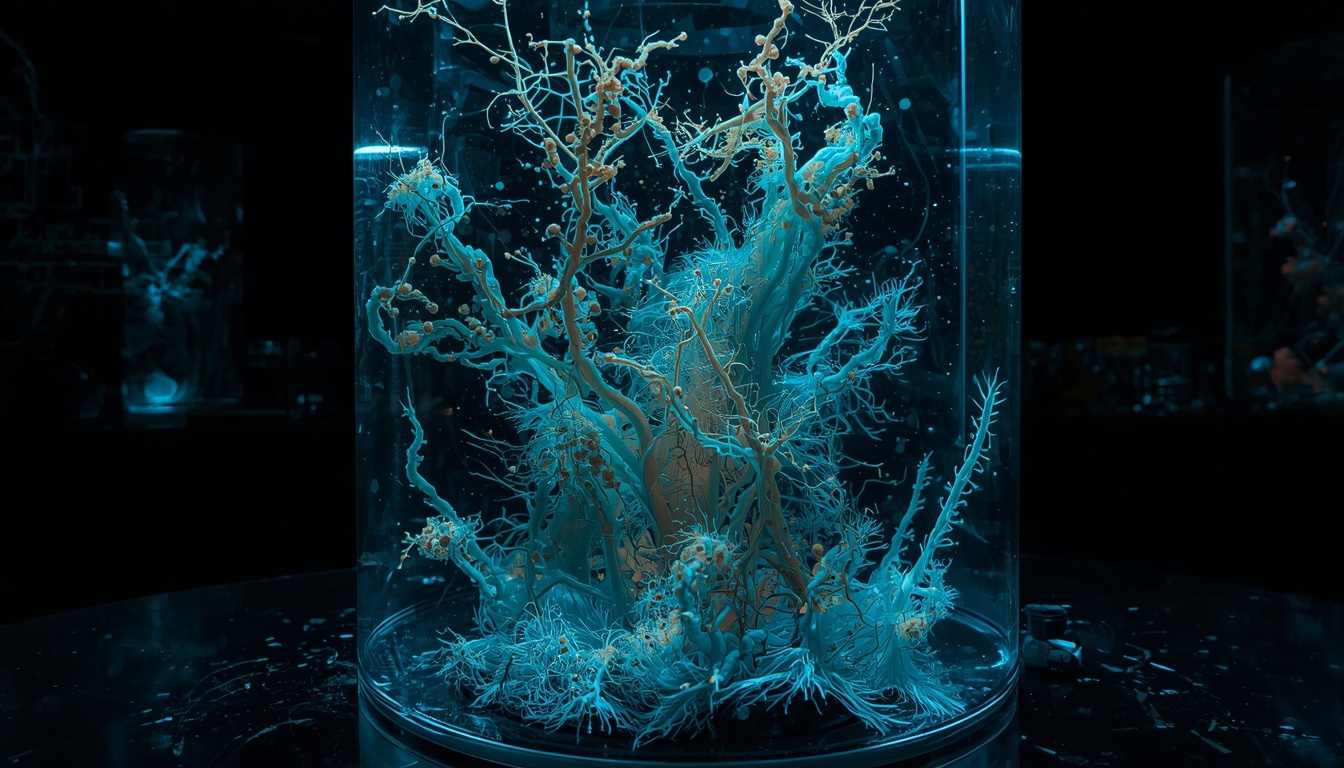
«Microbro» is a science-entertainment media platform about the invisible living environment of humans. It explores microorganisms, their interaction with people and the surrounding world through biology, medicine, visual experiments, and bioart.
Goal
To popularize biological knowledge, help the audience better understand their own bodies and the surrounding environment, cultivate a conscious perspective on the microcosm, and stimulate interest in independent observation and creativity.Content Strategy
To capture attention using visually unusual objects and short videos, retain the audience with regular segments, and then transition that interest toward deeper study of the topic, practical application, and community engagement.
Thematic Plan
The plan is built around four editorial lines from the project’s concept: «You Are Not Alone,» «A World You Don’t See,» «They Are Doing Things Too,» and «The Microcosm as Material.» These lines cover the life of microorganisms alongside humans, visual discoveries, biological interactions, and the creative use of the microscopic world.
The plan is designed for regular updates on Telegram and for repurposing materials into short videos. All four themes are covered each month, though one takes the leading focus.
01/ January — «You Are Not Alone»
Week 1 Telegram: Main Posts
«What is this anyway?» — a mysterious micrograph. «You are not alone”—who lives on human skin.
Shorts / Reels / VK Clips
Guess the object under the microscope, then reveal the image.Week 2 Telegram: Main Posts
„You wear this too”—Demodex mites: where they are found and why their presence alone does not mean illness. „Microbe of the Day”—one inhabitant of the skin.
Shorts / Reels / VK Clips
„Who lives in the hair follicle?“; macro photography of skin and hair.Week 3 Telegram: Main Posts
„The microscopic world inside you”—gut microbiome explained simply. „Microbe Fact-Check”—are all bacteria harmful?
Shorts / Reels / VK Clips
Beneficial and potentially harmful microorganisms: why division doesn’t always work.Week 4 Telegram: Main Posts
„Do they control us?”—what we know about the link between the microbiome and the nervous system. „Micro-world in daily life”—what antibiotics do to the microbiome.
Shorts / Reels / VK Clips
„Can the gut affect the brain?“ with a careful separation of facts and hypotheses.
Monthly Summary: The classroom explores the core object of media and understands that the microworld is not a threat.
February 2nd — «They are doing something too»
Week 1 Telegram: Key Posts
«The Invisible Neighbor”—bacteria that help digest food. „Connected to Everything”—the organism and its microbiome.
Shorts / Reels / VK Clips
„You have allies you cannot see.“Week 2 Telegram: Key Posts
„The World Isn’t Made for Humans”—how microorganisms compete for resources. „One Scientific Idea”—how microbial competition works.
Shorts / Reels / VK Clips
Microorganisms fighting for space and nutrients: a visual explanation.Week 3 Telegram: Key Posts
„They Do Something Too”—fungi capable of infecting insects. „Microbial Fact-Check”—does a parasite always kill its host?
Shorts / Reels / VK Clips
„The Fungus That Infects Insects“: a short story without horror exaggeration.Week 4 Telegram: Key Posts
„The World Isn’t Made for Humans”—how chemical signals help bacteria interact. „Connected to Everything”—microorganisms, animals, and ecosystems.
Shorts / Reels / VK Clips
How bacteria „exchange messages“; what this metaphor truly means.
Monthly Digest: This month offers intellectual depth and material for an audience interested in the unexpected connections between biology, behavior, and the structure of nature.
March 3 — «Invisible Life»
Week 1 Telegram: Key Posts
«The Micro-World in Daily Life» — what happens to a dish sponge. «Survival Guide» — safely handling kitchenware.
Shorts / Reels / VK Clips
«Why isn’t a sponge just a sponge?»; a visual story about a damp environment.Week 2 Telegram: Key Posts
«Microbial Fact Check» — can you slice off mold and eat the rest. «What Happens After…» — how mold develops on food.
Shorts / Reels / VK Clips
A time-lapse of mold growth or a scientifically accurate visualization with explanation.Week 3 Telegram: Key Posts
«You Wear This Too» — what you can and cannot assume about microbes after riding the subway. «The Micro-World in Daily Life» — why handwashing is truly important.
Shorts / Reels / VK Clips
«What’s left on a handrail?»; an explanation of pathogen transmission pathways.Week 4 Telegram: Key Posts
«The Micro-World in Cosmetics» — why storage conditions and expiration dates matter. «Microbial Fact Check» — what the label «antibacterial» on products means.
Shorts / Reels / VK Clips
«Antibacterial doesn’t mean sterile»: a brief explanation.
Monthly Takeaway: The audience begins to understand the value of saving posts and revisiting them. Media evolves from merely a source of visual wonder to a practical reference guide.
April 4 — «Spring Through the Eyes of the Microcosm»
Week 1 Telegram: Key Posts
«What is this anyway?» — guess the insect from a macro photograph. «How was this shot?» — the structure of the insect’s eyes, antennae, and integument.
Shorts / Reels / VK Clips
Extreme macro photography of an insect; comparison of a standard versus an enlarged image.Week 2 Telegram: Key Posts
«The Invisible Neighbor» — how ticks differ from insects. «Microbial Fact Check» — common misconceptions about ticks and protection against them.
Shorts / Reels / VK Clips
«Ticks are not insects»: a short fact and visual comparison.Week 3 Telegram: Key Posts
«The World You Can’t See» — mycelium and spores. «They Do Things Too» — the role of fungi in organic decomposition.
Shorts / Reels / VK Clips
«What you see may only be a fraction of the fungus.»Week 4 Telegram: Key Posts
«The World Isn’t For Humans» — what happens in the soil after winter. «Connected to Everything» — soil microorganisms, plants, and the cycle of matter.
Shorts / Reels / VK Clips
«One clump of earth, countless interactions»; a visual story about soil.
Month Summary: The content extends beyond medical themes and underscores the project’s central idea: the microcosm is everywhere, and humanity is merely a part of this system.
May 5 — «How to See the Unseen»
Week 1Telegram: Main Posts
«Magnification ×…» — one object at various levels of zoom. «How was this shot?» — how a microscope works.
Shorts / Reels / VK Clips
The object magnified by ×100, ×1000, or higher, provided the original data allows for proper comparison.Week 2Telegram: Main Posts
«How was this shot?» — sample preparation and image acquisition. «DIY» — safe ways to observe large and small objects.
Shorts / Reels / VK Clips
«What can be seen with simple magnification?»Week 3Telegram: Main Posts
«AI vs Microscope» — comparing scientific imagery and artistic visualization. «Microbe Fact Check» — how to distinguish real micrography from generated images.
Shorts / Reels / VK Clips
«Was this taken by a microscope or imagined by AI?» followed by an answer.Week 4Telegram: Main Posts
«Show Your Micro-World» — an invitation to send photos. «What Did I Capture?» — analyzing a user-submitted image with versions and an editorial explanation.
Shorts / Reels / VK Clips
Reaction to an unusual image; a brief analysis of a subscriber’s observation.
Monthly Summary: the studio receives tools for independent observation, and media begins gathering user-generated content.
06/June — «The Microcosm as Art»
Week 1 Telegram: Featured Posts
«The Microcosm as Art”—an analysis of the visual composition in photomicrographs. „How Was This Shot?”—how the photographic method influences the visible image.
Shorts / Reels / VK Clips
„Is This a Photograph or an Abstract Painting?“; revealing the original subject matter.Week 2 Telegram: Featured Posts
„BioArt of the Week”—a selection of projects using biological materials. „The Microcosm as Medium”—how artists work with living systems.
Shorts / Reels / VK Clips
A short story about a bioart project: concept, materials, visual outcome.Week 3 Telegram: Featured Posts
„The World You Don’t See”—how AI aids in visualizing the microscopic world. „One Idea from Science”—the difference between modeling, visualization, and a real biological process.
Shorts / Reels / VK Clips
„Did AI Draw the Microcosm or Help Explore It?“Week 4 Telegram: Featured Posts
„Open Lab”—an interview with a biologist, microscopist, or bioartist. „Show Us Your Microcosm”—a compilation of subscriber works and the six-month review.
Shorts / Reels / VK Clips
The best discoveries from the past six months; user-submitted images with annotations.
Monthly Summary: The «microbro» shifts from the «media tells» model to the «media explores with the audience» model.
Frequency
Telegram: 4–5 posts per week, including one in-depth piece.Shorts, Reels, and VK Clips: 2–3 short videos per week, adapted for each platform.Long-form articles, interviews, and deep dives: 2–4 pieces per month, depending on expert availability and team resources.
Content Samples: 10 examples
1. BioArt: When Microorganisms Become Art
Format: Shorts / Reels / VK Clips · Duration: 45–60 seconds
0–5 seconds · Hook
Voiceover: «Imagine an artist not painting a picture, but cultivating one. And the colors within it are alive.»
5–15 seconds · Concept
«In bioart, living systems—bacteria, fungi, cells, or other biological structures—become the creative material. The artist works not just with form, but with the process of life itself.»
15–30 seconds · Material and Method
«For instance, colonies of microorganisms can grow on a nutrient medium. Their placement, color, and shape depend on the organism’s species and the growth conditions. The artist defines the composition and experimental parameters, but the living material develops according to its own biological laws.»
30–45 seconds · Visual Result
«The result is an image that resembles abstract painting, a map of an unknown planet, or a glowing urban landscape. Yet, behind this aesthetic lies a genuine biological process.»
45–55 seconds · Finale
«Bioart changes the familiar question: not only what we can do with nature, but what nature itself can create when given space.»
Final screen text: «Microbro. The unseen world nearby.»
2. How was this captured? The microworld begins with a sample
Format: Telegram post