1. Media Concept
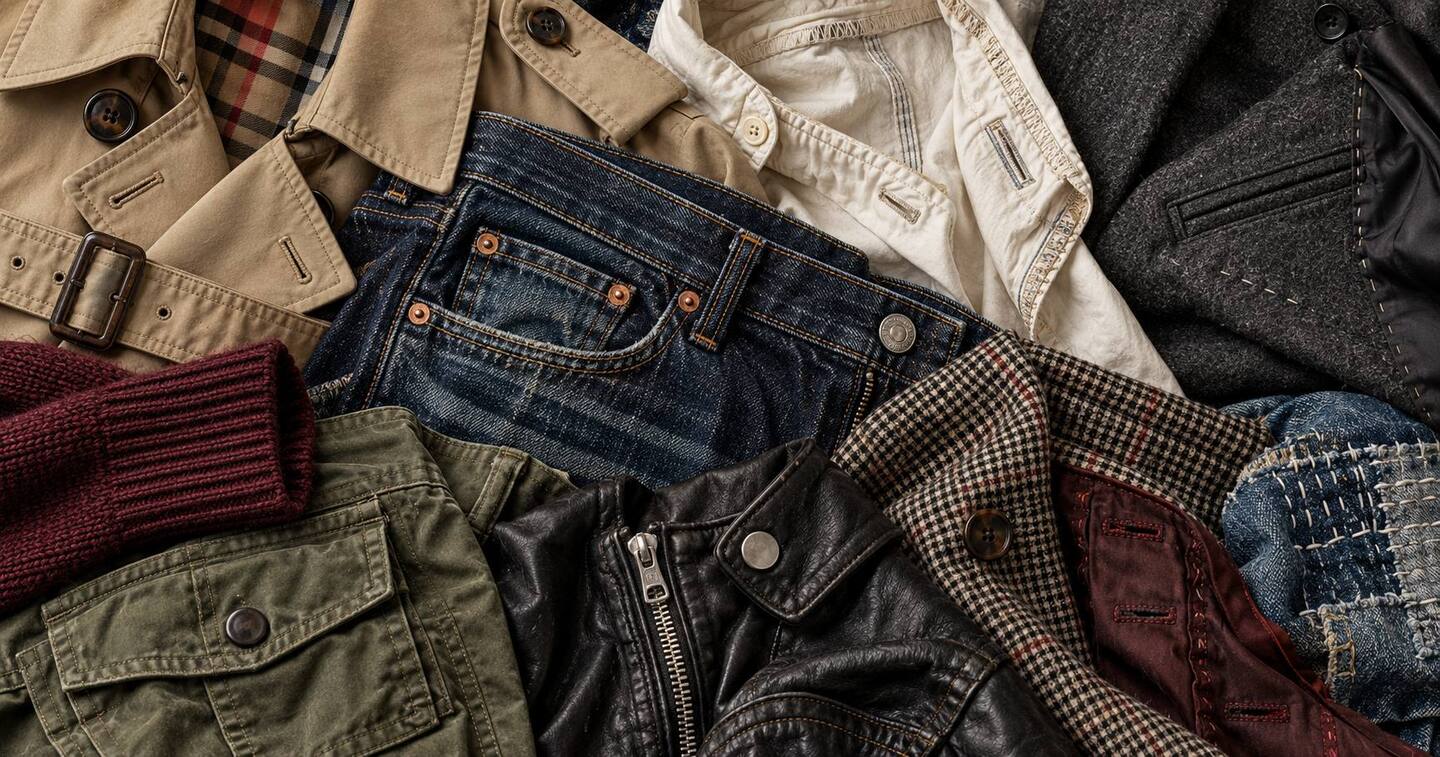
«The Underside» is an online journal about the stories behind the things we wear every day. Why is there a small pocket on jeans? Why do city coats have epaulets? How did a simple pin become a symbol of protest? The media examines familiar clothing through its origins, structure, and cultural significance.
The name connects to the project’s principle: to turn an ordinary object inside out and examine what lies beneath its surface. A specific seam, pocket, or clasp becomes the starting point for a conversation about design, daily life, and society.
2. Six-Month Thematic Plan
The plan is calculated for six months from launch. The primary rhythm is one publication per week, resulting in four pieces of content per month—a total of 24 core materials. If there is an extra fifth week, you can feature a survey or host a reader discussion.
Each month is unified by a central theme. This approach allows us to gradually transition from small details to the cultural and personal significance of clothing.
1. Details We Stopped Noticing1. Why does a pair of jeans have a small pocket? — «Detail.» 2. Why do jeans have rivets? — «Detail.» 3. A pocket that was worn separately — «Object Biography.» 4. There is a pocket, but you can’t put anything in it — «Internal Structure.»2. How Everyday Clothing Is Constructed1. Why do coats have epaulets? — «Detail.» 2. Why did the hoodie get a hood? — «Object Biography.» 3. Why does one fabric stretch while another barely does? — «Internal Structure.» 4. What can you learn about an object if you turn it inside out? — «Internal Structure.»
- Things Change Professions1. Jeans: How workwear became everyday attire — «The Biography of a Thing.» 2. Trench Coat: From military utility to urban wardrobe — «The Biography of a Thing.» 3. Jumpsuit: What happens to workwear outside of work? — «The Biography of a Thing.» 4. Why do we like clothing with visible markers of practicality? — An editorial analysis.4. Clothing as Community Language1. How did a pin become a symbol of protest? — «The In-Crowd Recognizes.» 2. A band T-shirt: Clothing that starts a conversation — «The In-Crowd Recognizes.» 3. Patches: Small signs of great belonging — «The In-Crowd Recognizes.» 4. Can you recognize «your own» by their clothing? — An editorial essay.
- Wear, Repair, and Second Lives1. The Patch That Isn’t Hidden: What is Patina? — «A Piece with History.» 2. Abrasion: Damage or Design? — «From Within.» 3. Why Does Visible Repair Change How We View an Object? — Editorial Essay. 4. Same Model, Different Life: How Wearing Changes Clothing — «A Piece with History.»6. The Personal Wardrobe as Archive1. Why Do We Keep Clothes We No Longer Wear? — «A Piece with History.» 2. A Stranger’s Item Becomes Your Own: Inherited Clothing — Editorial Essay. 3. What Does Your Favorite Item Reveal About You? — A Self-Exploration Piece. 4. Reading Your Own Wardrobe: Five Questions for Familiar Clothing — Final Feature.
3. Ten Content Samples
Sample 1. Why does a pair of jeans have a small pocket?Feature SegmentIt’s inconvenient for holding a phone, keys barely fit, and it’s difficult to get coins out later. The small pocket inside the front pocket of jeans looks as if it was made for an item we no longer have.That is approximately what happened. On early Levi’s jeans, this pocket was intended for pocket watches. In the late 19th century, people carried watches with them, and a small, separate compartment kept them close at hand.There is another surprise: the familiar name «fifth pocket» is misleading. The first models had four pockets, including the watch pocket. The fifth became the second back pocket, which Levi’s added in 1901.Watches gradually moved to the wrist, and later largely gave way to the phone. The pocket remained. Now, its presence seems natural: without it, the jeans would look a bit unconventional.It turns out that our clothing still has space reserved for an item from a different daily routine. Even if today, only a random coin is kept there.
Sample 2. Why do jeans have rivets?Feature: «The Detail»Look closely at the corners of the front jean pockets. Where the fabric experiences stress, small metal rivets are often placed. We are used to seeing them as a decorative element, although they were originally implemented for durability.Tailor Jacob Davis used rivets to reinforce areas that might tear during wear. Along with Levi Strauss, he patented this solution in 1873. The metal helped hold the fabric at points of tension, including near the edges of the pockets.However, this strength came with a drawback. The exposed rivets on the back pockets scratched furniture and saddles. In 1937, Levi’s began covering them with fabric, and in 1966, they replaced them with reinforced stitching.The history of jeans is shaped by these small revisions: reinforcing weak spots, removing discomfort, and maintaining a recognizable aesthetic.Therefore, the rivet offers a good opportunity to view clothing as the result of continuous improvement. Even the most familiar items once had flaws that needed solving, sometimes down to a single pocket corner.
Sample 3. The Detachable Pocket
«Object Biography» Feature
Imagine choosing a dress in the morning, and then separately putting on a pocket accessory. You secure it around your waist, tuck it under your clothing, and head out.
In European women’s wardrobes, such pockets were a common accessory. They were widely used from about the mid-17th century until the late 19th century, and sometimes even later. They existed independently of the dress and were fastened with ties.
Contents could be retrieved through specific openings in the garment. Some surviving pockets reached lengths of about forty centimeters—they could hold much more than a small pocket on modern trousers.
Inside, people kept money, keys, sewing supplies, and small personal items. This pocket could be removed along with everything inside and then worn with different outfits.
However, the story isn’t a simple sequence of «pocket first, then purse.» These items coexisted for a long time and served various functions.
For «The Underside,» what’s interesting is the shift in perspective: a familiar part of clothing was once a standalone item. And the question, «does this dress have pockets?» would have sounded entirely different back then.
Sample 4. There is a pocket, but you can’t put anything in it.
Feature: «From the Inside»
Fingers trace a neat strip of fabric on the jacket. It looks like a pocket. It feels like a dead end.
Before dismissing it as a trick, it’s worth looking inside the garment. A real pocket is sometimes temporarily sewn shut: the opening is closed with stitching, and beneath it is the pocket lining—that interior space where items go.
A decorative pocket may only have an external indication: a flap, a border, or a line of stitching. There is no storage space behind it.
In the first case, the pocket exists, but it is closed for now. In the second, we are presented with an element of external appearance.
And this raises a question for design. Is it enough for the garment to look functional, or do we expect every such detail to function?
For a photograph, the difference is almost imperceptible. In daily life, it becomes apparent the moment you need somewhere to put your keys.
Try checking your own items: how many pockets are visible, and how many of them can you actually use?
Sample 5. Why the epaulets and insignia?
«Detail» Segment
You can find a whole set of details on a city trench coat that seem overly serious for a walk to campus: epaulets, metal rings on the belt, extra fabric flaps.
They are a reminder of the coat’s military past. Historically, Burberry trench coats used epaulets for rank insignia, and they could also hold items, such as gloves. Gear was attached to the D-rings. The additional flaps helped provide protection from the elements.
During World War I, Burberry apparel was used by the armed forces. Over time, the trench coat transitioned into urban wardrobes while retaining its recognizable structure.
Today, these elements might be almost superfluous. There are no rank signs on the epaulets, and nothing hangs from the rings. But it is precisely these details that help us identify the trench coat among other coats.
Here begins the curious life of a detail: its original function becomes less significant, while its value for the overall aesthetic increases.
The coat continues to bear the apparatus of its former life, even if its owner is preoccupied with other matters.
Sample 6. Why did the hoodie get a hood?
In the «Biography of an Item» column
It’s easy to imagine a hoodie in any everyday situation—at home, on the go, or in class. It seems as if it was immediately conceived as versatile, comfortable clothing.
However, in Champion’s history, the hooded sweatshirt was connected to a specific need. In the 1930s, the company developed it for athletes: this type of garment allowed them to stay warm between practices and during breaks.
The hood was part of that solution. It was added to an existing athletic sweatshirt to expand its protective capabilities.
Viewed from this perspective, the familiar silhouette of the hoodie reads differently. The relaxed fit, the covered head, the ability to quickly slip it over other clothing—everything serves the context where a person is either moving or resting.
Today, we can wear a hoodie all day without exercising at all. But the comfort that made it everyday wear grew out of a very specific necessity.
Sometimes, the journey of an item into a large wardrobe starts with a simple question: how does a person stay warm while they wait?
Sample 7. How the safety pin became a symbol of protest?«Insiders Know» FeatureUsually, people try to hide a safety pin. It temporarily holds fabric in place where a seam has come undone or a clasp is missing. The less noticeable it is, the better it fulfills its function.In punk fashion, the safety pin was deliberately visible.Materials from the Victoria and Albert Museum describe 1970s garments featuring intentionally distressed surfaces: unraveling jumpers, ripped dresses and tops adorned with chains and safety pins. Signs of damage became part of a deliberate aesthetic.This technique can be interpreted as a rejection of the expectation to appear neat and well-kept. The garment showcased what would typically be considered a flaw or a reason for repair in standard clothing.The safety pin is especially powerful because of its ordinariness. To modify clothing, you don’t necessarily need complex tools—a familiar object allows one to intervene in a finished form.However, a single safety pin on a jacket says nothing about the person. Meaning emerges from the combination of details, context, and how the owner utilizes the image.
Sample 8. Band T-shirt: Clothing That Starts a ConversationThe «In-Crowd Recognition» FeatureSometimes an introduction begins with a band name on someone’s T-shirt.You recognize the band, recall an album or a concert—and for a few seconds, that person stops being a complete stranger. A potential common ground emerges between you.This T-shirt can be viewed as a small public gesture. The wearer puts their musical preference on the surface of their clothing, making it visible to others.However, this gesture cannot be interpreted definitively. For one person, the T-shirt connects to beloved music. For another, it relates to a specific trip. For a third, the image, color, or comfortable fit is what matters. Sometimes, the item was just received from a friend.Therefore, clothing can provide a reason to talk, but it won’t reveal the owner’s complete biography.Instead of asking, «Name three songs, ” it is much more engaging to ask, „Where did you get this T-shirt?“The answer can prove more unexpected than the assumption we already made based on the graphic.
Example 9. The Patch You Don’t Hide: What is Boro?«Object with a History» ColumnA patch is often perceived as an attempt to restore the garment to its original appearance—to match a similar fabric, make the stitches inconspicuous, and conceal the damage.Japanese textile items, Boro, suggest a different rationale for observation. Their surfaces are composed of repeated repairs: fragments of fabric are layered onto one another, joined, and reinforced with stitching.This practice helped extend the life of textiles. In impoverished rural families, items could pass between generations, accumulating more and more patches. Preserved pieces today are viewed both as cultural artifacts and as aesthetically expressive objects.However, beyond the attractive texture, it is important to see the circumstances under which it arose. The repairs were linked to the necessity of conserving available materials.On such an item, time becomes visible: here the fabric has thinned, here it was reinforced, and here an additional layer was needed.The patch allows one to read the garment as an object that evolved alongside the lives of its owners. Each intervention left a new record on it.
Sample 10. Why do we keep clothes we no longer wear?
Feature: «Objects with a Story»
On the shelf in the back lies a sweater. It no longer matches the rest of my wardrobe, the sleeves have stretched out, and I don’t plan on wearing it again.
Yet, when it’s time to empty the closet, the sweater stays.
Perhaps it’s because it is connected to a specific person or period in my life. You remember who gave it to you, where you traveled in it, what that year was like. An object acquires a significance that is difficult to see from the outside.
If you evaluate it solely by its condition and frequency of use, the decision seems obvious. But if you account for its personal history, it becomes more complex.
You don’t have to keep everything. Sometimes a photograph or a recorded memory is enough. But other times, it’s important to keep the actual object—its weight, its texture, its familiar form.
Try choosing one such item and finish this sentence: «I am keeping this because…»
Perhaps the answer will tell more about your wardrobe than a list of the things you wear every day.