Concept
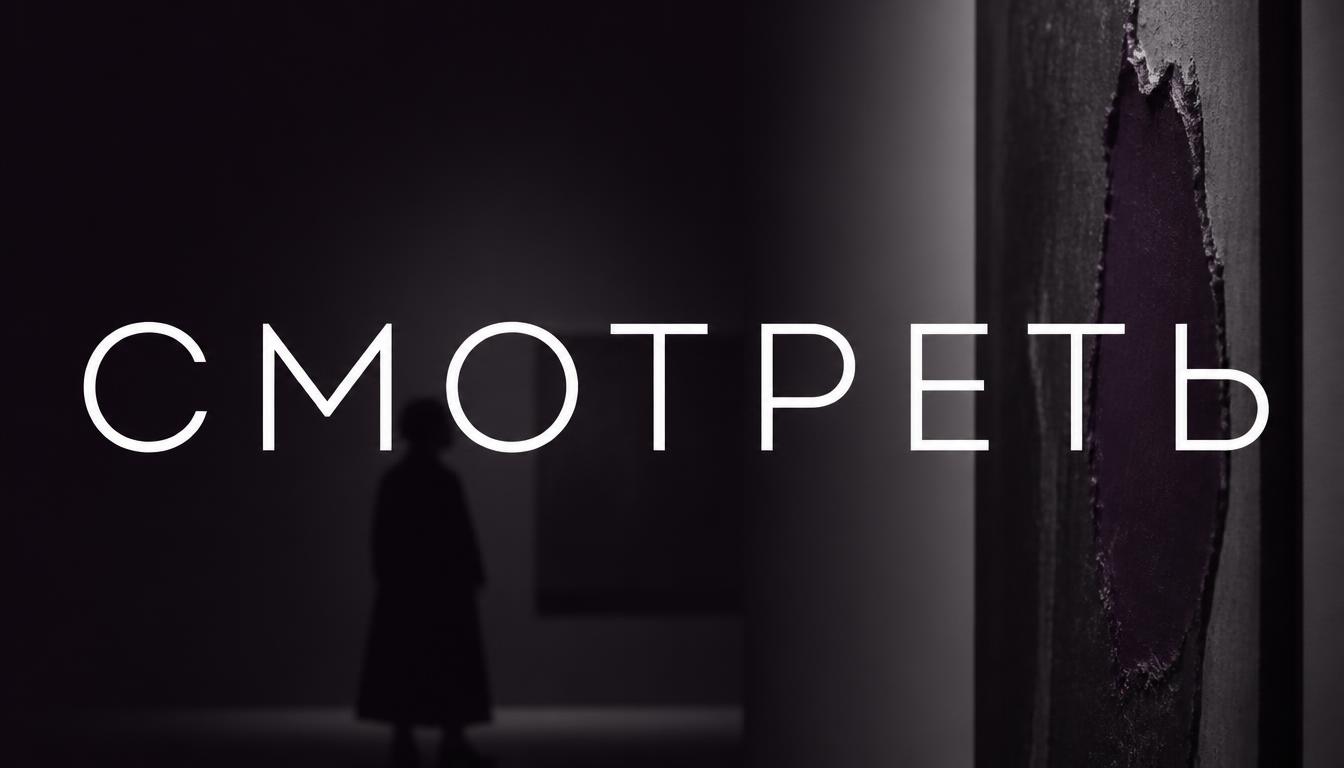
«View» is a Russian-language media outlet focused on the practice of observing art. The formula isn’t «what the artist intended to say, ” but rather how to look: to notice, to pause, to describe, and to ask questions. The key difference: every piece of content is built around a single question or conflict, not around the author. Users submit observations via a Telegram bot—after moderation, the observation becomes part of a collective archive.
Channels: Telegram — rhythm, participation, discussion. Website — archive, long-form essays, collections, glossary. Telegram Bot — submission of observations.
Categories
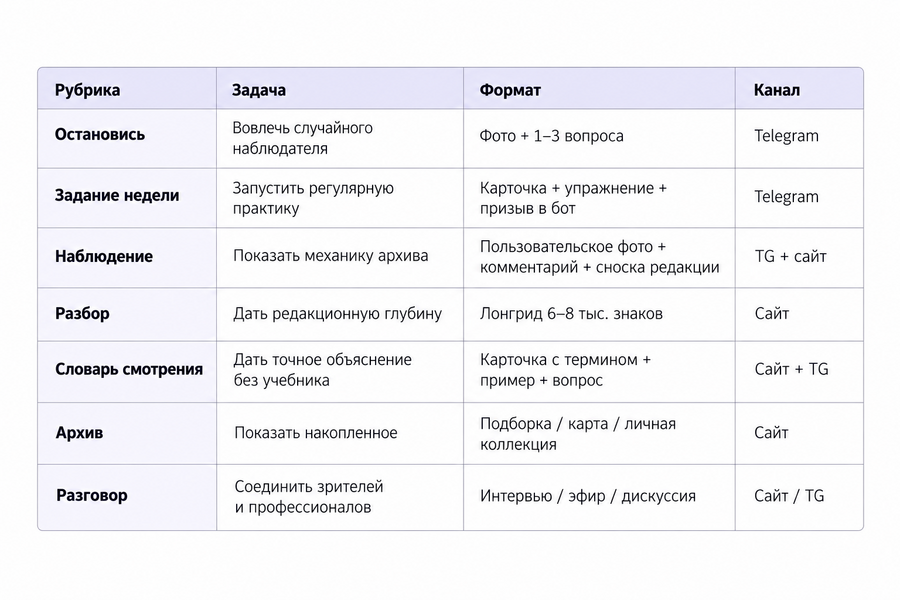
Six-Month Thematic Content Plan
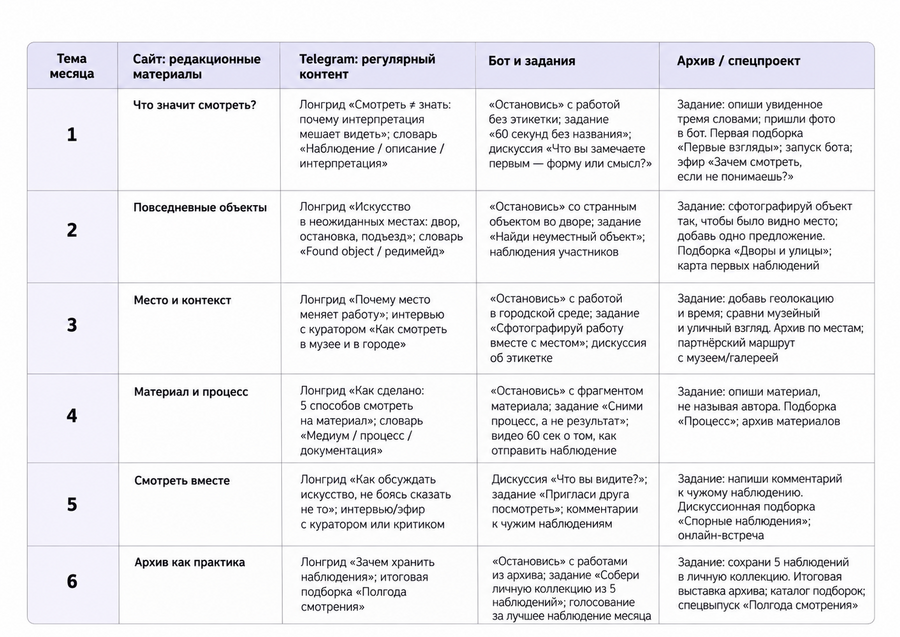
Weekly Content Plan
10 Content Samples for the «View» Media
1. Text Only — Telegram, «Stop» Column
Format: Text without an image (a rare format for the column, but possible as a «text exercise»).
Goal: To show that one can observe what is around them without relying on photographs.
Today’s exercise is photo-free. Leave your home and find one object you have never noticed before. Don’t look for something beautiful. Don’t look for something strange. Just find something you have walked past a hundred times. Look at it for 30 seconds. Answer these three questions: — What is it made of? — What is its shape? — What does it remind me of? Write down one word. Not a judgment, not an explanation—just a word. If you wish, send that word to the bot → [link]. No photo, no location. Just a word. We will compile these into a cloud of observations for the week. Today in the archive there are 142 observations. Each one began with a single word.
2. Text + Image — Telegram, «Observation» segment (after moderation)
Format: user photo + comment + editor’s note. Goal: to demonstrate archive mechanics and the value of moderation.
Image: a photograph of a shadow cast by a fence on asphalt—the shadow forms a profile resembling a face. The frame shows a part of a yard, a curb, and the edge of a lawn.
Observation #147
«I was walking by and noticed that the shadow of a fence resembled someone’s profile. I took a photo at 6:40 PM in the courtyard on Pyatnitskaya Street. I don’t know if this is art, but I stopped to look.» — Community Member
Editor’s Note: This is an example of pareidolia—the human tendency to see meaningful images in random stimuli. It is not a «visual error, ” but rather a function of how we perceive the world. The brain tends to complete familiar patterns even before we have time to consciously process them.
A question for you: Where was the last time you saw an image that „wasn’t there“? Send it to our bot—we will add it to the archive.
Photo: Community Member, Moscow, 6:40 PM.
3. Text + Image — Telegram, «Task of the Week» section
Format: a task card + text. Goal: to initiate a regular practice and collect observations in a bot.
Image: a minimalist card. Background—light gray. Large text: «Task of the Week. Find one object that seems out of place.» At the bottom, a small icon of the Telegram bot and an arrow.
Weekly Assignment: The Inappropriate Object. Find one object that seems out of place. A strange sculpture near a business center. A bright door on an old house. A patch of repair marks on a wall. A concrete pedestal painted in three layers. Take a photo that clearly shows the location. Add one sentence explaining why you stopped. Send it to the bot by Sunday → [link]. On Monday, we will compile a selection and discuss the descriptive strategies you used: form, material, emotion, comparison. Anyone can participate. You do not need to know art history. Just be able to observe.
4. Text Only — Site, «Analysis» Section (Excerpt from a Long Read) Format: Long-form text, 6–8 thousand characters. Goal: To provide editorial depth. Below is the lead and an excerpt. Title: «Seeing ≠ Knowing: Why Interpretation Hinders Perception»
Lead:
We are accustomed to the idea that art must be «understood.» But understanding often substitutes for seeing: we search for the title, the author, and a ready-made meaning before we even notice the form. This text is not about art history; it is about reclaiming the right to look.
Excerpt:
In the museum, we often behave as if we were taking an exam. We approach a piece, read the label, recall what we’ve heard about the artist, and only then—if we dare—we look. But by that point, our gaze is already occupied; it’s searching for confirmation that we have «correctly» understood the work.
Next time, try approaching a piece without reading the label. For the first 20 seconds, focus only on the form. For the next 20, focus on the material. For the final 20, observe what your body does: Do you feel the urge to step back, lean in, or touch it? Jot down one word. That is observation.
Looking is a skill, not an exam. And it can be trained.
5. Text + Image — Website, «Dictionary of Looking» Section
Format: A card featuring a term, an example, and a question. Goal: To provide a concise layer of precise explanation for the «inquisitive viewer.»
Image: A minimalistic card design. The large word «PAREIDOLIA.» Below it—a small photograph of the shadow of a fence with a profile. At the bottom—a question in fine print.
Pareidolia
The ability to see images in random patterns: faces in clouds, a profile in a shadow, a figure in a wall crack.
Example: a shadow from a fence in which a participant saw a profile. This is not a «mistake» of vision—it is part of how the brain completes familiar patterns.
Question: Where was the last time you saw an image that «wasn’t there»?
6. Audio — «See in 60 Seconds» audio guide (transcript)
Format: 2–3 minute audio. Channel: Telegram / website. Goal: to provide a tool for independent practice in a museum or outdoors.
Transcript:
«Hello. This is „Look, ” and we have the next 60 seconds. Do not read the label. Look at the work before you. The first 20 seconds are only about form: lines, patches, boundaries. Do not call it art. Just observe where things are. The next 20 seconds are about material: what is it—paint, metal, light, body? How was it made? What here was done by hand, and what happened naturally? The final 20 seconds are about what it does to you: do you want to step back, lean in, touch it? Did you notice something you missed in the first few seconds? Now write down one word. Not an explanation, not a judgment—a word. That is your observation. You can send it to our bot: photo, location, time, word. After 60 seconds, you won’t just have walked past.“
7. Audio — «Conversation» Podcast (Interview Excerpt) Format: 20–30 minute audio. Channels: Website / Telegram. Goal: To connect viewers and professionals. Below is an excerpt from the transcript. Episode Title: «How to view an exhibition if you are not an expert» Guest: Curator / Critic.
— Where should I start if I walk into an exhibition and don’t understand anything? — With one piece. Don’t try to see everything. Choose a work that catches your eye and look at it for a minute. Just one minute. No labels, no phone. — What should I ask myself? — Three questions: what was made here by hand? what happened in itself? what am I feeling in my body? This is simpler than «what did the artist want to say.» And it’s truer. — What if I’m afraid of saying something foolish? — Foolishness is repeating someone else’s interpretation without looking. Your description is valuable already: you saw this here and now. No one else saw it the way you did. — What to do after looking? — Write down one word. Send it to the bot. A month from now, you’ll open the archive and see how your perspective has changed. That is practice.
8. Video — «How to Submit an Observation to the Bot» (script and footage)
Format: 60-second video. Channel: Telegram / Website. Goal: to explain the participation mechanism.
Voiceover (Full script): «See something strange? Don’t just walk by. Take a picture, add the location and time, and write a single sentence. Send it to the bot. After verification, your observation will become part of a collective archive. You don’t need to know art history to participate. You just need to look.»
9. Video — Video Essay «How to Look at Shadow» (Script and Footage)
Format: 3–4 minute video. Channel: Website / Telegram (montage).
Section: «Analysis» in video format. Goal: to demonstrate how the practice of observing can work using a specific example.