Concept
Time for Movie — media that helps the viewer not only choose an interesting film but also understand it more deeply after watching.
Core Project Principle — each issue is dedicated to a single film. Instead of endless recommendation lists, the editorial team selects a specific movie and explores it from two angles. Topic: Film recommendations and an in-depth analysis of cinematography.
Format: original digital media published across two platforms—Instagram and Telegram. Frequency: Four films per week. The same film is featured on both platforms, but the material is adapted to suit the distinct needs of each audience. Target Audience: People with varying levels of interest in cinema—from viewers looking for a movie for the evening to cinephiles and emerging professionals in the film and media fields.
Instagram — short carousels and spoiler-free video clips: recommendations, interesting details, and reasons to watch the film.
Telegram — detailed breakdowns, including spoilers, analysis of the directing style, visual language, and the film’s creation context.
Data Sources for Media
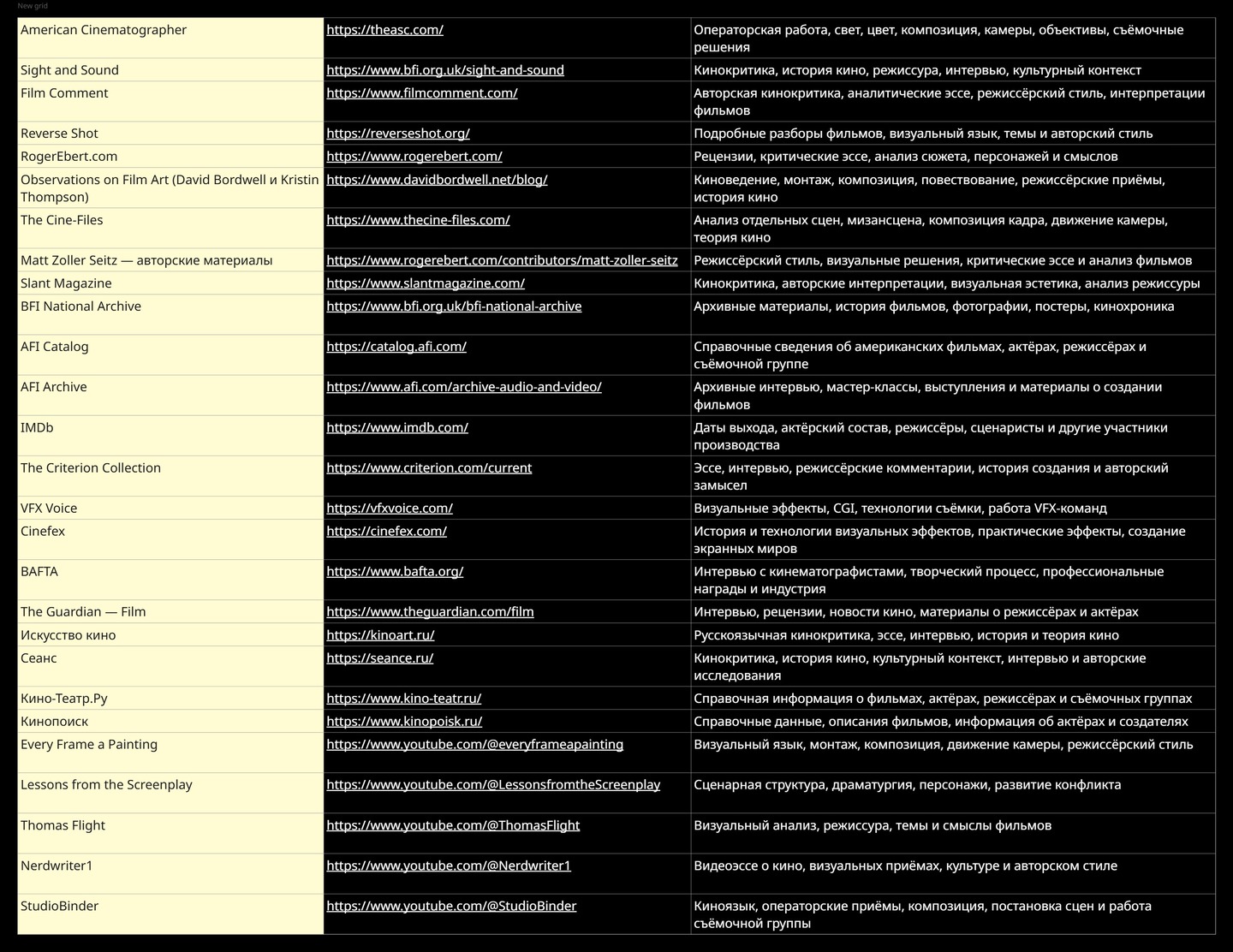
Source Selection Principle: Specific sources are determined by the focus of the film and the theme of the publication. If the film is primarily interesting for its visual language, lighting, color, and cinematography, priority is given to American Cinematographer, Observations on Film Art, and other sources on visual analysis. If the main focus is on the screenplay, characters, and dramaturgy, film criticism essays and materials on screenwriting craft are used. To study special effects, VFX Voice and Cinefex are selected, while film archives, databases, and interviews with creators are used to verify facts and the film’s history.
For selecting video, stills, photographs, and posters, we use Pinterest, Kinopoisk, IMDb and TMDB, ShotDeck, FilmGrab, and Flim.ai, official studio websites, and YouTube. If necessary, the post editor manually selects shots. This depends on copyright and usage licensing.
Data schema segmented for human and machine processing
- HUMAN
Film Selection and Theme Definition
Selects a film and determines the focus of the analysis: visuals, directing, script, sound, or special effects.
↓
2. MACHINE / AI
Data Search and Collection
Finds articles, interviews, facts, posters, and film stills; organizes the information, drafts the text, and suggests visual assets.
↓
3. HUMAN
Verification and Editing
Verifies facts and quotes, selects details, revises the text, chooses stills, and approves the final material.
↓
4. COLLABORATIVE WORK
Content Preparation
The human defines the concept and composition, while the AI assists with editing, subtitling, and processing. The human verifies the result and checks for content rights compliance.
↓
5. HUMAN + AUTOMATION
Publication
The human approves the publication, and the services help upload and schedule posts, videos, and articles on Instagram and Telegram.
↓
6. MACHINE / AI
Audience Analysis
Gathers available statistics on views, reach, likes, saves, and comments; identifies patterns and suggests themes for future publications.
↓
7. HUMAN
Feedback and New Directions
Responds to comments, evaluates the AI’s recommendations, and chooses the next film and content focus.The cycle repeats, taking into account audience response.
Guidelines for Automated Services within the Scheme
- Source Research and Verification Guidelines
— Prioritize the use of professional film publications, camera operator archives, interviews with directors, cinematographers, production designers, and special effects specialists.
— Give preference to primary sources and specialized publications.
— Verify facts using multiple sources whenever possible.
— Do not fabricate links, quotes, production facts, or statements by the film’s creators.
— Do not present unconfirmed information as fact.2. Copywriting Guidelines
— For Instagram, create short, spoiler-free captions detailing specific film elements according to the established template. (Do not alter the template until an editor intervenes and replaces it).
— For Telegram, prepare in-depth analyses covering directing, visual language, editing, lighting, color, and sound, based on the editor’s selection.
— Do not retell the plot; focus on analysis.
— Clearly separate verified facts from authorial interpretations.
— Adhere to the defined publication structure and the unified Time for Movie style.
— Any material generated by AI must undergo human editing before publication.3. Image and Video Handling Guidelines
— Use footage and posters that correspond to the film under discussion.
— Do not present AI-generated images as actual film stills.
— Ensure visual materials align with the text.
— During editing, do not distort the meaning of a scene or rip quotes out of context.
— Respect copyright and usage terms for footage, posters, music, and other materials.
— The editor must approve the final composition, sequence of shots, and editing quality.
- Audience Analysis Guidelines
— Automatically gather available metrics: views, likes, comments, saves, shares, and subscriber growth. — Compare results across different formats and topics. — Draw conclusions based on data, not assumptions. — Do not mistake correlation for causation: for example, increased views alone do not prove that a specific visual technique was the cause. — Use only legally accessible data and adhere to confidentiality requirements. - Automation Limitations and Quality Control
— AI can search, sort, summarize information, draft content, and analyze metrics. — AI must not publish unverified material independently. — Controversial interpretations, factual errors, and questionable sources must be passed on to a human reviewer. — A human must respond to audience comments, especially when a substantive discussion of the film is required. — Publication is permitted only after verification of facts, text, visual materials, and presentation.