Concept
The exhibition «Cybertheater» references the identically named project by Lev Nusberg and the «Dvizhenie» (Movement) group from the 1960s. The artist conceived a large-scale artificial environment populated by programmable mechanical beings—cybermen. Visitors were meant to freely navigate the theater’s grounds, interact with its inhabitants, and participate in unfolding events.
This historical concept is preserved primarily through the artist’s descriptions and model photographs. The exhibition invites visitors to explore this material and create a contemporary artistic interpretation of the project using virtual reality and artificial intelligence.
The centerpiece will be a specially developed VR world inspired by the visual language of Nusberg’s constructions. Visitors will be able to explore a virtual landscape inhabited by giant, luminous cybermen, observe their behavior, and influence the progression of in-game scenarios. Artificial intelligence algorithms will allow the characters to react to human actions and interact with one another.
The exhibition will be divided into two main sections: a historical section showcasing the archival documentation of the «Cybertheater, ” and an interactive section dedicated to the contemporary reinterpretation of the concept.
The goal of the exhibition is to update Lev Nusberg’s unrealized project by researching historical materials and creating a new interactive work that allows the audience to experience the model of human-machine interaction proposed by the artist.
Target Audience
The primary audience for the exhibition is visitors aged 18–35 who are interested in contemporary art, digital technologies, video games, and virtual reality.The secondary audience includes researchers of Soviet art history, artists, curators, and attendees of multimedia exhibitions.Location
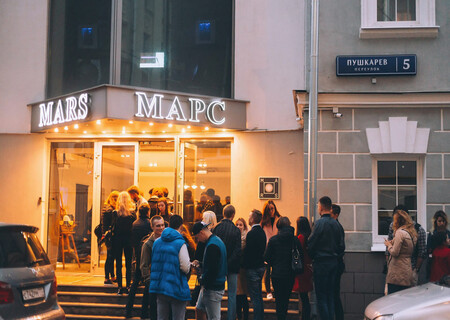
The M’ARS Center for Contemporary Art was selected as the exhibition venue due to its specialization in multimedia and immersive art. The institution has experience conducting VR projects and possesses spaces suitable for showcasing technological installations. The center’s format allows for the integration of archival displays with interactive works that require specialized equipment, darkened settings, and the organization of private viewing sessions. M’ARS’s space also aligns with the project’s focus—blending art history, digital technology, and experiential play.
Zone 1. Cybertheater Archive
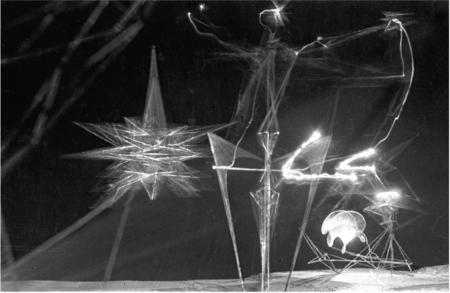
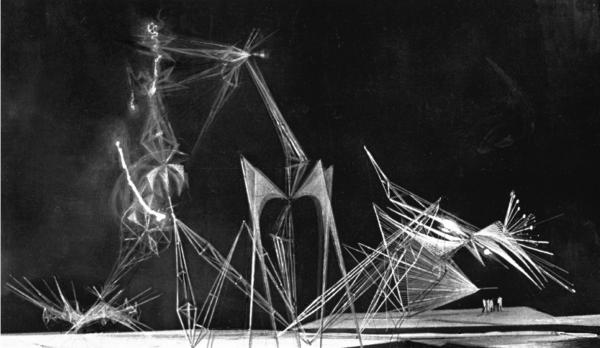
Group «Movement.» Layout «Cybertheater,» 1967. A spatial composition of cybernetic creature models, created as part of Lev Nussberg’s interactive theater project.
Zone 2. «The Cyber World»
«Cybersphere» is an interactive VR installation based on an unrealized project by Lev Nusberg.
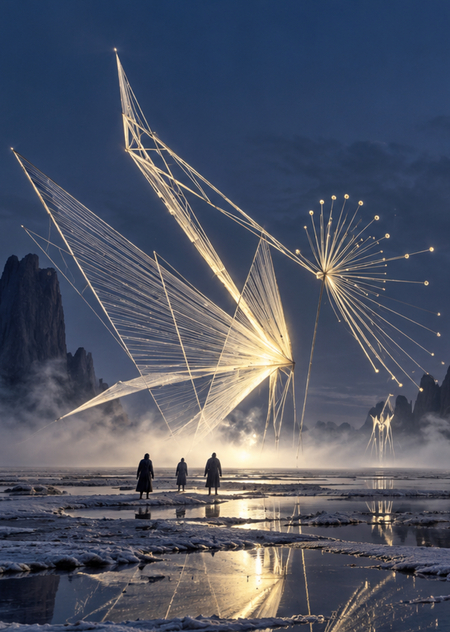
The virtual space presents a fantastical landscape populated by gigantic, translucent cybernetic creatures. Their appearance is inspired by surviving models from the «Cybertheater»: geometric constructions, delicate metallic lines, and complex spatial forms have been transformed into glowing digital objects.
Visitors freely explore the environment and interact with the cybernetic figures. Each character possesses a unique set of reactions—it can approach a person, respond to their actions with sound and light, change position, or interact with other creatures.
Game algorithms and artificial intelligence systems allow for the creation of variable scenarios. The sequence of events depends on the visitor’s actions, meaning every session can be different from the last.
The estimated session duration is 10–15 minutes. The project is being developed in collaboration with media artists and a game development studio.
Ghost Engine could serve as a potential development partner. Their portfolio features VR installations, interactive 3D worlds, projects involving digital characters, and a robotic installation with an AI assistant.
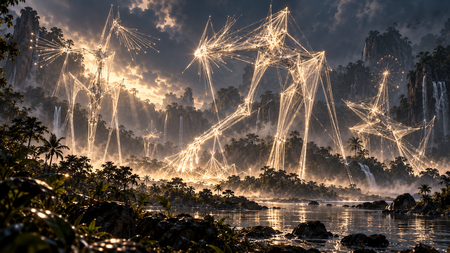
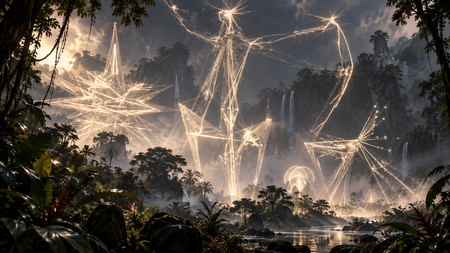
Concept art for the VR installation based on «Cybertheater» (AI-generated)
Visualization of the gameplay process (AI-generated)
Promotion Strategy
«Enter the Cybertheater» Advertising Campaign
The core of the advertising campaign will be the visual image of the virtual «Cyber World»: giant luminous entities inspired by the historical constructions of Nysberg.
Short video teasers will showcase the virtual landscapes, fragments of interaction with the cybernetics, and archival photographs of the original project. The campaign will emphasize the opportunity to personally step inside the artistic vision of the 1960s.
Social Media
Promotion will be executed via Telegram, VK, and short-form video content. Content is divided into three streams:— «Archive”—historical photographs and brief narratives about Lev Nusberg and the „Movement“ group.
— „World Building”—concept art, development of virtual characters, and the creation process of VR environments.
— „Inside the Cybertheater”—game trailers.
PR Campaign
Two to three weeks prior to the opening, the plan is to distribute a press release among cultural and technology media outlets. Potential publication venues include «Afisha Daily,» The Blueprint, ART Uzel, and video game media.
The main news hook will be the creation of a contemporary VR interpretation of an unproduced Soviet artistic project.
Before the opening, a press preview will be organized featuring the curator and the development team. Journalists and invited authors will have the opportunity to view the archival exhibition and participate in a VR session.
Partnership Promotion
We propose collaborating with creative and technical universities, developer communities, and media artists. Joint publications with game studios will help attract an audience that does not typically attend modern art exhibitions.An additional tool will be the distribution of digital flyers and invitations through partner cultural venues and student communities.Promotion Stages
One month before opening: release of the announcement, initial concept art, and historical materials regarding «Cybertheater.»
Two weeks prior: launch of the advertising campaign, distribution of the press release, publication of the game teaser, and opening of registration for VR sessions.
During the event: release of video materials from the exhibition, interviews with developers, visitor testimonials, and announcements of public events.
After closing: publication of the final video and project documentation, allowing viewers to explore the outcomes of this contemporary interpretation of «Cybertheater.»
Parallel Program
Artist Talk: «How the Cybertheater-VR Was Created» A meeting with artists and developers about the creation of the virtual environment, characters, and interaction algorithms.
Curatorial Tours: An introduction to the materials, the VR project development process, and its connection to Nusberg’s original concept.
Discussion: «Theater of the Future: From Cybernetics to AI» A discussion on Lev Nusberg’s experiments, the development of interactive art, and modern artificial intelligence technologies.
Design
Logo/Iconography