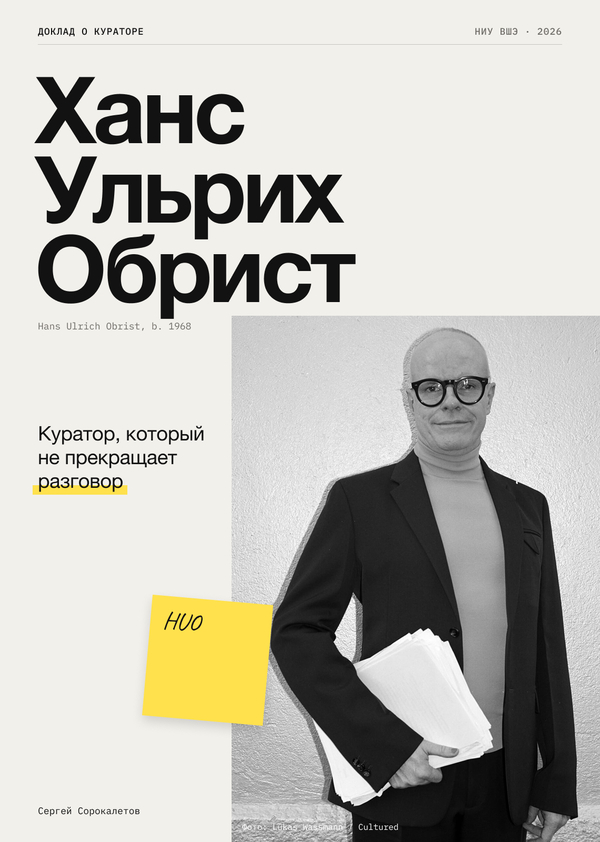
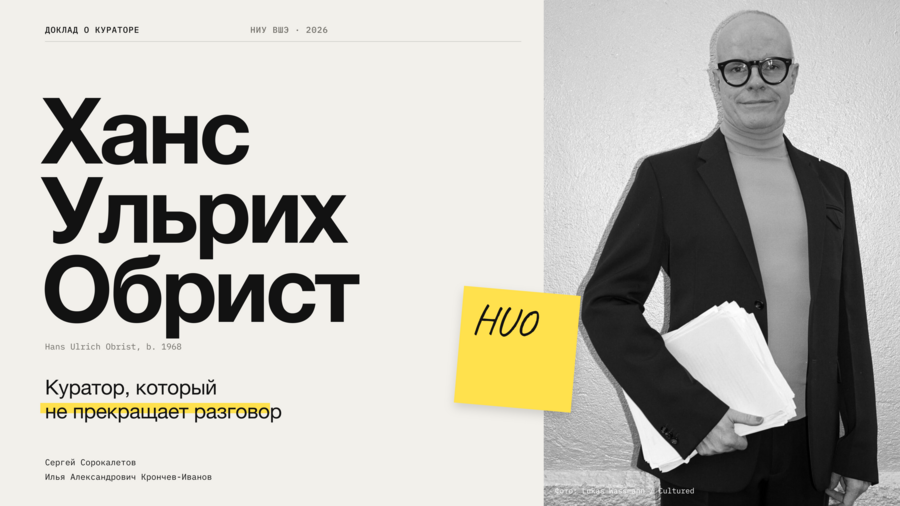
If you have ever opened a book about curatorship, you have likely seen his name on the cover or in the list of interviewers. He has been curating exhibitions for over thirty years, and throughout that time, he has spoken with artists, architects, and scientists, recorded these conversations, and transformed them into books and exhibitions. I was interested in understanding what drives this: a specific method or simply a massive amount of work. I wasn’t able to arrive at a simple «yes» or «no» answer, but by the end, I will tell you what I concluded.
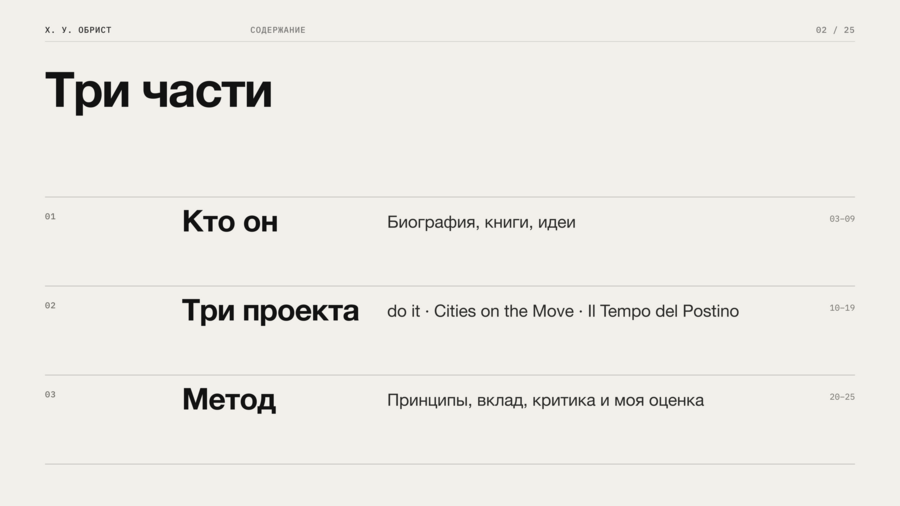
A three-part presentation. First, a brief overview of who he is: where he was born, where he studied, where he worked, and what he wrote. Then, three projects. I chose «Do It» because it is an exhibition that has been running since 1993. «Cities on the Move» because it is an exhibition that traveled the world and was reassembled each time. And «Il Tempo del Postino» because it is an exhibition in the form of an opera.
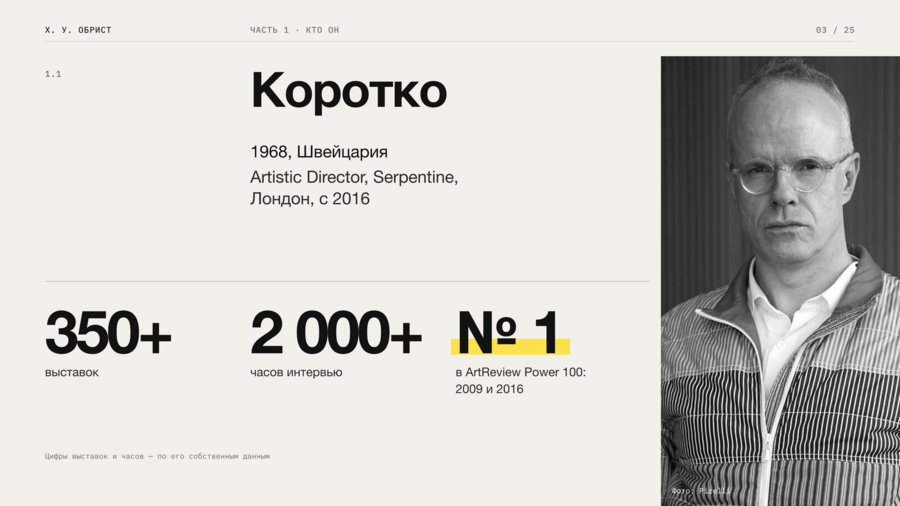
Obrist was born in Switzerland in 1968. Sources cite different dates and cities, so the slide only displays the year and country. Since 2016, he has been the Artistic Director at Serpentine in London. Now for the figures. Over 350 exhibitions and more than two thousand hours of recorded interviews. There is an important caveat here: these are his own figures, and the numbers are still growing. Around 2006, it was «150+»; by 2012, it was already «250+.» No one independently counted them. However, his ranking is verifiable: in ArtReview’s list of most influential figures in the art world, he was ranked first twice—in 2009 and 2016.
He grew up by Lake Bodensee, the only child; his mother was a teacher. In 1983, he attended Harald Szeemann’s exhibition Der Hang zum Gesamtkunstwerk in Zurich and returned to it again and again. In 1985, as a teen, he came into the studio of Fischli and Weiss, which he later called his «rebirth.» In 1986, he left a school trip in Rome with Allegro Boetti. Boetti advised him to become a curator, saying that curating is about making the impossible possible. Following that were Richter in Cologne and Louise Bourgeois in Paris. Bourgeois even called his mother: he was exhausted and traveled by overnight trains because he could not afford hotels.
Obrist studied at the University of St. Gallen. Different sources describe his program differently, but economics was always included. He himself says that there were no supervised courses back then—there was nowhere to truly study. In 1991, while still a student, he held an exhibition in his kitchen. He wasn’t cooking there; the kitchen served as a library. Fishli and Weiss placed an «altar» of restaurant packaging above the sink: five kilograms of noodles and five liters of ketchup. Boltanski concealed a candle projection under the sink, visible only through the door crack. Within three months, about thirty people attended. One of them, Jean de Luazi from Fondation Cartier, offered him a residency, and Obrist moved to Paris. There were no reviews back then; all this is known from his own account.
If you compress the career into a single line, this is what it looks like. The nineties in Paris: a residency at Cartier, followed by six years as curator at the Museum of Modern Art of Paris. In 1995, his first exhibition was at Serpentine, Take Me (I’m Yours), with Boltanski. In 2006, he moved there permanently, and since 2016, he has headed the entire program. Moscow is of particular interest to us. He co-curated the first Moscow Biennale, «Dialectics of Hope, ” in 2005, and participated in the second in 2007 with a project at TsUM. Since 2013, he has been an international advisor for the Garage program. The English-language Wikipedia states „since 2018, ” but this is incorrect: the New York Times already mentioned him in this role in February 2013. The most recent highlight: the Holy Table Pavilion at this year’s Venice Biennale.
He has a huge number of books; almost all of them are based on interviews. I’ve selected six that I consider to be the most important. Interviews 2003, the first thick volume of conversations. A Brief History of Curating, which is on the next slide. Everything You Always Wanted to Know About Curating: here, other people are interviewing him. Ways of Curating, written with Asad Raza, is his method in autobiography form. Lives of the Artists and Lives of the Architects—the title references Vasari. And the memoirs Life in Progress. Three of these books are in Russian; Ad Marginem published them alongside «Garage.» I would recommend Ways of Curating as a starting point if you want to read.
A Brief History of Curating — eleven interviews with the curators who invented the profession: Zeemann, Pontus Höllten, Walter Hopps, Lucy Lippard, Seth Siegelaub, and others. Curating had no history of its own, so Obris recorded it through the words of those who were making it. Six of them had passed away by the time the book was published; it is dedicated to their memory. Hopps recounts Duchamp’s rule there: artworks should not interfere—that is, the exhibition should not obstruct the art. Ways of Curating is structured differently. It is a story about his own journey and the people who set his standard: Feneon, Diaghilev, Walser, Dorner. The main ideas there are: the curator follows the artist, and the exhibition functions as a public laboratory. And of course, there are interview volumes. Literary critic Michael Dirks called Obris’s interviews a distinct art form back in 2003.
Obriester constantly refers to the formulas of others. His protest against forgetting draws from the historian Eric Hobsbawm; for him, interviews and curating are methods of engaging with memory. Following Maurice Blanchot’s book, L’Entretien infini, he states that his life has become such a conversation. Junction-making—the creation of intersections—is a concept by Ballard that Obriester gladly repeats. He calls unfulfilled projects the most significant untold stories and asks about them in every interview. Writer Bruce Sterling noted that this is the only question that recurs across all of his interviews. From Eduard Glissant, he adopts mondialité: a global dialogue where differences are not erased. And from Alexander Dorbner, the idea of a museum that is perpetually changing.
Before we move on to the three projects, here is a map of the places where he exhibited, and almost none of them are museums. A kitchen in a student apartment. Nietzsche’s house in Zils Maria, where Gerhard Richter was exhibited. His own room in a Parisian hotel: in 1993, about seventy artists visited—Pistoletto stacked a column of postcards, Messages hung a net of dead insects above the bed. Boetti’s works on Austrian Airlines aircraft and exhibitions in the pages of a Viennese magazine. Bangkok shopping malls. The opera stage in Manchester. And Instagram, where since the 2010s he has been posting handwritten notes, because Umberto Eco told him he needed to resist the disappearance of handwriting. I think this slide best shows how he thinks.
It was conceived in 1993 in Paris during a conversation between Ovrut and the artists Christian Boltanski and Bertrand Lavie. The idea is this: the artists send not artworks, but written instructions. At each site, local participants reenact them. The first exhibition took place in September 1994 in Klagenfurt, Austria, featuring twelve artists and instructions in nine languages. Ovrut himself says that do it grows out of the model of an open exhibition—an exhibition in process. He draws inspiration from Duchamp, for whom art is a game played among people from all eras. Later, the project transitioned to Independent Curators International and e-flux, and it continues to this day.
What’s new here? First: there is no logistics. Works are not packaged, insured, or shipped—only text travels around the world. Second: the author is no longer alone. The artist devised the instructions, but someone in Klagenfurt, Manchester, or Moscow executed them, and each time the result is different. Third: after the exhibition, everything returns to its original state; there is no original piece. And fourth: the exhibition proliferates. Versions have emerged for homes, for television, for streets, and online. Only the 1997 North American version was shown in twenty-five cities. For me, as a designer, this is a very clear concept: it’s like transmitting a system instead of a mockup.
Instructions come in all shapes and sizes. Louise Bourgeois wrote in 2002, «When you walk, stop and smile at a stranger.» Stephen Keltenbach, writing in 1969, offers only two words: «Listen closely.» Yoko Ono’s Wish Tree—where viewers attach notes with wishes to a tree—was implemented in Manchester in 2013. Ai Weiwei provided instructions on how to disable a surveillance camera. Anish Kapoor shared a recipe for gratin made from mallow stems. Tiësto Gates gave a sermon in a Manchester shopping center. In 2013, the collection Do It: The Compendium was released, containing 250 instructions. I appreciate that half of them sound like a mundane request rather than an artwork.
In 2014, do it arrived in Moscow at «Garage.» The curators were Snezhana Krusteva and Anastasia Mityushina, with over eighty instructions. Notably, new pieces were introduced by Russian artists: Yuri Albert, Nikita Alekseev, Oleg Kulik, Anatoly Osmolovsky, Andrey Monastyrsky, Konstantin Zvezdochotov, and the group Electroboutique. Anna Khalprin organized a Planetary Dance procession along the Crimean embankment, and Simabuku featured an instruction titled «make the animal laugh.» This is the critique, based on the 2013 Manchester version. ArtReview noted that this demonstrated an unusually non-cynical side of the art world, but the project heavily relied on established artistic brands. New Statesman was harsher: the ideas were often too disconnected from meaning.
The second project, Obrist, was completed with curator Ho Hanju. Cities on the Move toured seven cities over two years. It began at the Viennese Secession in November 1997, coinciding with the building’s centennial. It subsequently visited Bordeaux, P.S.1 in New York, the Louisiana Museum in Denmark, and the Hayward Gallery in London. It later moved to Bangkok—not just a museum, but the entire city—and concluded in Helsinki at Kiasma in late 1999. Sources vary on the closing date, so the slide only displays the start date. I deliberately listed all the dates so that it is clear this was not a single exhibit on tour, but rather a chain of various shows.