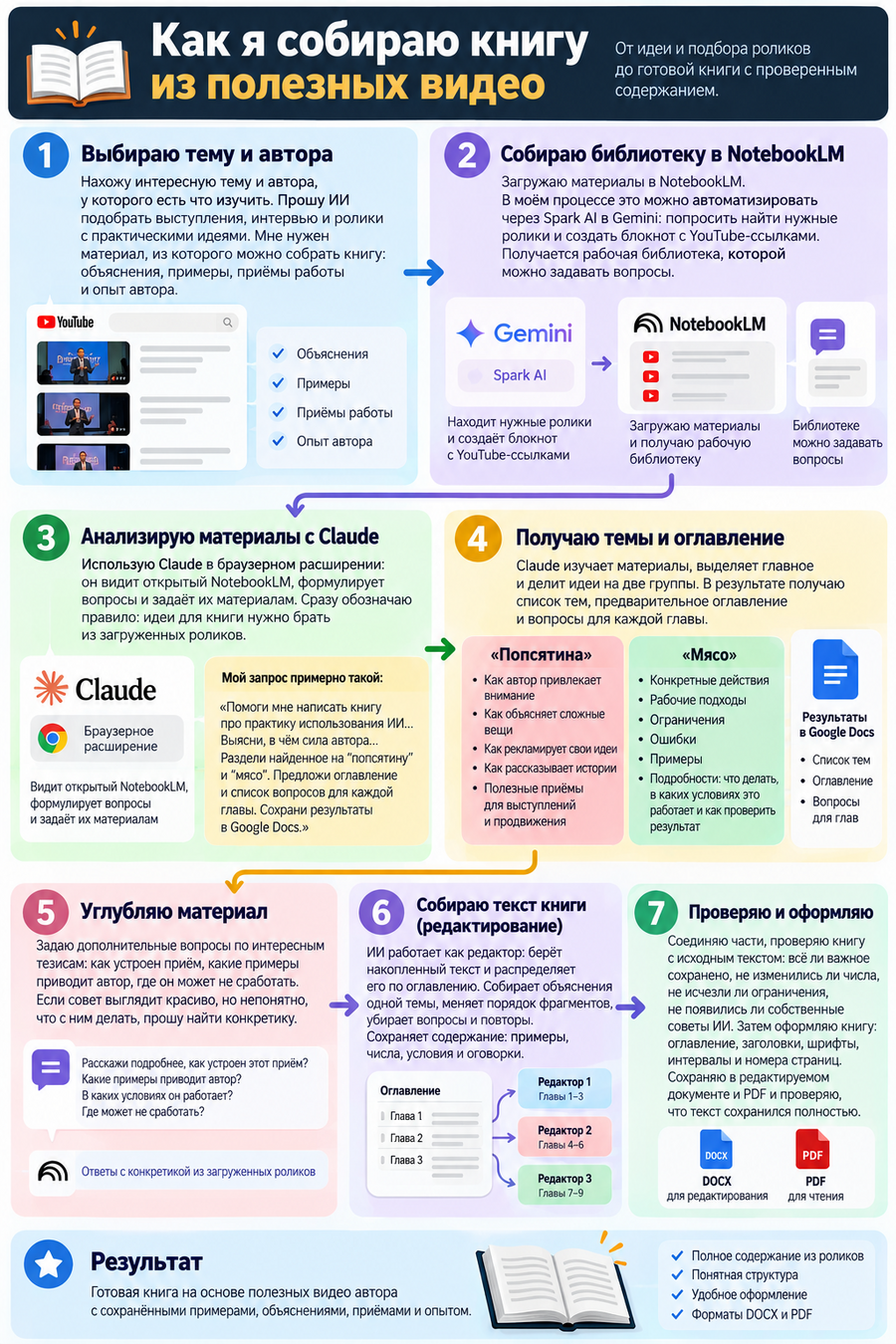
First, I find an interesting topic and an author with valuable insights to study. I ask the AI to gather speeches, interviews, and videos that offer practical ideas. I need material from which to compile a book: explanations, examples, working techniques, and the author’s experience.
Then I upload the materials into NotebookLM. In my process, this can be automated using Spark AI in Gemini: I ask it to find the relevant videos and create a notebook containing YouTube links. This results in a working library to which I can pose questions.The next stage is determining what is genuinely useful within this library. For this, I use Claude in a browser extension: it views the open NotebookLM, formulates questions, and submits them to the materials. It is crucial to set a rule right away: book ideas must be derived from the uploaded videos.My prompt is roughly like this:
Look at the materials loaded in NotebookLM. Figure out what the author’s strengths are—what interesting approaches they take, where there is concrete practice, and where there are just generalities and slick presentation.
Take ideas from the videos. Formulate questions, ask them in NotebookLM, and study the answers. Find techniques, examples, and explanations that a person can apply to their work. Divide what you find into two groups: fluff and substance.
In the fluff, study the presentation: how the author grabs attention, explains complex ideas, promotes their concepts, and tells stories. There might be useful techniques here for public speaking and promotion.
For the substance, compile concrete actions, working methodologies, limitations, mistakes, and examples. Dig into the details: what to do, under what conditions it works, and how to verify the results.
Propose a table of contents for the book and a list of questions for each chapter. Save the results in Google Docs.
This way, I get a list of topics and a preliminary outline. Then, I start delving deeper into the material. If an answer contains an interesting thesis, I ask for more detail on it—how the technique works, what examples the author provides, and where it might fail. If a piece of advice sounds good but it’s unclear what to do with it, I ask for specifics.
At this stage, the text for the future book is gradually accumulating. However, the answers to the individual questions still need to be assembled into a cohesive reading.
How Answers Become Chapters
Next, the AI functions as an editor. It takes the accumulated text and organizes it according to the approved table of contents. It groups explanations for a single topic, reorders segments, and removes questions and redundant boilerplate phrasing.
The main requirement is to preserve the content. A detailed explanation must remain detailed. An example must retain its specifics, a piece of advice must keep its conditions for application, and a statistic must maintain the caveats associated with it. The editor can refine the language and link adjacent paragraphs, but it must not invent new ideas for the author.
A large book can be conveniently divided among several editors. Each receives their respective chapters and associated material. Afterward, the compiler stitches the parts together, and an independent reviewer cross-references the book with the original text: ensuring that everything important has been retained, that figures have not been altered, that limitations have not disappeared, and that no proprietary AI advice has been introduced.
The page count here tells us little. It is more useful to verify where every substantial segment ended up and why something was removed. Reductions must be justified by questions, procedural text, and actual repetitions.
After the editorial review, the book is formatted: a table of contents is created, headings, fonts, line spacing, and page numbers are configured. The result is saved in both an editable document and a PDF. Finally, the pages are reviewed to ensure that the text was fully preserved during the formatting process.
Book Compilation Request
Assemble a cohesive book from the provided material according to this table of contents.
Use my text as the foundation. Retain the original phrasing, detailed explanations, examples, figures, conditions, and caveats. Do not transform the material into a summary.
Distribute the fragments logically among the chapters. Preserve the chapter titles and order verbatim. Remove interviewer questions, administrative remarks, and literal repetitions. Refine the language and connect paragraphs without introducing new assertions.
Do not add your own advice, conclusions, stories, or examples. Do not include any discussion of NotebookLM, AI work, verification, or the material preparation process in the book.
If the text is extensive, divide the chapters among editors. Then, merge the parts and independently verify the preservation of all unique content. If any gaps are found, retrieve them from the original text.