Background
Sogd was a historical region in the Zeravshan basin, home to Samarkand, the Bukhara oasis, Penjikent, and dozens of other cities. The Sogdians were an Iranian-speaking people who, from the 6th to the 8th centuries, dominated caravan trade along the Silk Road—conducting business from Byzantium to China and settling across the entire Eurasian continent. This is why their art proved exceptionally open: Iranian, Greek, Indian, and Chinese motifs coexisted freely within it, yet a distinct, recognizable style developed nonetheless. Just like anywhere else, the Sogdians had their own religion. Its foundations comprised elements predating the Iranian Empire itself: the deified Zeravshan River (called Namik in Sogdian, meaning «Water-Bearer»), ancestor worship, reverence for the elements, and the veneration of family patron deities connected to lineage and legends of ancestral exploits.
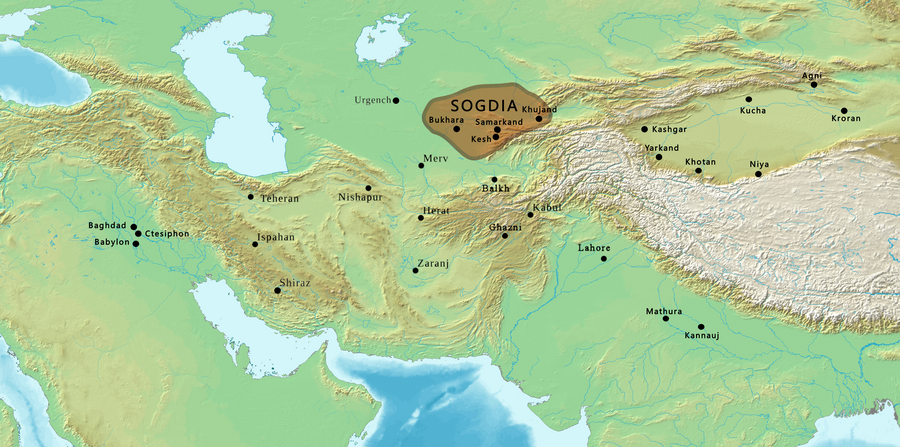
Map of Sogdiana region
Concept
At first glance, Sogdian art from the 1st–10th centuries bears a strong resemblance to other ancient Eastern art styles. There are indeed similarities, as Sogdian artists incorporated specific details from existing styles to create their own works. But which particular depictions of gods and demons did the Sogdians adapt from neighboring cultures?
Objective
Analyze the iconography of gods and demons, identify borrowings, and compare the figures to reveal underlying patterns.
Sogdian Fresco, Penjikent, 5th–10th centuries CE
Gods
Sogdians are an East Iranian people: their language is related to Bactrian and Khwarezmian, and their mythology derives from a common Indo-Iranian substratum. Sogd is directly mentioned in the «Avesta"—as the second of the blessed lands created by Ahura Mazda. Thus, Ahura Mazda, Mithra, Verethragna, and Anahita are not an «import from Iran, ” but a common Aryan foundation that the Sogdians inherited long before any cultural contact. Zoroastrianism was their primary religion—true, not in the Sasanian canonical form, but in their own Sogdian-Bactrian variation, with older roots. Thus, most of the divine imagery has an Iranian foundation, which the Sogdians adapted for themselves.
Nana
Nana—the goddess of fertility, love, war, and royal power. Her name is interpreted as «mother» or «matriarch.» In Sogdian tradition, she was the most important deity; it was believed that she bestowed divine power, fortune, and legitimacy upon rulers of the Farn. In inscriptions, she was called «Nana the Great Lady.» It is believed that her image is a fusion of the Sumerian-Babylonian Inanna-Ishtar with the local (Zoroastrian) Harakhvati Aredvi Sura Anahita.
Sogdian Fresco from Bundzikat, Goddess Nana, 5th–7th Century CE
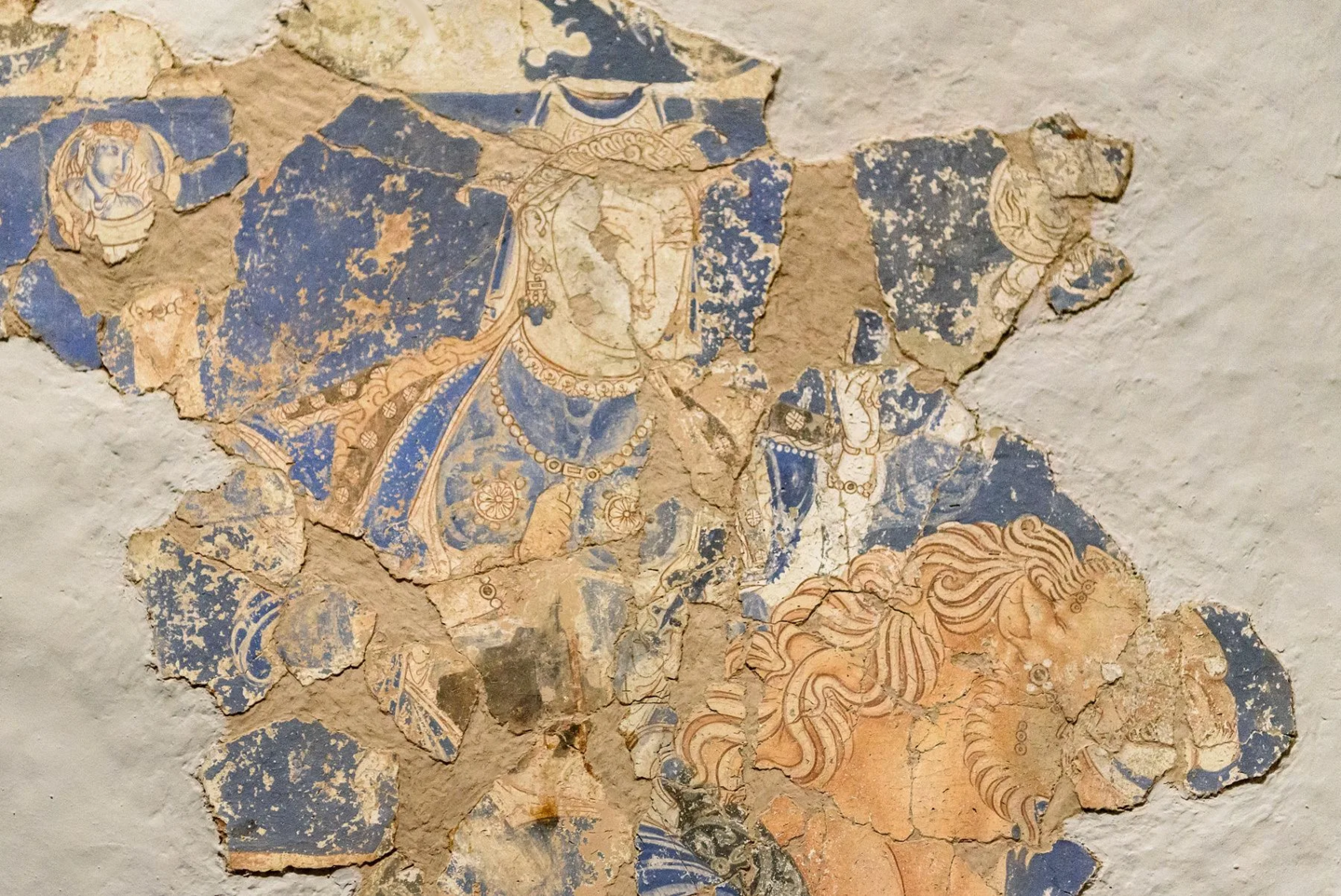
The central figure in this fresco is a woman riding an animal resembling a lion. She has two pairs of arms; in the upper pair, she holds disks representing the sun and the moon, along with numerous adornments (bracelets, beads, earrings, and an intricately detailed headdress). Her clothing is decorated with ornamentation. Comparing this to Indian mythology and painting reveals striking similarities. The Sogdians were inspired by the multi-armed goddess Durga, believing this depiction would help convey the superhuman divine power of Nana. Furthermore, they adopted the concept of the vahana—a mythical animal or creature used by gods for transportation. The image of the sun and moon in her palms, which is common among Hindu deities, signifies power and status. Similarly, the ornaments also denote status, albeit a material one.
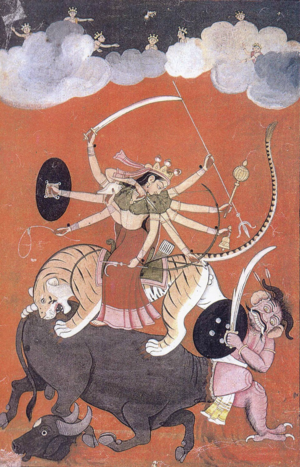
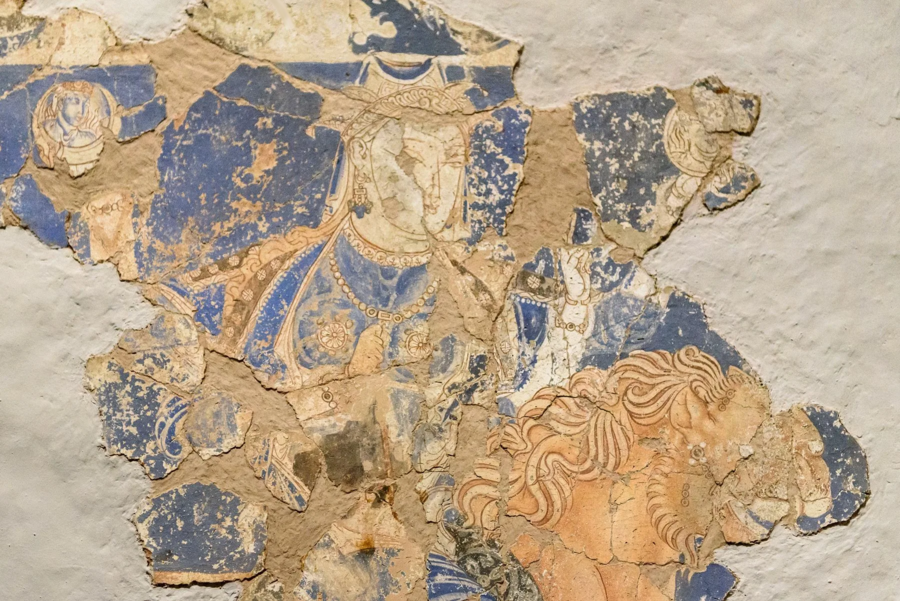
1. Goddess Durga, 18th century CE 2. Sogdian fresco from Bundzhikata, Goddess Nana, 5th–7th centuries CE
Nana’s face is round, pale, with elongated eyes, arched eyebrows, a straight nose, and a small, neat mouth. If we look at Tokharistan Buddhist painting, we can notice some similarities: the smooth oval of the face, a similar depiction of facial features, the same three-quarter head position, and a blue background.
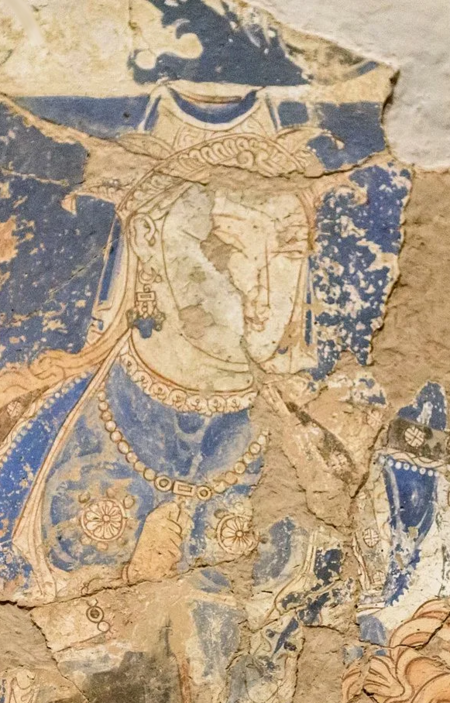
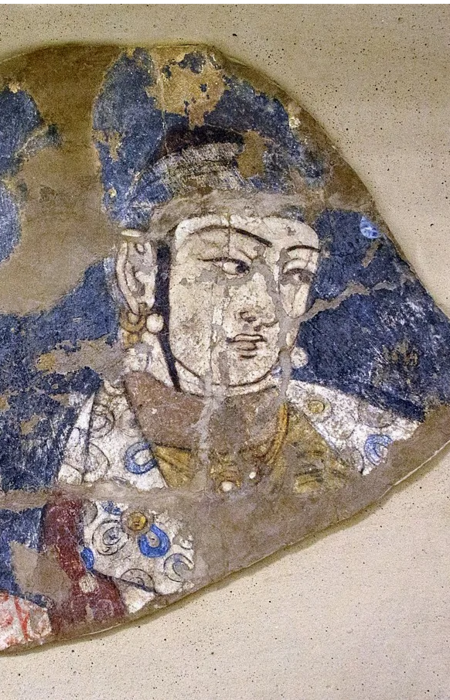
1. Sogdian Fresco from Bundzhikata, Goddess Nana, 5th–7th Century CE. Fragment. 2. Untitled, Termez, Shirabad, Tavkha Kurgan (Fortress), Mural Painting, 5th–6th Century CE, Archaeological Museum, Termez
Thus, Nana is a fusion of four cultures: Babylonian, Iranian, Indian, and Tocharian. The first two influenced the meaning and character of the image, while the latter two shaped the iconographic style.
Reconstruction. Nana, 5th–8th centuries CE, Panjikent
Veshparkar God
Veshparkar—one of the key deities of the Sogdian pantheon (6th–8th centuries)—was the god of wind and atmosphere, a cosmic guardian of order, and a conduit between worlds. His cult is vividly reflected in the monumental paintings of Panjikent, Afrasiab, and Ustrushana, as well as in Sogdian funerary monuments in China. Veshparkar corresponds to the Avestan (Iranian) Vaiu—the god of wind, intermediary between worlds, and bearer of power. In the Zoroastrian worldview, wind is a pure element connecting heaven and earth.
God Vesparkar with a bow, Kala-i Kakhakha I, Bundjikat, Ustrushana, 8th–9th centuries CE, National Museum of Antiquities of Tajikistan
Here we see a man with three heads. Like the goddess Nana, he is adorned with jewelry (earrings, headdress) and wears beautifully painted clothing. He holds a bow; the image presumably depicts a battle scene. Polycephaly, like multiple arms, originates from Indian mythology (for example, the four-headed god Brahma). Veshpakara’s face is depicted stylistically the same way as Nana’s, meaning the Sogdians took the Toharian painting as a foundation for rendering the faces, but adapted it slightly.
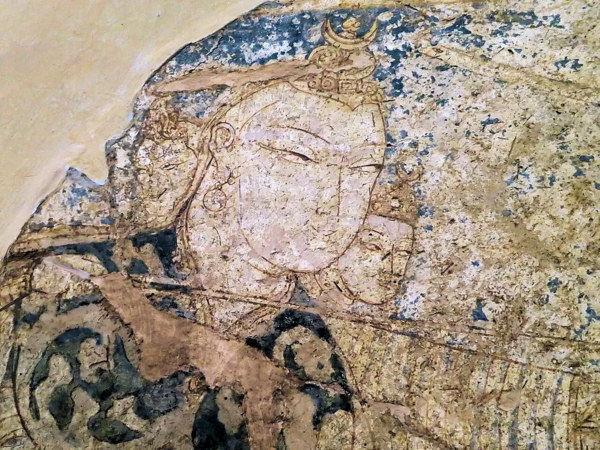
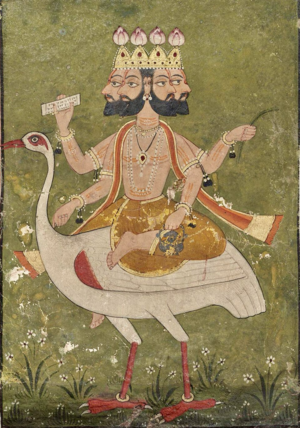
1. Image of the god Veshparkar with a bow, Kala-i Kahkhakha I, Bundzhikat, Usturshana, 8th–9th centuries CE, National Museum of Antiquities of Tajikistan 2. God Brahma. Pakhari. Presumably 18th century CE.
Consequently, Vesparkar is also a fusion of the same four cultures as Nana, and the Tocharian and Indian cultures also influenced icon painting.
Image of the god Veshparkar with a bow, Kala-i Kakhakha I, Bundjikat, Usturshana, 8th–9th centuries CE, National Museum of Antiquities of Tajikistan
Daena and Nana
This is an X-century line drawing discovered by the French orientalist Paul Pelliot in the Mogao Caves. It was created during the late Tang Dynasty and the Five Dynasties and Ten Kingdoms period and is likely connected to the Zoroastrian cult of the Sogdians. Historian Zhang Guanda, a member of the Taiwan Sinica Academy, recognized this «paper image» as one of the «paper drawings depicting Zoroastrian deities for the Saixian.»
(Presumed) Daena and the goddess Nana, 10th century, National Library of France,