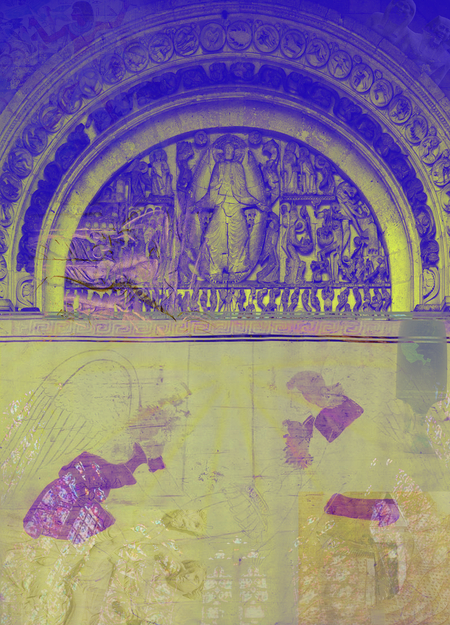
Concept
Ancient Egypt, Ancient Greece, and the Middle Ages are characterized by diverse human perspectives on death and the afterlife. Throughout these periods, art played a significant role in understanding human existence and the desire to transcend life’s finitude. These concepts were reflected in art: funerary structures, tombstones, and imagery were created.
Despite the differences between these epochs, art remained a means of comprehending death, expressing faith, and maintaining a connection between the living and the deceased. Comparing works from these periods allows us to trace how artistic representations of death and conceptions of what must be preserved after a person’s passing—and what awaits them in another world—have changed throughout history.
Research Topic
The research topic involves comparing the works of art and architecture from Ancient Egypt, Ancient Greece, and the Middle Ages to identify differences in worldviews concerning death. These historical periods were examined through the symbolism, the role of funerary architecture, and painting—the means by which people expressed their attitudes toward the afterlife.
In art, the theme of death has been, is, and will remain popular. Through it, people strive to preserve the memory of those who have passed, overcome oblivion, and re-examine their own existence. Therefore, studying how perceptions of death and eternal life have changed throughout history is vital for understanding art as a whole. By analyzing the meaning ancient artists imbued into death, we can trace shifts in societal worldview and comprehend how art evolved alongside it—how it became a conduit for humanity’s quest to understand eternity.
The goal of the research is to compare the symbolism of death across different eras and examine how the perception of it has changed.
(1) Ancient Egypt
In Ancient Egypt, art became the mediator for achieving desired eternal life after death.
Egyptians believed that life was merely a stage of preparation for eternity that followed. To achieve this eternity, they required a vessel for the soul’s particles (the mummy), sculptures as a backup, and paintings providing everything the deceased might need.
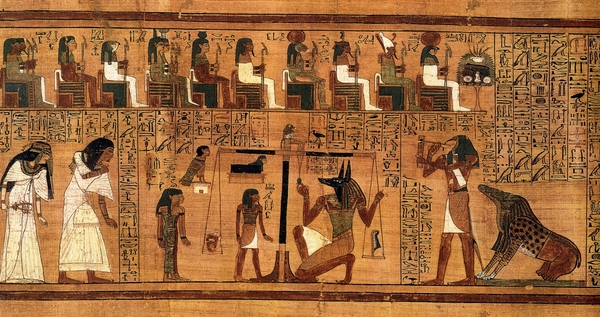
What truly frightened the Egyptians was not death itself, but oblivion—the fate that could be pronounced after the judgment of Osiris. There was no concept of hell; there was only complete disappearance without eternal suffering: the soul and personality were simply erased forever.
For a culture obsessed with the idea of immortality, such oblivion was the most terrifying punishment of all.
The soul was intrinsically linked to achieving eternal life in Ancient Egypt.
Fundamentally, all subsequent funerary customs originated from the Egyptians' concepts of the soul, as these elements were deeply intertwined.
In Ancient Egypt, the soul was understood to consist of several distinct substances, the most crucial of which were the «Ka,» «Ba,» and «Akh.»
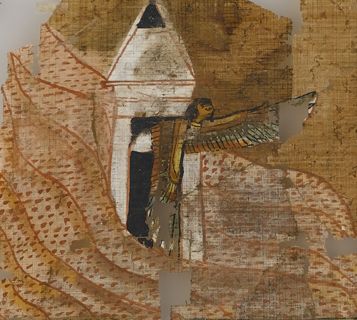
«Ba» was depicted as the spiritual aspect of a person—a part capable of leaving the tomb—but it could not exist entirely separate from the mummy. Every night, Ba had to return to the body to restore its strength for the following day.In depictions, Ba was often represented as a bird with a human head.«Ka» represented the vital life force. It continued to exist after the person’s death and remained bound to the tomb and the body.It required offerings, so relatives would bring gifts to the tomb to sustain Ka and, thereby, help the deceased continue its eternal existence in the afterlife [1].Vignette for Spell 92 from the «Book of the Dead»
These two fragments of the soul required a vessel—that is why the Egyptians placed such immense value on mummification. Without mummification, eternal life was impossible; preserving the body served as the fundamental basis for the existence of all the human spiritual components. [6]
Mummy in painted linen bandages. British Museum, London
To secure the soul after death, Egyptians also placed statues of the deceased in the tomb. These served as a backup in case the mummy deteriorated or was damaged. In such a scenario, the «Ka» would relocate to the statue and continue to receive offerings through it, providing a place for the «Ba» to return to. Therefore, the sculptures needed to be durable and long-lasting. Various, but sturdy, materials were used to create the statues: granite, diorite, and limestone.
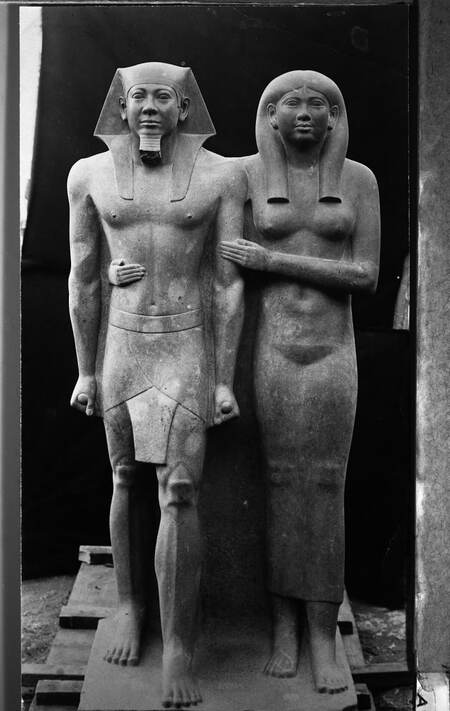
Most of the sculptures in the tombs feature a static and rigid composition—stability without dynamism. This choice of posture symbolized the eternity and steadfastness associated with the afterlife in Ancient Egypt. Thus, through sculpture, the Egyptians sought to preserve the unchanging essence of humanity. Paired statue of Pharaoh Menkaure (Mikérine) and his queen. Museum of Fine Arts, Boston, USA
Statue of Pharaoh Hafry on a throne. Egyptian Museum, Cairo
Sculptures and mummification served to preserve the soul’s elements, primarily to ensure the deceased successfully passed the Judgment of Osiris. It was believed that after death, a person needed time to arrive at this judgment.
Therefore, these vessels, which supported the «Ka» and «Ba,» provided that crucial time. The preservation of the soul’s elements determined the final stage of achieving eternity after the trial—becoming an «Akh» (the highest form of afterlife existence, which granted the person eternal life among the gods and stars).
Three conditions were required for this: the preservation of the body (mummification); correct burial rites accompanied by spells; and acquittal at the judgment of Osiris. Only after this could the Ba and Ka unite, transforming the deceased into a complete Akh spirit.
Painting also played a significant role in achieving eternity. The Egyptians believed that images on tomb walls could provide the deceased with everything they needed. This is why they used painting to depict food, servants, animals, and everything else that might be required in the afterlife.
Fragment of the mural from the tomb-chapel of Nebamun. British Museum, London
In an attempt to preserve the mundane, tombs were also decorated with depictions of the deceased’s daily leisure activities: hunting, banquets, and musical performances. These images adhered to the idea of preserving order, an order meant to exist not only in earthly life but also in the afterlife.
Thus, in Ancient Egypt, death was not an end but merely the beginning of eternal afterlife. The primary rule for achieving it was the complete preservation of the past life—the soul’s particles, leisure, possessions, and body.
In many ways, eternity resembled earthly life, as it continued the deceased’s usual leisure, albeit in a different realm.
(2) Ancient Greece
In the ancient Greek understanding—a person’s physical and personal life simply ended with death.
The soul of the deceased (psyche) in the bleak realm of Hades transformed into a lifeless shadow, devoid of reason and feeling. This was an incomplete existence. The individual could no longer participate in societal life or interact with loved ones. Therefore, people in Ancient Greece strove to live in a way that ensured they would be remembered. Warriors aspired to heroic deaths, and the populace sought a good reputation.
Thus, the memory of a person—their earthly actions and the trace they left behind—held great significance. The memory preserved by the living was considered immortality. Families erected tombstones featuring expressive stelae or painted white-backed lekythoi along busy roads, so that every passerby could read their relative’s name and recall them.
One form of grave monument was the stele—a vertical stone slab placed on a grave. Its surface was often decorated with a bas-relief. The base featured the names of the deceased and dedicatory inscriptions.The stele served as a form of visual testament. It indicated that a specific person—an aristocrat, a major landowner, or a merchant—was buried at that location.
Idealization played an important role in stelae. The deceased was often depicted at the height of his vitality—calm and physically healthy. While such an image did not always reflect his actual age or appearance, it allowed for the preservation of a dignified image of a once «great man.» The sculpture seemed to release him from the physical changes associated with time. The stelae were designed to communicate specific episodes from the departed’s life to the viewer, rather than attempting to represent reality.
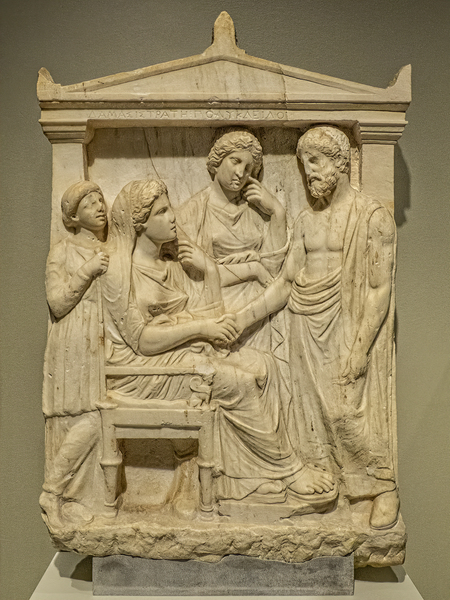
Stelae often depicted scenes of farewell. These scenes lacked vivid emotion, but the figure of the deceased was often rendered with greater restraint than the relatives.A cool clasp of the hand and nothing more. Thanks to these details in the interaction between the characters, the viewer gets the impression that the departed already belongs to another world, even though their image is still presented to the audience.Grave stele of Damasistrate, daughter of Polyclitus. National Archaeological Museum, Athens.
Steles often feature compositions centered on the interaction between two or more figures. The deceased may be depicted seated, accompanied by relatives, servants, or loved ones. In this way, the artist illustrated the departed’s connection to their environment, inviting the viewer into their former daily life.
Grave Stele of Hegeso. National Archaeological Museum, Athens
This approach allowed for a softening of the perception of death. This was important for Ancient Greece, as their understanding held that there was no afterlife at all. Instead of depicting a ruined body or suffering, the artist created an idealized image of the human, which inspired the viewer.
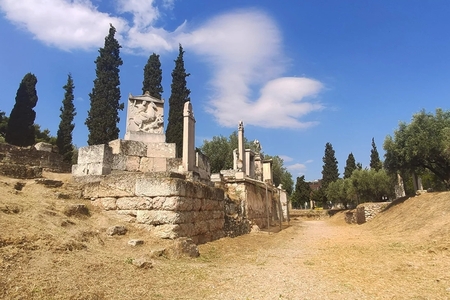
The very placement of burial monuments played a significant role. Greek necropolises were built along busy roads, immediately outside the city gates. The architecture of the tombstones was designed to catch the eye of passersby: towering stelae formed a kind of «street of memory,» where anyone walking by could pause and read the deceased’s name.
One of the carriers of funerary art was the Attic white-ground lekythoi—vessels for perfumed oil that were used in farewell rituals by both the wealthy and ordinary citizens.
The most frequent subject depicts relatives bringing offerings to a tombstone.