Navigation
- Concept
- The Emergence of Ukiyo-e in Japan 2.1. Core Techniques and Principles of the Style: Beauties' Portraits 2.2. Shifts in Engraving Themes: Kabuki Actors
- Katsushika Hokusai: Obsession with Art 3.1. The Beginning of His Journey: Development 3.2. Global Success: «The True Artist»
- Influence on Contemporary Culture
- Conclusion
- Bibliography
- Image Sources
Concept
Katsushika Hokusai’s creativity is familiar to anyone who has ever shown an interest in Japanese art. The artist played a significant role in the development of printmaking, becoming one of the most renowned masters of the Ukiyo-e school. Hokusai’s works remain relevant even to the contemporary viewer today: he was obsessively dedicated to art, striving for perfection in every piece he created. His paintings are housed in the world’s finest museums.
This topic attracted me because it allows for an analysis of the development of Japanese creativity: to understand contemporary art, one must look to its origins—where the core principles of today’s artists and designers were born. This approach not only allows for a fresh perspective on the techniques of 18th-century masters but also enables a re-evaluation of their views on labor and idealism embedded in every line.
My hypothesis is that the masters of that era established the fundamental principles for modern art. Each of us must engage with these works and adopt the diligent approach characteristic of the Edo period artists. The goal of my research is to demonstrate how 18th-century Japanese art evolved, using one of its most renowned representatives—Katsushika Hokusai—as a case study. Furthermore, I aim to prove the profound influence Japanese artists have had on contemporary culture and creativity.
Japanese engravers and painters have left their mark on history with their unique and perfected works. They greatly influenced Impressionists and Modernists in Russia and Europe, including Van Gogh, Claude Monet, and many others. The masters studied the techniques of the engravers, their approach to color and line. No less important were the subjects the Japanese depicted: they were all close to the common people, showing everyday life or landscapes. These paintings still resonate with people even in modern times; many don’t even realize that these prints are several centuries old.
Japanese creativity remains relevant even hundreds of years later—it was created for people, reflecting their lives, daily routines, and thoughts. Katsushika Hokusai strived to convey all of this in his paintings throughout 88 years. However, the master was not satisfied with the result he achieved his entire life. He believed that if he had ten more years, he would definitely have become a true artist. Perfection was limitless for Hokusai, yet his works are still considered genius to this day.
What principles guided my material selection and the structure of this visual study?
The visual study is broken down into three main sections. In the first, I discuss the emergence of the ukiyo-e movement in Japan. The second focuses on the most celebrated artist of the Edo period, Katsushika Hokusai, his finest works, and how these works have been reflected in culture. This structure allows for a detailed exploration of the interrelationship between history, the artist’s life, his creativity, and the world around him. The conclusion offers a final assessment of the master’s profound influence on contemporary art and culture.
For this visual study, I examined private and museum collections that house both original and reproduced works by the artist, including the series «Thirty-six Views of Fuji, ” „One Hundred Famous Views of Edo, ” and „Hokusai Manga.“ Furthermore, I researched other masters from the 17th and 18th centuries in Japan who created and developed the ukiyo-e genre. Each of these artists is unique and made an indispensable contribution to history, and subsequently, to modern art.
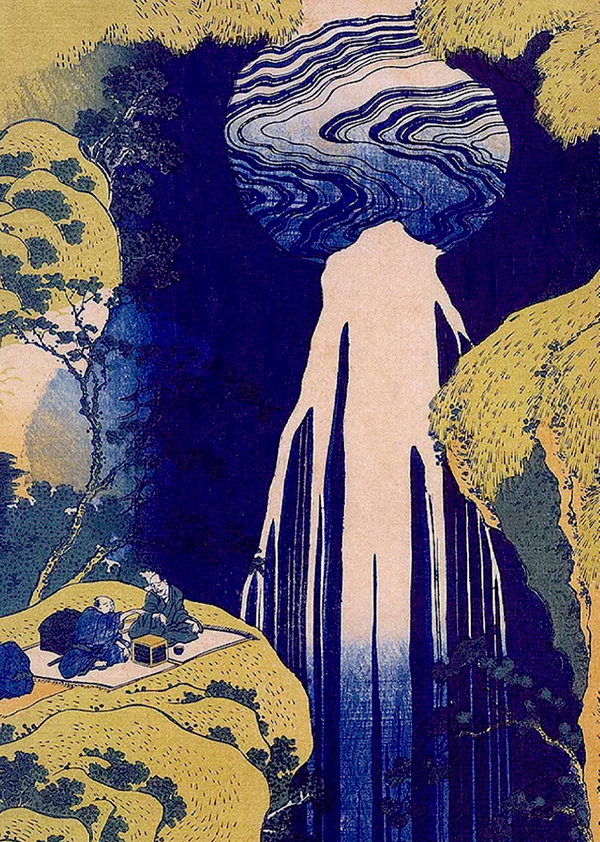
«Kojiki-sawa, Kai Province» by Katsushika Hokusai, 1831
The Genesis of the Ukiyo-e Movement in Japan
Ukiyo-e reflects the ever-changing world. The literal translation of the word ukiyo, «floating world, ” sounds similar to the Buddhist term for the „cycle of suffering.“ However, everything changed after the early 17th century when distinct districts formed in Japanese cities, offering the services of Kabuki theaters and Okiya, geisha houses. These were situated near the Kamogawa River in Kyoto, and later appeared in the cities of Osaka and Edo. Because of this, the word’s meaning became associated with pleasure and enjoyment—literally the „world of fleeting pleasures“ or the „world of romance.“ Most often, the paintings depicted themes from artistic literature and advertisements for Japanese entertainment culture, the Karyūkai.
Triptych from the series «Kabuki Theater Actors» by Toyohara Kunitika, 1861
Core techniques and principles of the specialization. Portraits of Beauties
Initially, painted works predominated in Ukiyo-e, but by the mid-17th century, masters began creating woodblock prints. By the early 18th century, painting started to lose popularity to them. The imagery became more vibrant, and artists started combining various techniques: brush painting was combined with woodcut impressions, and color began to appear in the paintings.
Prints were created by carving the outline of an image onto wooden blocks, which were then covered with ink and pressed onto paper. This led to the creation of full albums with double-sided pages that were bound together. A large number of people were hired for this process—from wood carvers to writers and printers.
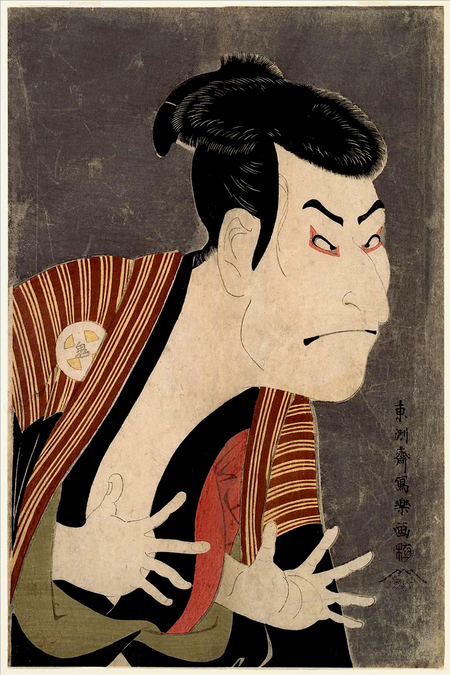
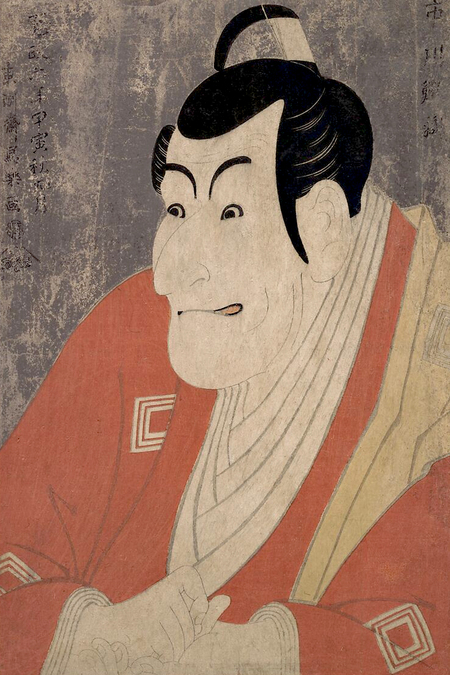
«Oni O-ni III as Yakko Edobe» and «Itikawa Ebizo IV as Takemura Sadanojo, ” Tōshūsai Sharaku, 1794–1795
In prints, courtesans were most often depicted while grooming themselves—fixing their hairstyles or applying makeup. Another variation of these illustrations were «portraits of beauties"—the same courtesans, but from a more respected class. These images were collected into entire volumes and books. Depictions of the lives of these «beauties» were popular throughout the development of ukiyo-e, with the prints of master Kitagawa Utamaro being the most memorable.
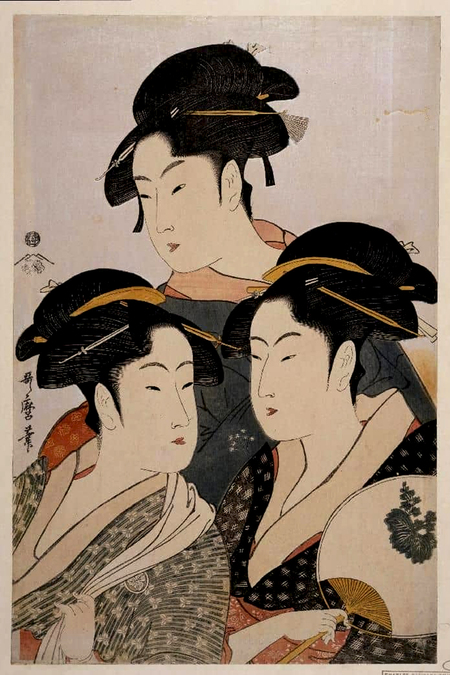
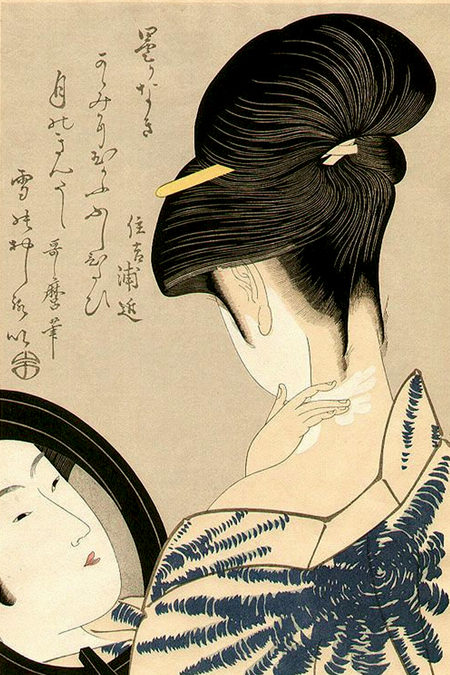
«Three Beauties of Our Time» and «Portrait of a Woman» by Kitagawa Utamaro, 1793–1794
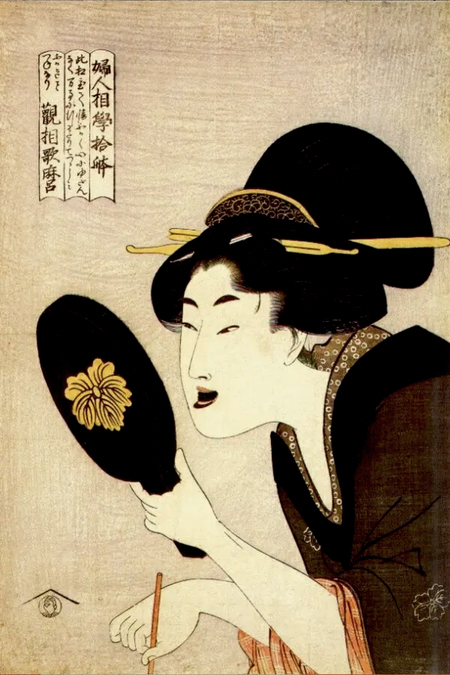
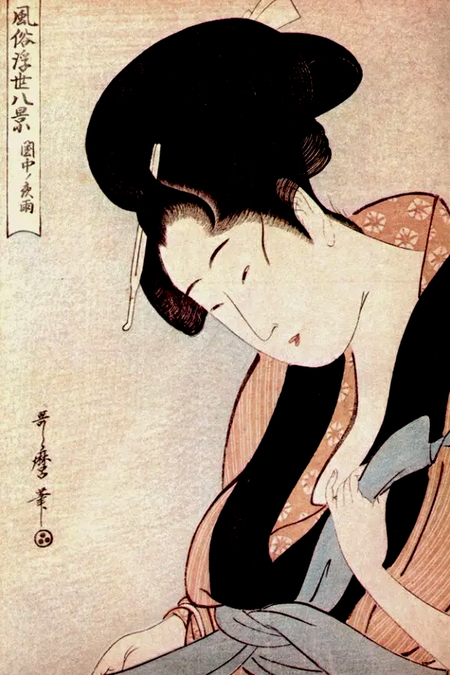
«Woman Preparing for Tooth Blackening Ceremony» and «Woman in a Bedroom on a Rainy Night» by Kitagawa Utamaro, 1790
«Courtesan and Maid with Firefly Net, ” „Actor Matsumoto Koshirō II, ” „Actor Matsumoto Koshirō III, ” Ippitsusai Butyō, 1769–1770
A turn in the plots of engravings. Kabuki actors
By the mid-18th century, Kabuki culture underwent a reinterpretation, leading to the popularity of works featuring actors from the theater, who performed in vibrant and spectacular costumes. Schools in Edo began commissioning works from artists—posters and programs depicting excerpts from emotionally charged performances. The primary focus of these works became the poses of the actors during dances and songs, reflecting the culture of Japanese theaters of that era.
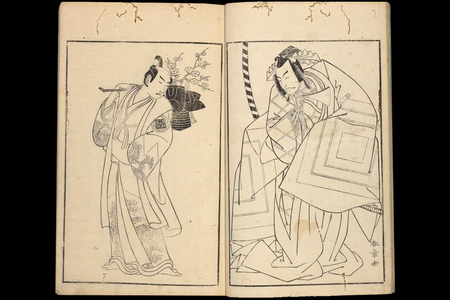
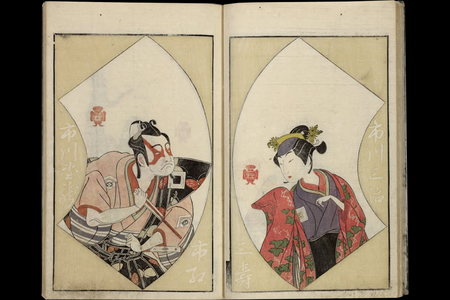
«Kabuki Actors» Kyūsai Shunsō, Ippitsusai Buntō, 1778
Engravings by Kitagawa Utamaro, Ōtani Oniji III, and Ando Mitsugoro II, Tōshūsai Sharaku, 1794
Katsushika Hokusai: Obsessed with Painting
Katsushika Hokusai is the most renowned figure in the Ukiyo-e movement. Despite his fame, the master’s work does not fall under traditional art. Hokusai was the one who managed to combine Japanese printmaking techniques with Western painting, creating something entirely new and unique. His works featured subjects unlike the earlier art of the Edo period masters: a keen attention to detail and depth, and a closeness to the common people of Japan.
«The Great Wave off Kanagawa» by Katsushika Hokusai, 1832
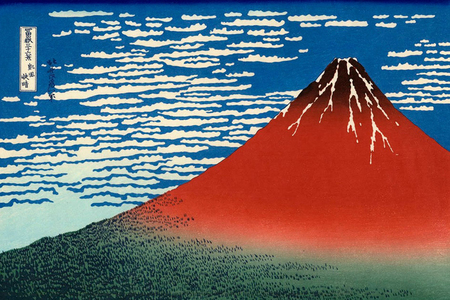
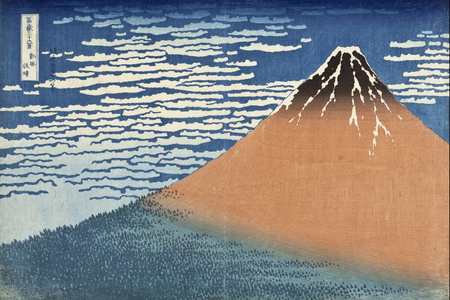
«The Southern Wind, Clear Day» and «The Southern Wind, Clear Dawn» by Katsushika Hokusai, 1823–1831
The Beginning of the Journey. Development
In his childhood, Katsushika possessed a talent for crafts, which led to his first attempts at creation. Later, he was able to enter a Japanese workshop where he was trained in engraving and painting. As a young artist, he prepared boards for work, carved pictures into wood, and painted. Thanks to his skills, he found his way into the studio of the renowned master, Katsukawa Shunse.
Throughout his life, Hokusai dreamed of creating his own unique and memorable style, which led him to become interested in European painting.
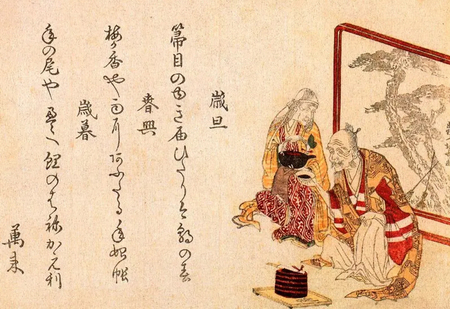
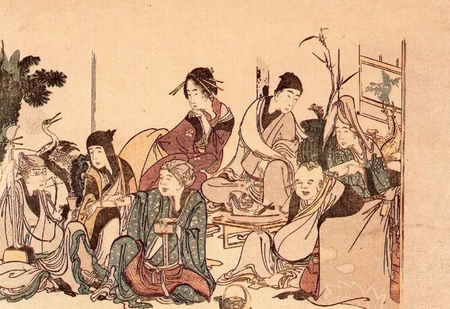
«The Great Wave off Kanagawa» and «The Seven Gods» by Katsushika Hokusai, 1802 and 1792