Research Structure:
1. Concept 2. From a Collection Museum to an Interactive Museum 3. The Spectator Within the Museum 4. Between Exhibit and Play 5. The Freedom of Play and Institutional Power 6. Conclusion 7. Bibliography 8. Image Sources
Concept
In this research topic, I address the contradiction between the freedom of children’s participation in the interactive environment of the Boston Children’s Museum and institutional control. This choice stems from an interest in the changing role of the visitor in the modern museum and how interactive exhibits influence the relationship between the institution and the viewer. The traditional museum model assumes a predominantly contemplative perception of artifacts, whereas the Children’s Museum invites visitors to interact with the object, experiment, and participate in play scenarios. It must be understood that expanding opportunities for interaction does not necessarily equate to absolute visitor freedom. The museum still dictates the exhibition layout, available actions, and rules of conduct. This contradiction forms the foundation of the study of the Children’s Museum in Boston.
The primary materials examined include archival images of the «What’s Inside?» exhibit, which opened in 1964, as well as photographs of the museum’s contemporary play area. The first allows us to trace the emergence of a model based on direct interaction with the exhibit, while the second offers a chance to explore the organization of the children’s experience within the current museum environment.
Textual sources are selected based on their relevance to the historical and critical analysis of the subject. Official museum materials, including historical notes, exhibit descriptions, mission statements, and visitor guidelines, are used to study the institutional positioning of the Children’s Museum in Boston. Theoretical works on the museum as a space for shaping behavior and the spectator’s position—particularly studies by Tony Bennett and Carol Duncan—serve as the basis for interpreting the visual material.
The main criteria for selection are relevance to the research topic and the reliability of the sources.
The structure of the research moves from historical context to an analysis of the mechanisms of institutional power. The first chapter, «From Collection Museum to Interaction Museum, ” demonstrates which museum model the interactive museum draws from and how it redefines perceptions of the audience. The second chapter, „The Viewer Inside the Museum, ” explores how the viewer’s status changes and whether they become a participant in creating meaning or experience. The third, „Between Artifact and Play, ” answers the question: what becomes the artifact—an object, an action, or a designed experience? Finally, the fourth chapter, „The Freedom of Play and Institutional Power, ” synthesizes the observations from previous sections to reveal the core thesis: interactivity can expand the visitor’s freedom while simultaneously establishing new methods for guiding their behavior.
The main research question is: How does the contradiction between the freedom of children’s participation and institutional control over visitor experience manifest in an interactive environment at a children’s museum in Boston?
The research hypothesis posits that interactivity does not eliminate institutional power, but rather transforms the ways it is expressed: instead of directly regulating visitor behavior, the museum organizes the space, objects, and interaction scenarios within which the child can exercise independent action.
Visual analysis will allow us to examine the relationship between the child’s autonomy and the institutional organization of the visitor experience within this environment.
From the collection museum to the museum of interaction
Source: Boston.com
The traditional museum model has historically been built around the collection: objects were gathered, classified, preserved, and displayed to visitors. The exhibition space dictated the distance between the viewer and the object, and museum presentation primarily involved the observation and interpretation of the exhibited items. In this system, the institution acted as a mediator between the object and the visitor—it decided what deserved attention, how the exhibits should be organized, and in what context they should be perceived. However, this model was not universal across all museums and periods, and interaction with objects did not exclusively arise in the second half of the 20th century.
The history of the Boston Children’s Museum illustrates how curatorial and educational functions could gradually merge with the visitor’s direct experience. The museum was founded in 1913 by a group of Boston educators who aimed to provide teachers and children with materials for studying natural history and the surrounding world. In its early decades, the collection included natural specimens, historical artifacts, and materials used in educational work. Thus, the museum was initially viewed not only as a repository of objects but also as a learning resource.
Source: official anniversary archive — 100 Years of Boston Children’s Museum
A crucial phase in the institution’s transformation occurred with the appointment of Michael Spock as director in 1962. According to the museum’s historical records, during this period, traditional displays housed in glass vitrines began to yield to formats that encouraged direct interaction. The «What’s Inside?» exhibition, which opened in 1964, became a key example of this shift: the museum abandoned the customary prohibition against touching and invited kids to explore the objects independently. In the official history of the institution, this project is presented as a turning point in the evolution of interactive museum experiences. This change affected not only physical access to the artifacts but also the role of the visitor. Whereas in a contemplative model, the child primarily absorbs content prepared by the museum, in an interactive exhibition, they gain the opportunity to test the properties of objects, try out different actions, and independently construct a sequence of engagement with the material. The visitor becomes a participant in the process of knowledge acquisition, and the exhibition transforms from an organized line of objects into an environment where experience is shaped through action. At the same time, the museum does not relinquish its role as an organizer: it continues to select materials, define modes of interaction, and set educational objectives.
Source: PlaySpace Boston Children’s Museum official website
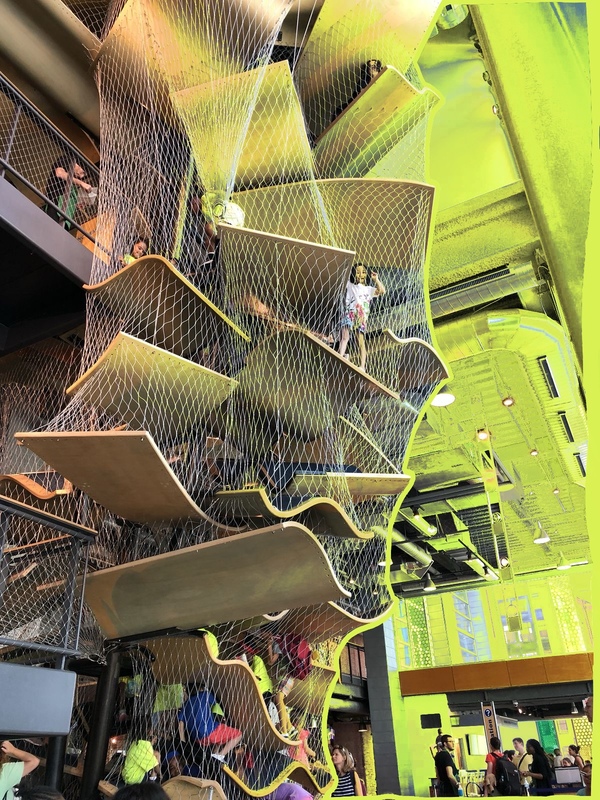
It is interesting to compare the historical exhibition, «What’s Inside?», with the modern PlaySpace area designed for children from birth to three years old and their accompanying adults. PlaySpace features sensory materials, play structures, movement zones, and spaces for imaginative scenarios. Concurrently, its design accounts for visitor age, safety requirements, and maximum capacity. Therefore, while interactivity expands a child’s possibilities, it is realized within a pre-designed environment.
Thus, the shift from a collection museum to an experience museum should be viewed as a change in the relationship between the institution, the object, and the visitor.
Museum Visitor