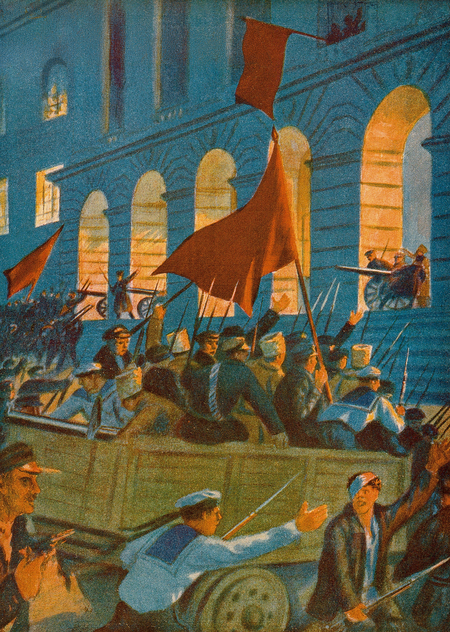
The Civil War in Russia was fought not only on the battlefields but also in the artists' studios. The military chronicle of those years is inseparably linked to the cultural one: the birth of the Volunteer Army coincided with the creation of the People’s Commissariat for Enlightenment, and the height of the fighting coincided with the flourishing of agitprop art. The avant-garde, led by Mayakovsky, became an ally of the new government, transforming the poster, monumental propaganda, and agitprop train into weapons for remaking the world. The White Movement responded with its own propaganda, and the tragic outcome fueled emigrant painting. This timeline shows how the bayonet and the brush acted together, changing the consciousness of millions.
Октябрь–ноябрь 1917 года
October Revolution
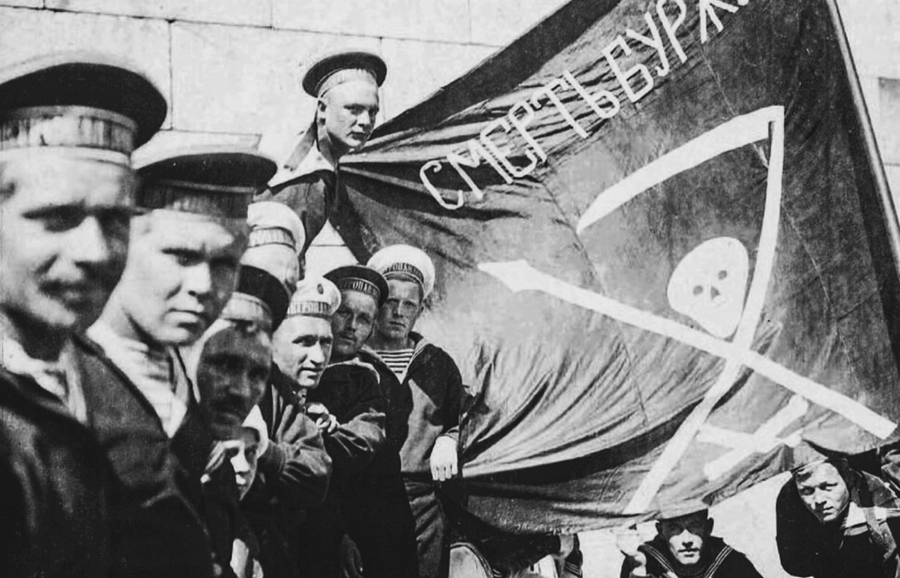
Revolutionary sailors of Kronstadt with the flag «Death to the Bourgeoisie»
On October 25 (November 7), 1917, power shifted to the Bolsheviks led by Lenin in Petrograd. In the south of the country, in early November, General Alekseev arrived in Novocherkassk and began forming the first volunteer units from officers, young cadets, and cadets—the so-called Alekseev Organization, which became the foundation of the future Volunteer Army and the first organized center of resistance against the Reds.
The Bolshevik seizure of power coincided with the restructuring of cultural institutions: the People’s Commissariat of Enlightenment—a cultural organization of Soviet Russia that replaced the former Ministry of Culture—was established as early as November 1917. Many avant-garde figures, particularly the Futurists led by Vladimir Mayakovsky, enthusiastically welcomed the revolution, viewing it as a break from the old order that resonated with their own creative impulses.
General Lavr Kornilov, commander of the Russian Army. His arrival at the State Council. Moscow, August 1917
On December 25, 1917 (January 7, 1918), the detachments formed by the Alexeyev organization in Novocherkassk received the official designation of the Volunteer Army; Alexeyev became the supreme commander, with Kornilov as the commanding officer and Lukomsky as the Chief of Staff. Thus, the organized White movement took shape.
On January 29, 1918, the Department of Fine Arts of the People’s Commissariat of Education was organized in Petrograd, led by the painter and graphic artist David Sternberg. The department’s artistic college also included Nathan Altman, Artur Matveev, and Nikolai Punin. The department received state resources for purchasing avant-garde works and reforming artistic education—a short-term alliance formed between the new government and the avant-garde that defined the character of the country’s artistic life.
Март 1918 года
Brest Peace
Signing of the Armistice Agreement on December 15 (28), 1917
On March 3, 1918, a separate peace treaty was signed in Brest-Litovsk between Soviet Russia and the powers of the Quadruple Alliance, securing the withdrawal of the RSFSR from World War I. Under its terms, Russia relinquished its claim to the Baltic states and part of Belarus, recognized the independence of Ukraine, and withdrew troops from Finland, which sparked internal protest.
Alongside the foreign policy crisis, theatrical life was undergoing a transformation: Proletkult, established in September 1917 under the leadership of Alexander Bogdanov, championed the idea of a «pure» proletarian culture rooted in materialism, while the People’s Commissar of Education, Lunacharsky, insisted that the proletariat could not ignore the cultural treasures bequeathed to it by the past. Despite famine and devastation, hundreds of new theaters and studios opened across the country, and the Maly Theater and the Moscow Art Theatre continued to operate.
Февраль–апрель 1918 года
Ice Hike
Kornilovtsy. The First Kuban Ice Expedition. Winter 1918
From February 22 to May 13, 1918, the Volunteer Army, under the command of Kornilov and Alekseev, conducted the First Kuban Campaign (the «Ice» Campaign)—a campaign involving battles from Rostov-on-Don to Ekaterinodar and back to the Don. During the three-day assault on Ekaterinodar, from April 9 to 13, General Kornilov died from an exploding shell in his headquarters. Following this, Denikin took command of the Volunteer Army.
Shortly thereafter, in early summer of that same year, the Tretyakov Gallery was nationalized by a decree of the Council of People’s Commissars on June 3, 1918, and was designated a state museum under the administration of the People’s Commissariat of Education. Concurrently, the National Museum Fund began to form, receiving works from the confiscated private collections of Shcherbatov, Botkina, Girshman, and other collectors.
Май 1918 года
The Checoslovak Corps Uprising
Czech armored car in Isilkule. Omsk Oblast. 1918
In May 1918, a rebellion broke out at the Chelyabinsk station within the Czechoslovak Corps—consisting of former prisoners of war being transported along the Trans-Siberian Railway to Vladivostok—which was quickly supported by local anti-Bolshevik forces. By the end of the year, the White Czechs had captured Chelyabinsk, Omsk, Tomsk, Irkutsk, Chita, Vladivostok, and other cities, leading to the collapse of Soviet power in the Urals, Siberia, and the Volga region.
On the territories liberated from the communists, cultural life continued in the pre-revolutionary tradition out of inertia: theaters, museums, and educational institutions kept operating, and the new anti-Bolshevik governments relied on them as symbols of continuity and legitimacy. Specialized propaganda structures that defined the aesthetic of the White Movement’s fine arts—such as OSVAG in Southern Russia—would emerge just a few months later, that very summer.
Лето 1918 года
KOUMECH and Terror
First group from left to right: B. K. Fortunatov, P. D. Klimushkin, I. M. Brushvit, V. K. Volskyi, I. P. Nesterov
In the summer of 1918, alternative governments emerged in territories that had been wrested from the Bolsheviks—the Committee of Members of the Constituent Assembly in Samara and the Provisional Siberian Government. Political terror began on both sides of the conflict.
At that time, General Denikin established the Informational Agency (OSVAG)—the propaganda organ of the Volunteer Army. Parallel to this, mass printing of agitprop posters began in the Soviet territory, and starting in August 1918, under the initiative of the People’s Commissariat for Enlightenment (Narkompros), the first propaganda trains were created, the walls of which were decorated by professional artists under the general direction of Ignati Nivinsky.
Весна 1919 года
The White Advance
Anton Ivanovich Denikin was one of the principal leaders of the White Movement, the commander-in-chief of the Armed Forces of Southern Russia (VSYUR) from 1918–1920, and the organizer of the Volunteer Army.
In the spring of 1919, the White Armies launched a coordinated major offensive: Kolchak was advancing in the east, Denikin in the south, and General Yudench was preparing a strike on Petrograd from the northwest. This was the moment of the White Movement’s greatest territorial success throughout the entire war.
By this time, the propaganda apparatus of Southern Russia had reached its greatest scope: the Kharkiv branch of OSVAG, one of the largest regional offices, opened in June 1919 and issued posters, particularly outlining Denikin’s statements on land and labor issues. The Soviet side responded with mobilization posters that employed the same techniques as woodcut illustrations and punchy text.
Лето–осень 1919 года
The Red Counteroffensive