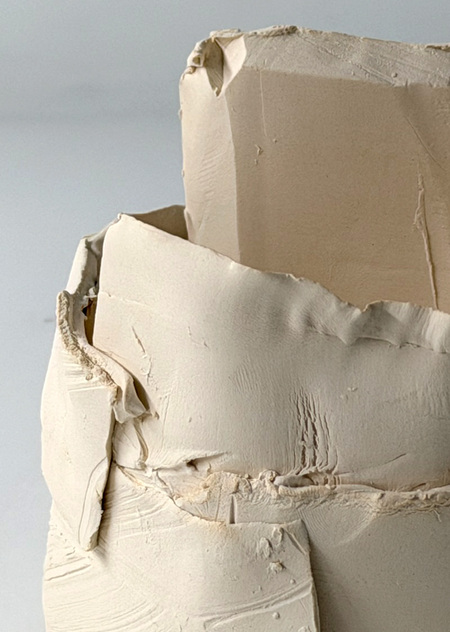
concept
While working on an exhibition project focused on the processes of decay, I decided to work with clay as a raw material. The firing permanently fixes the traces of impact, transforming the process into a document. The rejection of glaze, sanding, and a perfect form is deliberate. In an era of polished, standardized imagery encouraged by algorithms, I leave the material raw, engaging with the temporality and fixing the moments of vulnerability it offers.
GOST 9169-75
«Clay raw materials for the ceramic industry.»
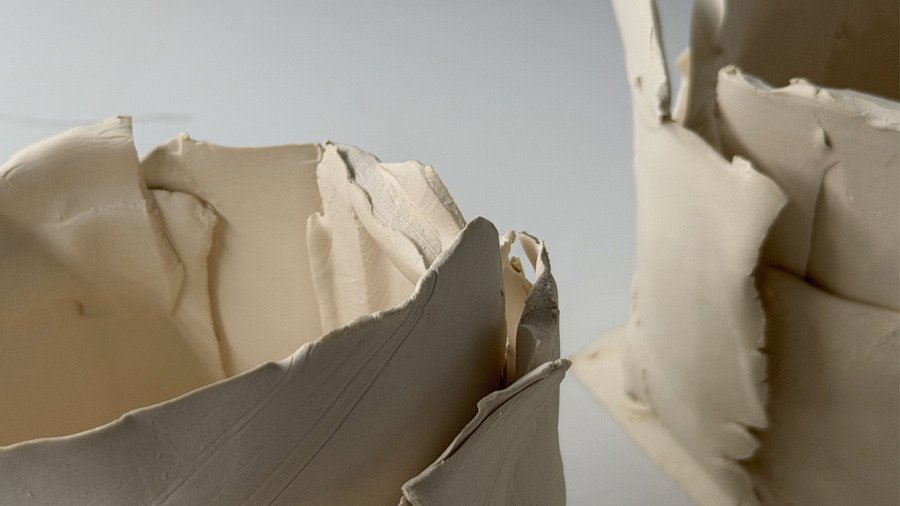
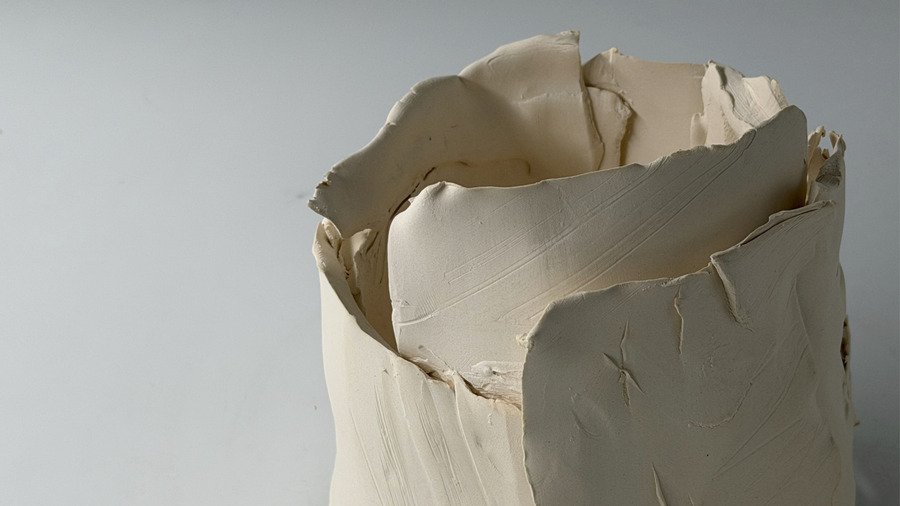
Dimensions after firing:
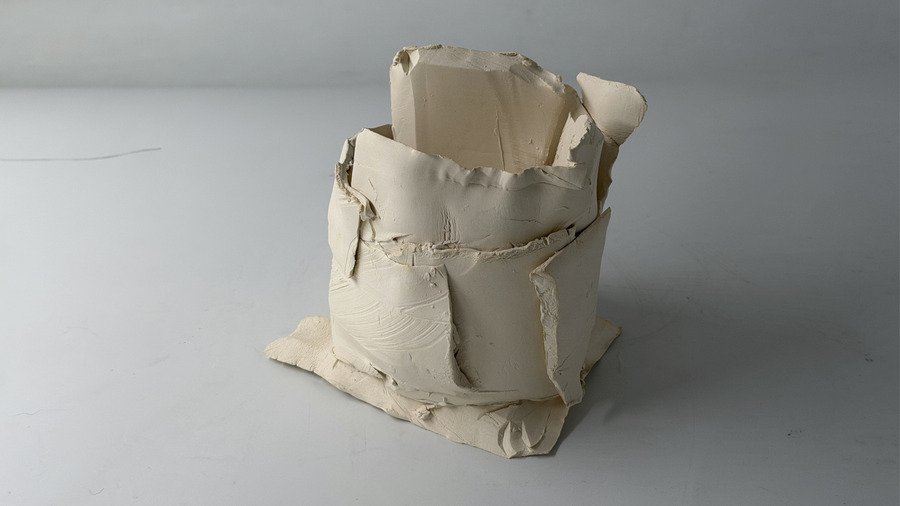
· Height — 120 mm,
· Maximum diameter — 100 mm,
Material — Plastic ceramic mass S-6043. Ceramics Laboratory. Temperature range: 1200–1260°C.
The body is solid, without separate parts.
Glazing is absent.
fabrication technology
layer removal
Giselle’s preparation
Drying on plaster before firing
Irregular strips, approximately 0.7 cm thick and measuring about 5×8 cm, are cut chaotically from a solid piece of unfired clay using a knife.
A separate, larger piece is prepared for the base.
Strips are built up around the perimeter of the desired cylindrical shape; bonding one strip to another is achieved by scoring both pieces and then applying slip (small pieces of clay mixed with water until a sticky consistency is reached).
The base is joined to the walls in the same manner at the end.
Drying on plaster before firing.
Firing in a kiln at 1200°C.
Glazed Sample
Conceptually, the matte finish proved more successful, so we decided to forego the glaze.
Glaze S-0128-01 opaque glossy black
t: 1180-1250°
glazing the surface using an atomizer; scraping up the residue
Porcelain and Ceramic Workshop at the School of Design
Instructor: Ivan Arkadyevich Grabovenko