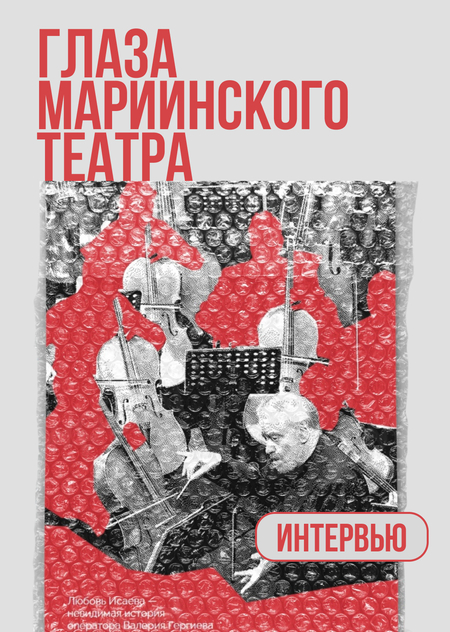
«The Eyes of the Mariinsky Theatre”—a portrait interview centered not merely on job descriptions, but on the personality of Lyubov Isaeva and her unique journey.
Task: To tell the story of an inconspicuous, «invisible» profession in the world of major theater through the genre of the portrait interview.
What I did: I found a subject, conducted an in-depth conversation with Lyubov Isaeva, constructed the narrative, and edited the text.
«And here—please: become the ‘eyes of the theater.’ That’s how I became, ” Lyubov Isaeva on working as an operator at the Mariinsky Theater.
My work in theater isn’t about the atmosphere or free tickets.
Lyubov Isaeva embodies the «living schedule» of Valery Gergiev. She monitors the maestro through cameras, tracking his movements around the Mariinsky Theatre, and notifies services of his location. But is this even something taught? How a finance professional from a closed military settlement became Gergiev’s «eyes, ” why she cannot attend the ballet as an audience member, and why one must stay at the theatre until late at night—Isaeva shared this in an interview.
— The professions of the «living schedule» of Valery Gergiev are not taught in universities. What professional skills from your past as a financier turned out to be invaluable here? And what did you have to learn from scratch?
— I certainly didn’t bring any direct skills from finance. I had to start from absolute zero. It’s a completely different world, a different culture. I had to learn everything—how a theater operates, what its rhythm is. At first, I just walked around, watched, and memorized every corner. Then I learned how to work with cameras and mastered how video surveillance is connected here.
I saw the intensely demanding schedule the maestros work, and the sheer number of questions—including those about finance—they have to address simultaneously. That level of responsibility and dedication is, of course, inspiring me to strive even harder in my profession.
— What did your professional path look like before moving to St. Petersburg, and what specifically drew you to this city?
— I come from a family of military personnel, and we always lived in closed settlements accessible only by official order. Furthermore, due to frequent moves, I couldn’t always work in my field, but I got to explore various disciplines instead; I loved discovering new cities where I served.
In every place, from Tomsk to Moscow, that my family never visited, I preferred a career in finance. But a unique story unfolded in Irkutsk: while my husband was serving on the border, I needed to stay in the city with our son, who was attending a railway college. To get to know Irkutsk better, I started working as a real estate agent. One of my clients suggested I learn about video surveillance systems. As I mentioned before, I have always enjoyed immersing myself in something new, so I agreed to take the three-month course.
To be honest, before meeting this person, I didn’t know there was an entire security service with operators. For me, the classes became a second higher education that I initially enrolled in out of curiosity, but which has genuinely proven useful in my life.
After my husband retired, we were given a very limited selection of cities to live in moving forward. The city we dreamed of wasn’t on the list, but Petersburg was among these cities, and we decided to go for it. And that’s where a completely different life began! I got a job at Sberbank, but I soon started looking for a calmer position due to health issues.
— Moving, searching for a stable job — and suddenly the Mariinsky Theatre. Tell us how a finance professional with a diploma in video surveillance ended up within the walls of one of the world’s leading theaters?
— As I mentioned, after moving to St. Petersburg, my doctors advised me to find a calm job. Acquaintances directed me to the HR department, where I was told, «The Mariinsky Theater needs an operator. Since you have a diploma—give it a try.» I came, spoke with my future supervisor, and was shown around the massive building. Seeing the sheer number of cameras and monitors, I was stunned. But at that very moment, I agreed—and decided to start life anew. I see no logical pattern in how I ended up here. I think it was simply fate. I needed a place that didn’t require active social interaction for my health, and here it was—become the «eyes of the theater.» So I became it.
Do you view this as a life-changing moment?
— You know, fate loves to play tricks on us. After high school, I dreamed of going to the Institute of Culture, but it didn’t work out because of a «four» in literature—and I had to permanently close the door on art. But years later, it returned to me in an incredible way.
— Your primary tool is the camera, and your mission is to be the «living schedule» of the Mariinsky Theater director. Please describe your workday during a period of maximum workload—what does it begin with? And how do you determine what is most important in that moment?
— On days when the maestro is in the theater and multiple stages are running performances simultaneously, the workload is at its peak. Everything begins with checking all the equipment—cameras, monitors. A natural tension sets in from the very first minute.
On such a day, my main priority is the maestro’s presence. All my work revolves around him; I am his eyes. When he goes to the orchestra pit for rehearsal, I immediately inform all necessary departments: «The maestro is in the pit; sound work is in progress.» His route through the theater can be anything, and my job is to track every step so that I can clearly report at any moment: where he is, where he is headed. If the maestro is not in the theater, it is slightly simpler, but vigilance never lets down—you never know what might happen.
In a theater, there are always many people present at times like these—audiences, staff (we have about four thousand of them), and artists. The movement never stops. This is especially true if the maestro has a premiere—then filming crews from federal channels arrive. You work in close contact with various departments: security, information, and administrators. You grab a cup of coffee and continue monitoring the maestro on the cameras with renewed energy. People come to me for internships, but they can’t handle it; they can’t absorb everything that happens in a theater, especially everything related to the maestro. You must be ready to respond, demonstrate, or explain at any moment. This is precisely why finding someone who can master this job is such a significant challenge.
— Your profession demands absolute precision and meticulous attention to detail. Are you able to maintain concentration throughout the workday? Do you have any personal principles or rules that help you achieve this?
— Concentration has become a habit. There are no special rituals—I just switch into work mode and execute my tasks. The anxiety that used to hinder me no longer surfaces. Although, I remember experiencing nervous tremors in the first few months.
I believe the main principle for maintaining focus is one’s attitude toward their work. I have seen many times how professionals—for instance, TV camera operators during interviews with a maestro—work precisely, clearly, and without fuss. And the maestro himself remains calm and composed in such situations; it’s familiar to him. I would say I strive to emulate them in this regard.
Work truly becomes interesting only when you have fallen in love with the process, the responsibility, the rhythm—not when you go to the theater just for the atmosphere or the chance to see a performance for free.
— You could be described as the «voice» of the inner circle at the Mariinsky Theater. How is access to the information you control structured? Who and how can they obtain it?
— I am intentionally unavailable for direct contact — I do not have the authority to unilaterally decide what or to whom I can show or tell. People cannot just walk up to me and ask questions.
So, if any staff member or department needs information about the maestro—for example, to view a record of his movements—they must contact my supervisor. Only he can grant permission, either in writing or verbally. Once he calls directly, I can then show or tell them something. It turns out that without this directive—nothing can happen. This is necessary for order and safety within the theater.
— Being the link that knows where the maestro is in real-time is a huge responsibility. How has your feeling about this role changed: from the beginning of your work until today?
— This feeling has become automatic; it no longer provokes additional emotions. Responsibility isn’t felt as something separate—it’s built into a professional perspective. Wherever the maestro is, no matter which corner he turns, he won’t hide from me.
But it hasn’t always been this way. In the beginning, there was fear, yes. You have to anticipate every move, understand where the maestro might go, and be able to clearly answer at any moment: is he in the hall, in rehearsal, or in the orchestra pit? Novices who come to us still tremble with it.
People sometimes ask me, «Why are you working in theater? Maybe you’ll return to your previous career?» But I don’t understand another life anymore.
My work long ago stopped being merely an obligation; now it is something deeply personal. When the Maestro broke his leg a year or two ago and came out to conduct on crutches, we—the security staff—were crying. We froze, watching, and realized—that is true dedication and commitment to the craft. Our Maestro is a magician. The feeling that emerges is less like duty and more like responsibility for someone close to you.
— Working in the heart of a theater changes a person. What has this profession become for you—what has it taken, and what has it given?
— The profession certainly changes you. In the theater, you immerse yourself in a unique creative atmosphere. All around you are talented, famous people. You see them in the elevator, in the hallways… Over time, you stop noticing it; you just work alongside them. But you begin to perceive art differently—I, for instance, fell in love with ballet.
True, I barely get to attend performances. While the maestros are at the theater—I am at my post. Especially during long operas that run for four or five hours. You return home late at night, or you stay at the theater entirely.
But most importantly—the entire attitude toward the work changes. I want to stay until the master is satisfied, until everything is complete, and only then leave myself. I have a colleague who is going through the same thing. It’s not because we don’t trust others—it’s just that it feels more peaceful that way.
What did she give up? Perhaps free time, a regular schedule. But she gained so much more—that very creative environment that has now become the natural backdrop to her life.