Chapter 1. Concept

Michael Hansmeyer and Benjamin Dillenburger. Digital Grotesque I, 2013
Generative design, or artistic programming, is a form of computer programming aimed at creating something expressive rather than functional: «Creative coding — is a type of computer programming in which the goal is to create something expressive instead of something functional — for example visual art, interactive projections or installations» [1].
When we discuss generative design, we are primarily referring to «art» created using autonomous systems: «Generative art refers to art that is created in whole or in part using an autonomous system» [2].
The term «generative design» encompasses numerous artistic and engineering practices—from the visual works of Sol LeWitt and the musical compositions of John Cage to digital installations and additive construction realized with the help of artificial intelligence.

Sol LeWitt. Mural at the San Francisco Museum of Art, 1975
However, the term «autonomous system» can imply more than just technologies involving artificial intelligence or computers with a predefined set of actions. Historically, the trajectory of generative practices begins with the search for new artistic methods rooted in systemic logic—from intuitive gestures and manual modernist techniques to algorithmic calculations and node-based platforms, where complex variations became accessible through digital tools.
Composer John Cage during his concert. Opening of the National Endowment for the Arts, 1966.
That is to say, by using the term generative design, we are referring to a broader scope of definition. Therefore, generative design can be conceptualized as a process for creating a specific autonomous program that, in turn, will generate an initial object.
Generative art is art created entirely or partially with the aid of autonomous systems—whether they are computer programs, biological processes, or physical phenomena imbued with algorithmic logic.
Historically, the path of generative practices begins with the search for new artistic methods rooted in systemic logic—from the intuitive gestures and manual techniques of modernism to algorithmic calculations and nodal platforms, where complex variations became accessible through digital tools.


Natural Generative Systems of Visual Arts. Southern Mongolia 2019. Sand and Wind.
Although generative design is referred to as an autonomous system, it cannot create itself. Such a system can exist independently of its creator and self-replicate. However, the human is the original source of the system’s construction. A crucial aspect here is establishing specific constraints within which the program will exist and generate variations.
The role of the designer is to establish a set of constraints for an autonomous generative system to achieve a more predictable result.
Program created by Michael Hansmeyer for generating his work, 2010.
Chapter 2. History: Origins of the Generative Approach in Art and Design
If we continue to discuss generative art as the creation of algorithms for execution, the Dadaists were the first to begin mastering this approach.


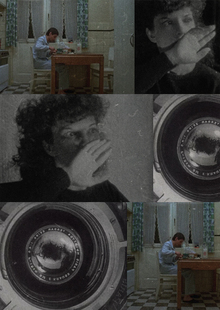
Creation of Dadaist Poem, Tristan Tzara. Stills taken from a 1920s video.
In the video, Tristan Tsara narrates instructions for creating a Dada poem:
«Take a newspaper. Take some scissors. Choose an article from this paper that is the length you want your poem to be. Cut out the article. Next, carefully cut out each word that makes up this article and put them all in a bag. Shake gently. Next, take out each word one after the other. Carefully transcribe them in the order in which they came out of the bag. The poem will reflect your unique voice. And there you are—an infinitely original author of charming sensibility, even if unrecognized by the mainstream.»
He creates an algorithm that can be reproduced an unlimited number of times by different people, yielding a varying result each time it is executed.
In addition to the Dadaists, Sol LeWitt also embodied the idea of writing instructions for his artworks. The radical characteristic of his work is that the underlying concept is paramount—not the execution itself. Annotations accompanying the canvases, which depict instructions for their creation, become a crucial element of the artist’s work.
Wall Drawing 16, Sol LeWitt, 1969
Project Description: 12-inch (30 cm) lines intersect in three directions (vertical, horizontal, diagonal right).
Wall Drawing 46, Sol LeWitt, 1970
Project Description: vertical lines—not straight, not touching, evenly covering the wall.
Wall Drawing 142, Sol LeWitt, 1972
Project Description: A 10-inch (25 cm) grid covering a wall. Increase the number of vertical oblique lines from the left side and horizontal oblique lines from bottom to top by adding one line per grid row. All lines must be spaced equally based on the total number of lines, filling the last row in each direction.
Levitt said, «The idea becomes the driving force that creates art.»
This means that the artwork itself consists of the instructions or conceptual framework created by Levitt, and the drawing on the wall is merely the material realization of that idea.
The artist often did not execute many of his works himself, thereby creating space for the generation of various variations of his instructions.


Blue Poles and No. 5, Jackson Pollock, 1952 and 1948