Concept
The phenomenon of looping occupies a special place in the history of experimental film, as it is through repetition that cinema’s manipulation of time is most clearly revealed. The return of a gesture, a route, a frame, or an entire spatial configuration transforms the image from a trace of an event into an autonomous tool of thought. In this study, looping is examined not as a formal effect or a montage trick, but as a principle for organizing the viewer’s experience—a principle where time ceases to be perceived as a straight line and begins to exist as a system of returns, delays, shifts, and overlaps. The research material consists of eight films: Man with a Movie Camera (1929), Afternoon Nets (1943), Angel-Interceptor (1962), Wave Length (1967), Jeanne Dilman, 23, Commerce Quai, 1080 Brussels (1975), From the East (1993), Colosseum Corpse (2002), and Decasia: State of Decay (2002). This corpus spans several modes of experimental visuality. Repetition acts as the mechanism that connects the form of the image to the model of time.
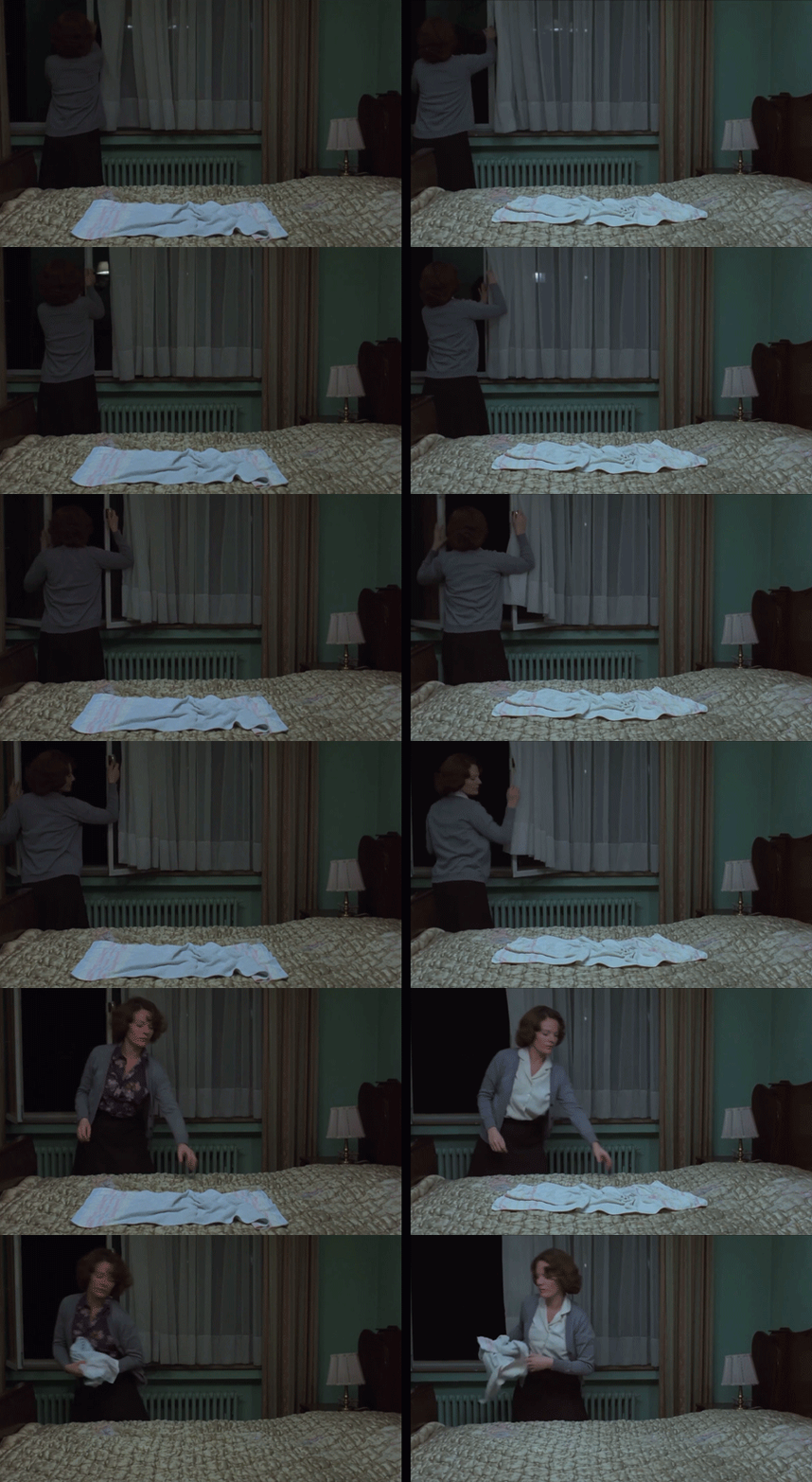
[1], [2] «Jeanne Dielman, 23, Quai du Commerce, 1080 Brussels» (1975, dir. Chantal Akerman)
The principle of the study’s categorization is based on types of repetition that transition from one film to the next while simultaneously shifting their function. The work is structured into six chapters: «The Ritual of the Everyday, ” „Rhythmic Failure, ” „Shift of the Subject, ” „Spatial Loop, ” „Fragmented Image, ” and „Image Loop.“ This sequence allows us to trace the movement from a recurring action to a recurring space, then to the multiplicity of the subject, and finally to the repetition of the image itself.
The core research question is framed as follows: how does looping in experimental film deconstruct the linear model of time and construct a multi-layered mode of perception?
The hypothesis posits that repetition does not simply duplicate what has already been seen, but rather creates a distinction, thereby redefining the meaning of the frame. The central theoretical foundation is Gilles Deleuze’s formula: «Repetition changes nothing in the repeated object, but it changes something in the consciousness that perceives it» (Deleuze, 1998). It is this logic that allows us to view repetition as an active perceptual operation: by returning, the image alters not the object itself, but the vantage point through which that object is interpreted.
[3], [4], [5] «Jeanne Dielman, 23, Quai du Commerce, 1080 Brussels» (1975, dir. Chantal Akerman)
The theoretical framework for this research incorporates the works of Rudolf Arnheim, Gilles Deleuze, and Ivon Margulis. Their texts serve as the foundation for analyzing visual form, screen perception, and difference within repetitive structures. From this perspective, looping emerges as a fundamental principle of cinematic thinking—a mode where time is discovered not in linear progression, but in the repeated return of an image, each iteration altering the conditions of its reading.
The Ritual of the Everyday
[6], [7] «Jeanne Dielman, 23, quai du Commerce, 1080 Brussels» (1975, dir. Chantal Akerman)
[8], [9] «Jeanne Dielman, 23, Avenue des Arts, 1080 Brussels» (1975, dir. Chantal Akerman)
[10], [11] «Jeanne Dielman, 23, Avenue des Arts, 1080 Brussels» (1975, dir. Chantal Akerman)
[12], [13], [14] «Jeanne Dielman, 23, Quai du Commerce, 1080 Brussels» (1975, directed by Chantal Akerman)
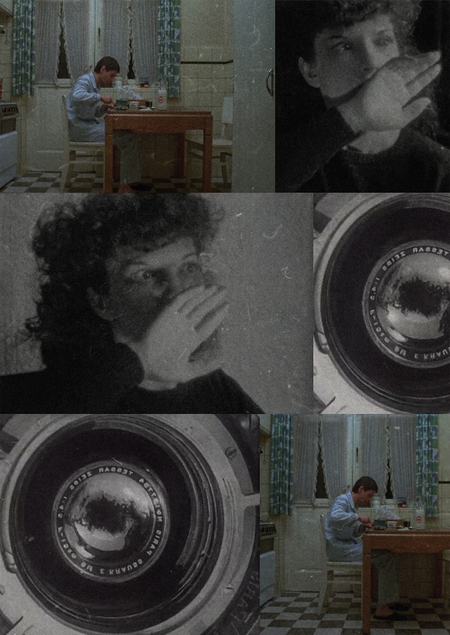
[15], [16] «Man with a Movie Camera» (1929, dir. Dziga Vertov)
The same gestures return with almost mathematical precision: hand movements, interaction with objects, recurring transitions within space, identical pauses between actions. The frame captures not an event, but a mode of existence, where rhythm becomes the primary content. As Ivon Margulis precisely observes: «Every gesture and every sound leaves an impression on our consciousness» (Margulies, 2009). Everyday life is organized as a cycle, and it is this cyclicity that creates a feeling of fragile order—time does not flow forward, but reproduces its own pattern.
Rhythm Glitch
[17], [18] «Afternoon Networks» (1943, directed by Maya Dern and Alexander Hammond)
[19], [20] «Afternoon Networks» (1943, directed by Maia Dern and Alexander Hammid)
[21], [22] «Angel-Fighter» (1962, dir. Luis Buñuel)
[23], [24] «Afternoon Networks» (1943, dir. Maya Deren, Alexander Hammid)
[25], [26] «Afternoon Nets» (1943, dir. Maia Deren, Alexander Hammid)
Rhythmic disruption occurs when a repetition maintains the form of an action but violates its internal coherence. The same gesture returns, but the camera shifts emphasis within the frame, alters the distribution of attention, and redefines the meaning of the already familiar action. The repetition here does not disappear; on the contrary, it becomes more noticeable because the congruence of form enters into tension with the new viewpoint.
[27], [28] «Afternoon Networks» (1943, directed by Maia Deren and Alexander Hammid)
[29], [30] «Angel of Death» (1962, directed by Luis Buñuel)
[31], [32] «Angel-Interceptor» (1962, dir. Luis Buñuel)
[33], [34], [35] «Afternoon Networks» (1943, dir. Maia Deren, Alexander Hammond)
The action remains the same, but changes in the body, plasticity, tempo, and visual appearance of the figure alter its emotional state. It is this internal difference that shatters the neutrality of the cycle and transforms repetition into a realm of meaningful tension. As Gilles Deleuze precisely states: «Repetition is never the repetition of the ‘Identical, ’ but always the repetition of the Different» (Deleuze, 1998).
Subject change
[36], [37] «Man with a Movie Camera» (1929, directed by Dziga Vertov)
[38], [39] «Man with a Movie Camera» (1929, dir. Dziga Vertov)