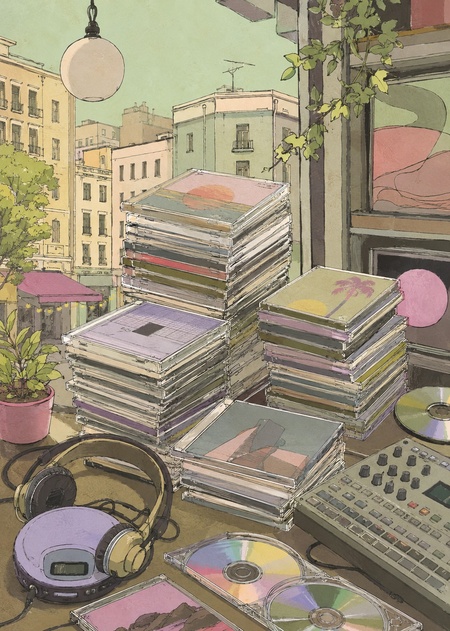
We selected seven electronic albums released in July—definitely worth adding to your playlists.

Batu & Donato Dozzy — Exhale
Italian techno-carpaccio specialist Donato Dozzy continues to explore new shades of the already potent word «hypno.» This time, he collaborated with British producer Omar McCatchen, better known as Batu. This producer’s sonic interests lie not only in experimental electronics but also in the realm of bass music.
The result is a rather good piece where both producers retain their distinct sonic signatures, without straying too far from the already expanded definition of «techno.» There are tracks here that are perfectly danceable, but Exhale also feels quite comfortable at home, outside of club walls.
Overall, Exhale isn’t overly concerned with genre purity—what matters more here is how sound changes form, how one rhythmic pattern can subtly morph into something completely different, and how tension works: it builds, it dissolves, it reappears.
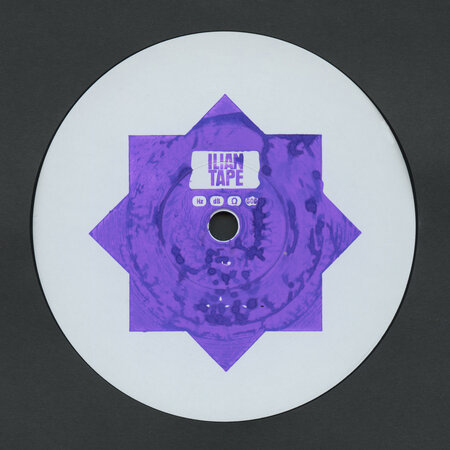
MPU101 — MPU107
The enigmatic German electronic producer maintains a strong pace: having started with his debut album in 2021 on the excellent Zenker brothers' techno label, he releases an average of two albums per year. This time, he has reached a happy number seven. The highlights include the complete absence of drum machine sounds, the scope of the concepts, and a captivating atmosphere. An experienced listener can easily catch references to great past albums here—from the early explorations of the chimera known as intelligent techno to purely classic works such as John Carpenter’s somber retrofuturism.
Arca — XXXXX
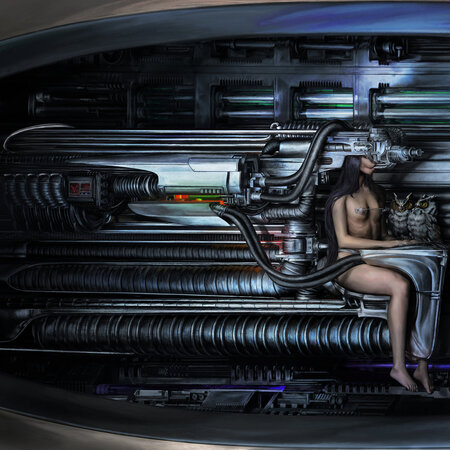
The cover art for a new album from one of the most essential sound avant-garde artists of our time seems to be saying something. The graphics are executed in a style reminiscent of how domestic science fiction publishers envisioned the future in the early 2000s—a future where humans finally became slaves to machines. It depicts a naked woman who has become an inseparable part of some great machine, the Matrix.
Perhaps after the cosmic megalomania that Alejandra Hersi Rodríguez, Arca, unleashed on the last album, KiCk, she returns here to a familiar pursuit—deconstruction. It seems the sole objective underpinning XXXXX is the attempt to determine where the body ends and the machine begins: the beats crunch, the synthesizers gasp, the voices fracture into fragments—and soon, some homunculus will emerge from this sonic machinery.
The most captivating aspect is that Arca does not strive to predict the future—she creates music as if the future has already happened to the human body. This is likely why XXXXX feels simultaneously futuristic, erotic, frightening, and somehow very primal.
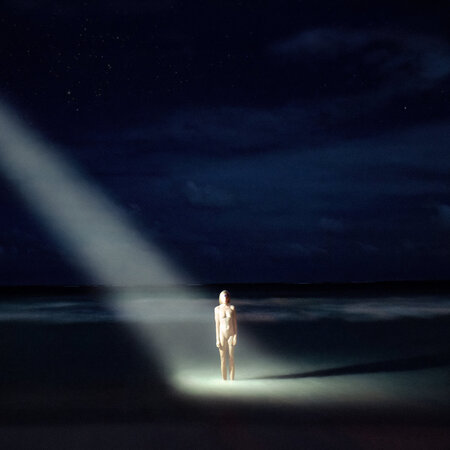
Ellen Allien — New Life
After a rather long hiatus, Ellen Allien—one of the queens of Berlin techno sound and the curator at BPitch Control—returns with an album that is simultaneously deeply Berlin in its essence while striving to transcend the phrase «Berlin techno, ” a term that has become considerably worn out over the years.This is a collection of tracks that could easily be mistaken for a high-quality soundtrack to a rave trapped inside some concrete box. But alongside that, there is an attempt to bring the heavyweight techno beat out into nature. Essentially, Allien tries to incorporate the machine into the surrounding environment. Her techno still thrums like a powerful engine, but now you can faintly hear wind, the ocean, birds, and the human voice inside it. Therefore, even the most straightforward tracks do not feel cold—rather, they seem to be searching for life within mechanical repetition.In fact, *New Life* is the work of an artist who still believes in the power of this music, but who now hears not only the city, but the entire living world around it, within its mechanical pulse.
Alexander Kowalski — Echoes
A quarter of a century ago, German producer Alexander Kowalski made a powerful statement with his debut album, Echoes, simultaneously sketching the boundaries of his own techno sensibility. In this universe, time flows differently, making the reissue after twenty-five years particularly compelling. For some, it serves as further confirmation that «the music was better back then»; for others, it’s a revelation that great music never ages.
Essentially, Echoes today is perceived less as a historical document and more as a reminder of a time when techno still felt like music of the future. One can distinctly feel the pulse of industrial Berlin, yet the artist himself never dissolves into the machine construct—he layer upon layer adds something uniquely his own: melody, melancholy, a sense of space.
The title of the debut now seems prophetic: Echoes turns out to be an echo of an era when club music was just beginning to establish itself in album format. But a good echo doesn’t just recall the past—it shows that sound has the ability to transcend its time and return in an entirely different future.

Bot1500 — The Black Sea
For those who prefer to look at genre definitions before deciding whether or not to include an album, The Black Sea by Japanese producer Shinichi Kobayashi might present a challenge. Everything seems very simple: IDM, ambient. But with music this delicate, it feels like a futile attempt to verbally describe the nonverbal.
There is a lot of air, pauses, and silence here, and the rhythm—if it is drawn out at all—is more like a suggestion of movement. You shouldn’t look for direct connotations with the Black Sea in the title. Rather, it is dark music, and Kobayashi has composed a beautiful soundtrack for it. It is the music of a dark sea—warm, nocturnal, infinite. Amidst endless expanses, a small boat drifts from somewhere to somewhere. Can you sense the anxiety? Beauty, the author suggests, and one wants to agree with him.
Kobayashi’s minimalism works very well here: the composer does not try to fill every second with sound, allowing individual notes, beats, and rustles to gain weight and significance. All tracks, except for the final one, are written at 140 beats per minute, but this tempo feels more like a number—emotionally, it is a current that remains largely imperceptible throughout the journey.
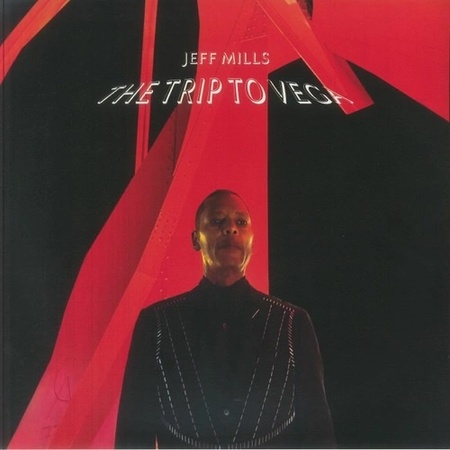
Jeff Mills — The Trip To Vega
Pioneering techno-futurist Jeff Mills has long detached himself from earthly realities, crafting his numerous albums in the style of audio logs sent back to Earth from his own cosmic odyssey.
The year is 2097. Earth becomes uninhabitable, and humanity mass-evacuates to Vega—a star located 25.3 light-years away. The result is a 75-minute soundtrack to this journey—techno for interstellar travel: dry percussion, slow compositional arcs, anxious melodic figures, and immense space—as if you’ve been thrown into deep space.
The feeling is that this album captures how music leaves Earth along with its people. The expected Detroit techno has been reduced to a rhythmic skeleton—dry, almost mechanical—with everything else long dissolved into the boundless void.
Ultimately, this is less about techno about space than it is about techno that has become space itself: cold, infinite, and inaccessible to the human mind.