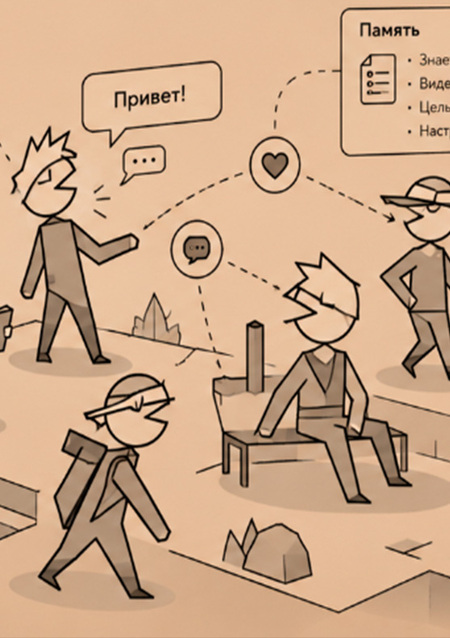
«Fake Mind» is a web-based editor designed for creating, configuring, and testing the behavior of in-game NPCs. The project allows developers to build characters with their own personalities, memory, daily routines, and relationships, and then observe how they interact with each other without constant user intervention.
The core concept of the project is to move beyond perceiving characters as mere objects executing pre-programmed commands, instead treating them as active participants in the game world with their own history and behavior.
The assignment requires a thematic plan spanning six months and ten content samples. For this project, I chose the format of educational and interactive media that surrounds the editor, illustrating how in-game character behavior is developed.
Six-Month Thematic Plan
Over six months, the media outlet will familiarize the audience with the fundamental principles of creating NPCs, explore in-game character behavior, and demonstrate the editor’s capabilities through practical experiments.
We plan to release between 4 and 8 publications per month. This frequency will increase as more editor demonstrations and user experiments become available.
November—CHARACTER. Character Creation
December—MEMORY. NPC Memory and Personality
January—ROUTINE. Daily Routine and Autonomy
February—RELATIONSHIP. Relationships and Interactions
March—SIMULATION. Behavior Testing
April—WORLD. Building an Independent World
CHARACTE or Why Do Identical NPCs Behave Differently?
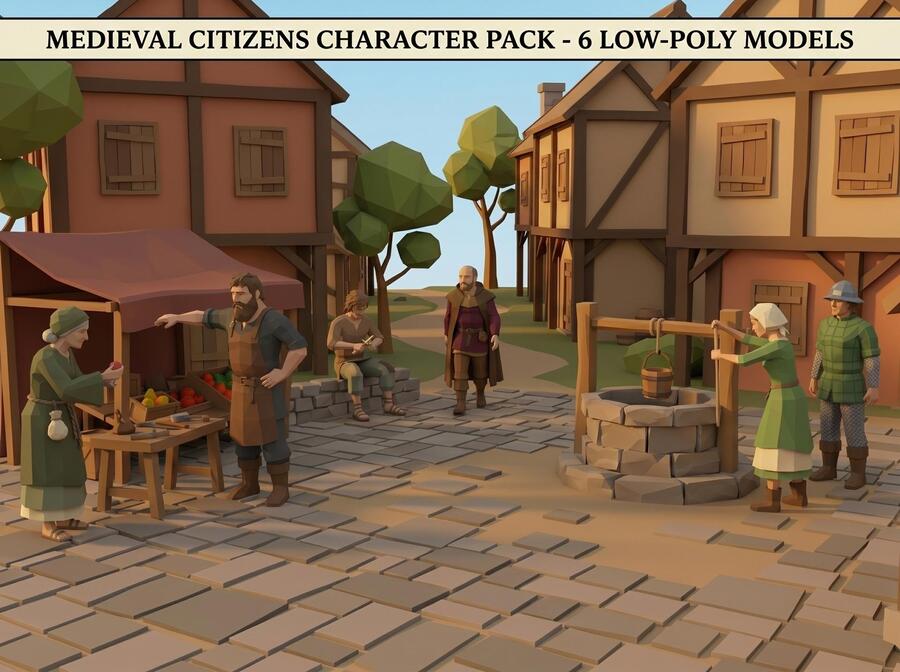
Three characters are given the same task: deliver a package to a neighboring village. However, each NPC has a distinct personality. The first is cautious, the second is curious, and the third is prone to risk.
Setup The user is asked to choose a character’s personality and predict the route they will take.
In the demonstration example, the characters have access to a safe road, a shortcut through the forest, and an unknown trail. Their choice depends on the set priorities, route information, and current needs.
An NPC’s personality can be represented by a set of parameters that influence situation assessment. A cautious character might prefer safe routes, while a curious one is more inclined to explore unknown areas.
However, personality should not dictate every action. Circumstances and past experience also influence behavior. Convincing character behavior is built upon a combination of personality and the game situation.
MEMORY or What Happens When an NPC Holds a Grudge?
Two characters live in a village. One lent money to the other, but the debt was never repaid. A few days later, the debtor comes back asking for help again.
The same scenario is initiated with three memory options. The user compares character dialogues and decisions. Memory allows for the consideration of previous events when making decisions. This enables character relationships to evolve, and past actions to have consequences.
Even a simple system for saving key events can make NPC behavior more consistent.
ROUTINE or what is the NPC doing before the player sees them?
Video Script
00:00–00:08. A village appears on screen. The narrator asks: «What happens to the characters when the player leaves the area?»
00:08–00:18. The blacksmith’s daily routine is shown. In the morning, he opens his workshop; during the day, he works; in the evening, he returns home.
00:18–00:28. An unexpected event appears in the schedule. The blacksmith falls ill and cannot come to work. The consequences for another NPC who came to place an order are shown.
00:28–00:40. The change in routine is demonstrated. The narrator explains that autonomous characters can react to events without constant player input.Routines help create a sense of life in the game world. However, for behavior to feel convincing, it is important to plan not only for routine actions but also for situations where the usual schedule is disrupted.
RELATIONSHIP or How One Argument Can Change the Entire Village?
Three characters reside in one settlement. Anna is friends with Mark, Mark conflicts with Viktor, and Viktor is barely acquainted with Anna.
An event occurs in the simulation: Viktor accuses Mark of theft. Anna witnesses the conflict. This is a simplified example of a character relationship tree.
Users observe how the conflict impacts the trust between the characters. Changes depend on what Anna believes, how much she trusts the participants, and what information she receives.
The relationship system can be built on more than just a single affinity scale. For more complex behavior, trust, shared memories, commitments, and attitudes toward specific events can be taken into account. The relationships between NPCs can create new gameplay situations without pre-scripted dialogue for every possible conflict.
SIMULATION or Why Aren’t Characters Required to Always Complete Tasks?
The character is assigned a quest to go to the forest for resources. However, before leaving, another need arises: they haven’t rested in a long time and are very tired. The author demonstrates a priority system. For example, gathering resources receives 60 arbitrary points, while rest receives 85. These values are an example of design, not a measurement of real human behavior.The NPC chooses to rest, even if the developer expected them to complete the task. After recovering their energy, the character can return to the original quest.If the character always executes the last command received, their actions may appear mechanical. A needs system allows for considering the NPC’s state and selecting actions based on the situation.However, the priorities must be understandable and predictable at the level of rules. If the character constantly switches tasks without a discernible reason, their behavior will appear random. The autonomy of the NPC lies not in chaotic actions, but in the ability to choose among several tasks according to established rules.
MEMORY or Should an NPC Remember Every Interaction with the Player?
The player encounters a merchant, buys several items, and leaves. A few in-game days later, they meet again. Participants are presented with three options for the merchant’s behavior: he completely does not recognize the player, he only remembers the last purchase, or he retains a history of previous interactions. Three dialogues are displayed. In the first, the merchant addresses the player as a stranger. In the second, he offers similar items. In the third, he takes into account the purchase history and his relationship with the player. Storing every event might be superfluous. For convincing behavior, it is often sufficient to save the most significant information: important agreements, conflicts, and changes in relationship. The realism of memory is determined not by the quantity of saved events, but by how appropriately the character utilizes them later on.
WORLD or What Happens if You Leave Ten NPCs Without a Player?
Video Script
00:00–00:07. A small village with ten characters appears on screen. Narrator: «We gave each NPC a distinct personality, a routine, and several needs.»
00:07–00:17. The simulation begins. The characters move to their workstations, visit shops, and interact with one another.
00:17–00:27. An unexpected situation unfolds. One merchant fails to show up for work, preventing another character from completing their task.
00:27–00:37. The sequence of events in the village changes. Some characters find alternative actions, while others wait for the initial condition to be met.
00:37–00:45. A cause-and-effect diagram emerges. Narrator: «The game world begins to generate stories from the interactions of its own systems.»This experiment helps to test how autonomously characters can sustain a coherent simulation without constant player intervention.
CHARACTER | Interactive Settings
The user is prompted to create a merchant for a small fantasy village. After selecting the parameters, the user receives an example of how the character might behave when encountering a stranger, during a conflict, or while fulfilling a dangerous quest. Even a small set of attributes can help create distinctions between characters. However, the numerical parameters themselves do not automatically generate behavior; one must define how they influence the choice of actions.
RELATIONSHIP or Can NPCs Become Friends Without Player Involvement?
Two characters work in the same building. Initially, they feel neither attraction nor aversion toward each other.
In the editor, general work objectives, the possibility of conversation, and a system for changing relationships after events are set up.
In the demo scenario, the characters help each other complete tasks. After several positive interactions, the level of trust increases. However, if there is a conflict of interest, their relationship may deteriorate.
Friendship between NPCs should not arise merely because they spend a lot of time near each other. For believable relationship development, specific actions, shared events, and ways for the characters to assess those events are essential. The relationship system becomes more engaging when actions influence it, rather than just the time spent together.
WORLD or Can You Create a Story Without a Prewritten Script?
In a small settlement live five NPCs. Each has a personality, a profession, needs, and relationships with other characters.At the beginning of the experiment, an event occurs: the village’s food supply disappears. Users choose the conditions: how many resources remain, how much the characters trust each other, and what actions are available to them. In the demonstration scenario, one character attempts to find new resources. Another suggests dividing the remaining supplies. A third character hides their own food, which could lead to conflict.The development of the situation is determined by rules that connect needs, memory, relationships, and the events of the game world.Such a system relates to the principles of emergent narrative. The story arises from the interaction of game mechanics rather than being reproduced as a fully predetermined sequence of events.However, the developer still establishes the core rules, conditions, and possible actions. Therefore, the emergent story is not entirely independent of the author’s intent. The Editor can help create game stories where events unfold through the interaction of autonomous characters.
For the first half of the year, the «Fake Mind» project has planned 36 publications, divided into six thematic areas. The media is gradually introducing the audience to character creation, NPC memory, daily routines, character relationships, and autonomous simulations. The main difference between this project and typical game design content is that the user does not just read about in-game character behavior; they can independently adjust parameters, run demonstration scenarios, and compare the results. Thus, the content simultaneously serves an educational purpose, familiarizes users with the editor’s capabilities, and helps gather feedback for future product development.