Contents
- Introduction
- Main Body • Sketches • Objects • Books
- Conclusion
- Bibliography
- Image Sources
Introduction
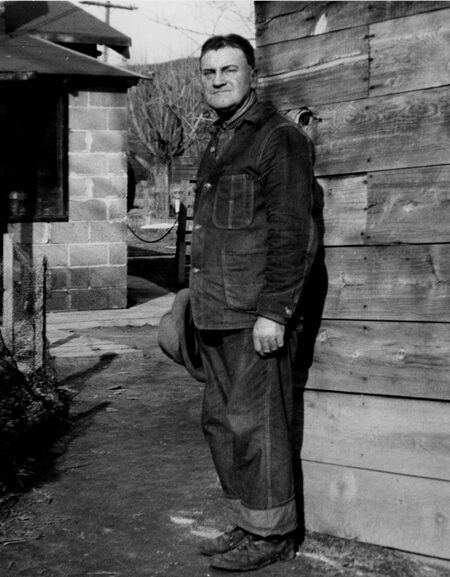
American outsider art is a phenomenon of the 20th century, bringing together artists without formal education, often marginalized by mainstream cultural movements, who created their work using found materials without academic training. James Castle (1899–1977) is one of the unique representatives of American «folk» art. James was born completely deaf and received only five years of schooling at a school for the deaf; formally, he could neither read nor write, and he communicated with his family using a reduced sign language. However, he began drawing at the age of six.
Kastl’s works combine elements of realism and abstraction by depicting imagery from village homes, barns, animals, and people: distinct architectural lines and textures coexist with «totemic» and formal symbols. Kastl created art nearly every day, capturing his familiar surroundings in detail, and his practice resulted in a visual diary spanning almost seventy years.
The author’s congenital deafness resonates with the idea of a «quiet» lifestyle. According to the canons of American regionalism from the first half of the 20th century, there is a general sense of Puritan strictness, isolation, and detachment—that very «American Gothic.» Castle’s works echo the search for «natural» images of the country: life on the land, the architecture of the homeland, and peasant culture. They are somewhat unsettling because, despite their playful atmosphere, they reveal political or cultural issues of the nation.
In the works of James Castle, one can discern echoes of the Brutalist aesthetic—a movement that fully formed in the second half of the 20th century. Although Jean Dubuffet coined the term «art brut» later, Castle essentially predicted its principles: self-sufficient, intuitive art that emerged without the influence of artistic canons. However, applying this term to him in a literal sense is problematic; Castle was more of an «endemic”—an artist whose visual system developed in complete isolation, both physically and culturally. His style cannot be typified or broken down into academic categories because it was not derived from established schools; rather, it grew out of an internal need to document the world and „communicate“ with it. This is not art that is „naive“ in the simple sense, but organically autonomous.
Castle is an outsider artist among outsider artists. He draws with saliva and soot on packing cardboard, employs naturalistic perspective, stylized rectangular figures, and fictional elements like multi-tiered monoliths that spontaneously appear in provincial Idaho—a combination not very typical of Art Brut artists, but characteristic of simply being an artist.
Gleb Simonov, Art Critic
The objective of this study is to test the hypothesis that James Castle’s isolation, his developmental characteristics, and his lifestyle did not form a barrier, but rather allowed him to express the identity of the American province with the greatest accuracy and intuition. Can a self-taught artist, unknown to academic dogmas and trends, convey the essential tone of the era through limited materials? Can an outsider and a recluse serve as a credible narrator of the cultural code of nearly a whole century?
Drawings
«Post Office.» Paper, soot
Untitled (landscapes, wooden structures). Paper, charcoal
Untitled. Detailed drawing copied from an advertisement—a monument to soldiers and sailors in Indianapolis. Scrap paper, soot, 9 3/8×11 inches.
Untitled (station, wooden structures). Paper, soot
For the author with rudimentary knowledge of artistic canons, Castle had successful attempts in perspective: some works depicting architecture or interiors possess depth and even a play of light and shadow.
Untitled (house interior). Cardboard fragment, soot
Untitled (Attic). Cardboard, soot
Untitled (House Interior). Scrap of paper, soot
Untitled (Ladder). Paper scrap, soot, 5 5/8×7 ½ inches / Untitled (Home Interior). Paper scrap, soot, 9 ½×10 ½ inches
Untitled (home interior). Snippet of paper, soot, and paint of unknown origin.
Untitled (piano). Drawing on the unfolded cardboard box, soot.
Untitled (barn, house interior). Drawing on the unfolded cardboard box, charcoal.
Untitled (Turkey). Scrap of paper, soot / Untitled (Rabbits). Paper, soot
Gradually, the brushes made from his own hair wore out, so Castle dipped pointed sticks in ink and drew with them, as if they were pencils. Later, his family finally bought him watercolors, and he was able to paint with color.
Untitled (Chicken). Paper, soot, and paint of unknown origin.
Untitled. Piece of paper, paint of unknown origin, 4 ¾ × 6 inches
Untitled. Series of coat images. Scraps of paper, soot, and paint of unknown origin.
Untitled triptych. Paper, paint of unknown origin.
Untitled. Series of house images. Paper, soot, paint of unknown origin.
Untitled (cow). Fragment of paper, paint of unknown origin