Navigation
- Concept
- The Musical Geography of New Orleans
- People, Ensembles, and the Sound of New Orleans Jazz
- Recordings, Musician Movement, and the Legacy of New Orleans
- Conclusion
Section 1. Concept
New Orleans holds a special place in music history: it was here, at the turn of the 19th and 20th centuries, that one of the earliest forms of jazz emerged. The rise of this style was fostered by the city’s diverse population, the close proximity of various musical traditions, and its vibrant urban life. Over time, brass bands, blues, ragtime, African musical traditions, and European music began to intermingle, ultimately creating the recognizable sound of New Orleans jazz.
The city’s musical landscape was shaped by African, French, Spanish, and Creole heritage. Music echoed through the streets, in public spaces, during celebrations, dances, funeral processions, and parades. These performances served as a form of communication between musicians and different communities, and the constant exchange of knowledge and playing techniques contributed to the emergence of new musical sounds.
The venues where the music sounded—the streets, dance halls, clubs, and entertainment venues—also played a significant role. One of the most famous areas was Storyville, which existed from 1897 to 1917. It provided musicians with performance spaces, but jazz did not develop there exclusively. Its growth was connected to the entire musical life of New Orleans, not to just one neighborhood.
Key figures in the history of New Orleans jazz include Buddy Bolden, Freddie Keppard, Kid Ory, King Oliver, Jelly Roll Morton, and Sidney Bechet. Their work illustrates how local traditions and musical performance techniques evolved. However, attributing the birth of jazz to any single individual is inaccurate; this style developed gradually, stemming from the collective experience of numerous musicians.
The defining characteristic of early New Orleans jazz was ensemble playing. The trumpet or cornet typically played the main melody, the clarinet added fast and varied ornamentation, and the trombone provided lower notes. Drums, banjo, and other instruments established the rhythm. The interwoven parts created a lively, multi-layered sound, where improvisation and the musicians' ability to play together—listening to and adapting to one another—were particularly crucial.
In the early 20th century, jazz began to extend far beyond New Orleans. This was facilitated by musicians moving to other cities and states, touring, and the advent of sound recording. The 1917 recording by Original Dixieland Jass Band played a particularly crucial role, contributing to the genre’s rising popularity. While music continued to evolve outside the city, it never severed its connection to its roots.
Therefore, New Orleans jazz is not merely a style; it is an integral part of the city’s culture. Understanding it requires examining the places where it was heard, the cultural influences, the musicians' lives, and the specific characteristics of ensemble playing. New Orleans is a city where everyday life, tradition, and creativity converged to give birth to one of the most vibrant musical phenomena of the 20th century.
Section 2. The Musical Geography of New Orleans
In the late 19th and early 20th centuries, New Orleans became one of the primary hubs where jazz began to take shape. Diverse musical traditions intertwined in this city, and the music itself echoed from every corner, perpetually accompanying the people.What set New Orleans apart was its vibrant and diverse cultural atmosphere. Here, African American and Creole traditions blended closely with European brass music, blues, and ragtime. It was from this amalgamation that the new style—early jazz—gradually emerged.
Canal Street, the main thoroughfare of New Orleans, LA. 1901
Jazz in New Orleans evolved gradually, thanks to the interplay of various musical traditions. African and African American elements contributed important characteristics to the music: a distinct rhythm, collective performance, and musical dialogue. European brass band music influenced the ensemble composition and the selection of instruments. Blues imbued jazz with emotional depth, while ragtime provided musical structure. New Orleans Creole culture also played a significant role, boasting its own diverse musical traditions. The fusion of these cultures created the conditions for the emergence of new performance methods. Early jazz was the result of prolonged cultural exchange, not merely the imitation of a single musical style.
King Oliver’s Creole Jazz Band. 1922/23
Street music was a vital part of New Orleans' cultural life. Musicians performed during festivals, parades, and other events. Brass bands played directly on the streets, without needing a dedicated stage or concert hall. This performance format made the music accessible to people of all walks of life. People could gather around the musicians, watch them play, and join the celebration or the event. Furthermore, these street performances helped musicians gain experience playing together. The interaction between performers, rhythm, and improvisation became defining characteristics of New Orleans music.
The Eureka Band. 1955
Beyond holidays, brass bands in New Orleans also accompanied funeral processions. The traditional New Orleans jazz parade would begin with slow, solemn melodies, and after the formal part, the music would become more energetic and the collective procession would start. This tradition is connected to the Second Line—participants who follow the main parade and the band. Today, such processions remain a recognizable part of New Orleans' cultural life. The music during a funeral becomes not just a performance, but a way of expressing emotion and maintaining human connection.
In New Orleans, during the 18th and 19th centuries, there were historical spaces known as Congo Square—gatherings of people of African descent. These gatherings were accompanied by music played on percussion instruments and dance. Under conditions of slavery and racial inequality, such gatherings served as a vital refuge for the preservation of traditions. Music and dance helped people maintain their connection to their roots and to each other. Congo Square is frequently mentioned in the history of New Orleans' musical culture. It was here that African and African American traditions intertwined with local culture, eventually giving rise to jazz.
«The Bamboula.» Edward Winsor Kemble. 1885 (published 1886)
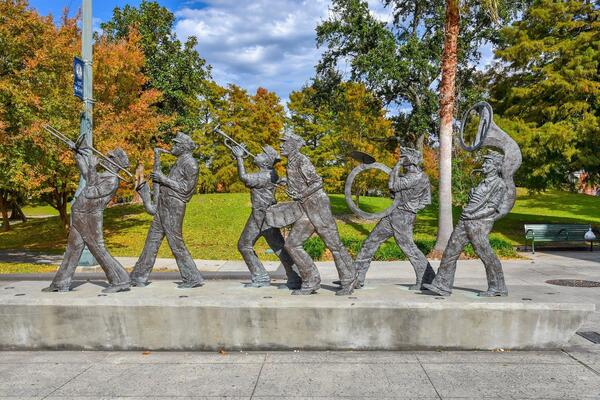
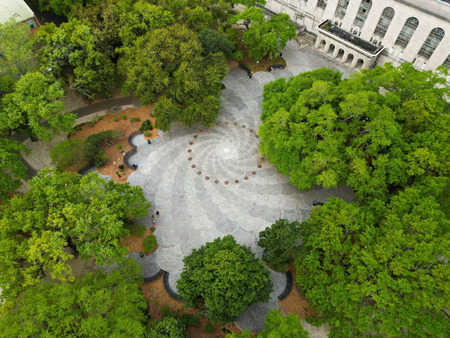
1. The New Orleans Brass Band sculpture by Sheleen Jones-Adenle (2010). Louis Armstrong Park, New Orleans, LA. 2. Congo Square, Louis Armstrong Park, New Orleans, LA
Storyville was an entertainment district in New Orleans that existed from 1897 to 1917. It housed venues where patrons could listen to music, dance, and spend the evening.
For some musicians, these places became a source of income and an opportunity to perform regularly. In such an environment, performers developed skills in ensemble playing, often with different musicians, and adapted to the audience. Storyville holds an important place in early jazz.
The district was closed in 1917, but jazz continued to develop and spread beyond New Orleans.
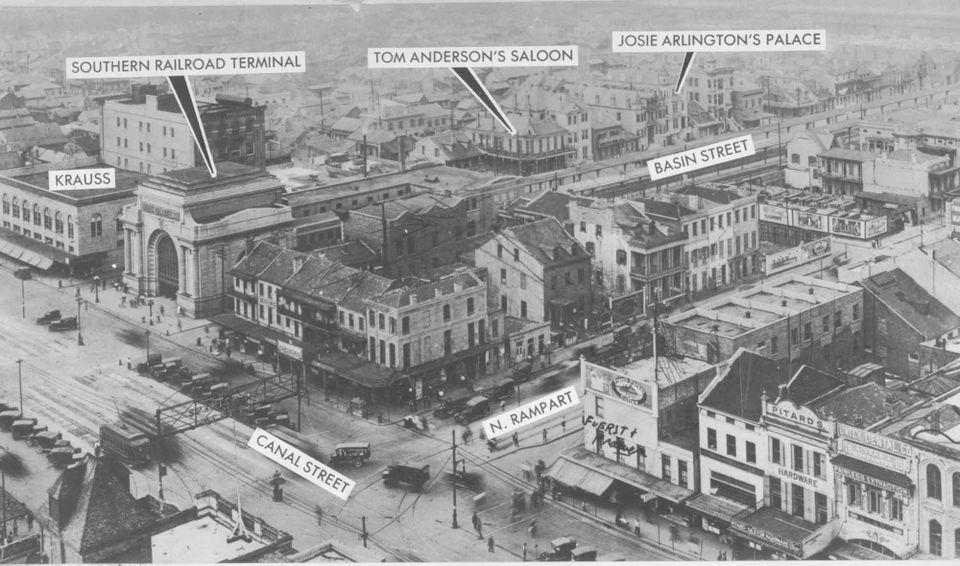
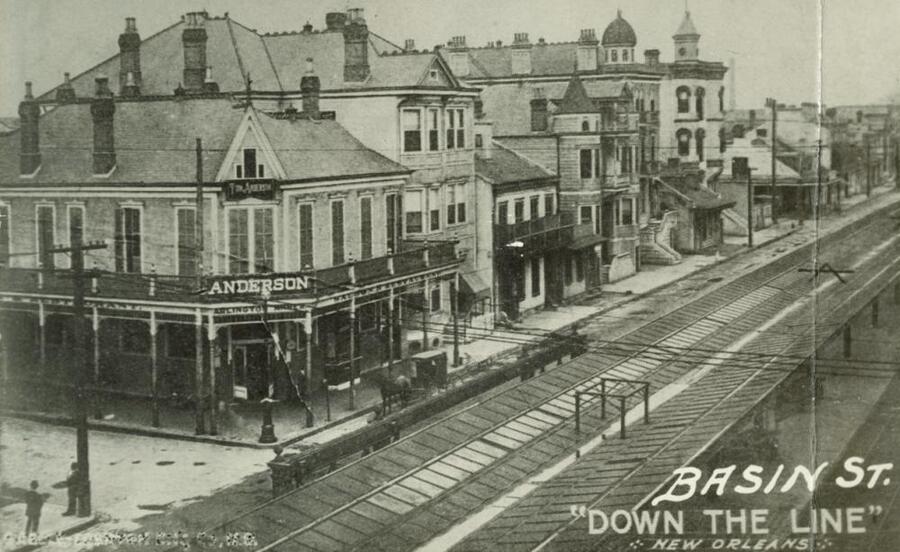
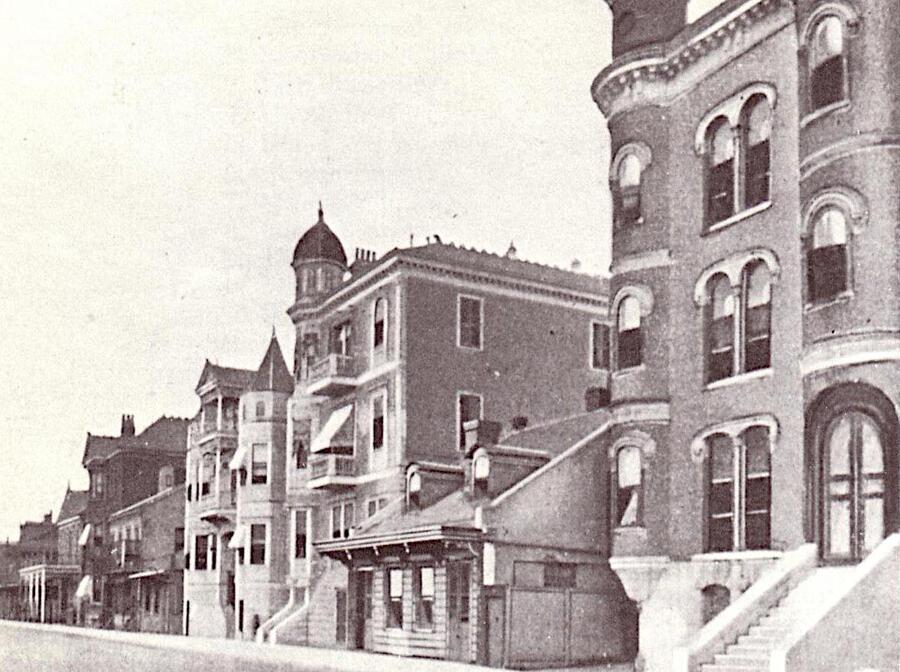
1. Archival photographs of Basin Street and neighborhood buildings; 2. Archival photographs of Basin Street and neighborhood buildings; 3. Historical map of Storyville
https://unsplash.com/photos/canal-street-the-main-thoroughfare-of-new-orleans-la-H91xQowZcNk (Accessed: October 15, 2026)
https://home.nps.gov/jazz/learn/historyculture/index.htm (Accessed: October 15, 2026)
https://hnoc.org/publishing/first-draft/how-brass-bands-became-new-orleans-tradition-picking-new-sounds-along-way?__cf_chl_rt_tk=TEW8cH0k6NcPY4vlPeuV.YsJmSkOXZoSTaGogcF_71U-1792068464-1.0.1.1-9MOcPOG0DUUSXWfWJTVSuNaWBmhKqcsZ3wjjIinOSlw (Accessed: October 15, 2026)
https://hnoc.org/presentations/congo-square (Accessed: October 15, 2026)
https://www.brandnudesign.com/louis-armstrong-park-congo-square (Accessed: October 15, 2026)
https://www.brandnudesign.com/louis-armstrong-park-congo-square (Accessed: October 15, 2026)