00. Navigation
- Introduction
- Mirrors and Reflections
- Camera Operation
- Editing and Lighting Design
- Conclusion
- Bibliography and Image Sources
01. Introduction
Superhero cinema currently occupies a significant space in modern mass culture and is one of the most profitable segments of global filmmaking. Its roots trace back to the American comic book industry of the 1930s and 1940s. During the Great Depression and World War II, society developed a demand for a heroic figure—a symbol of hope, justice, and protection. Since the late 20th century, the genre has undergone substantial changes: moving from simple narratives about the struggle between good and evil to increasingly complex psychological and moral conflicts.
Films have begun to delve more deeply into the theme of a hero’s or villain’s «birth» and its connection to traumatic experiences, such as the loss of parents and loved ones, accidents, war, disaster, or personal humiliation.
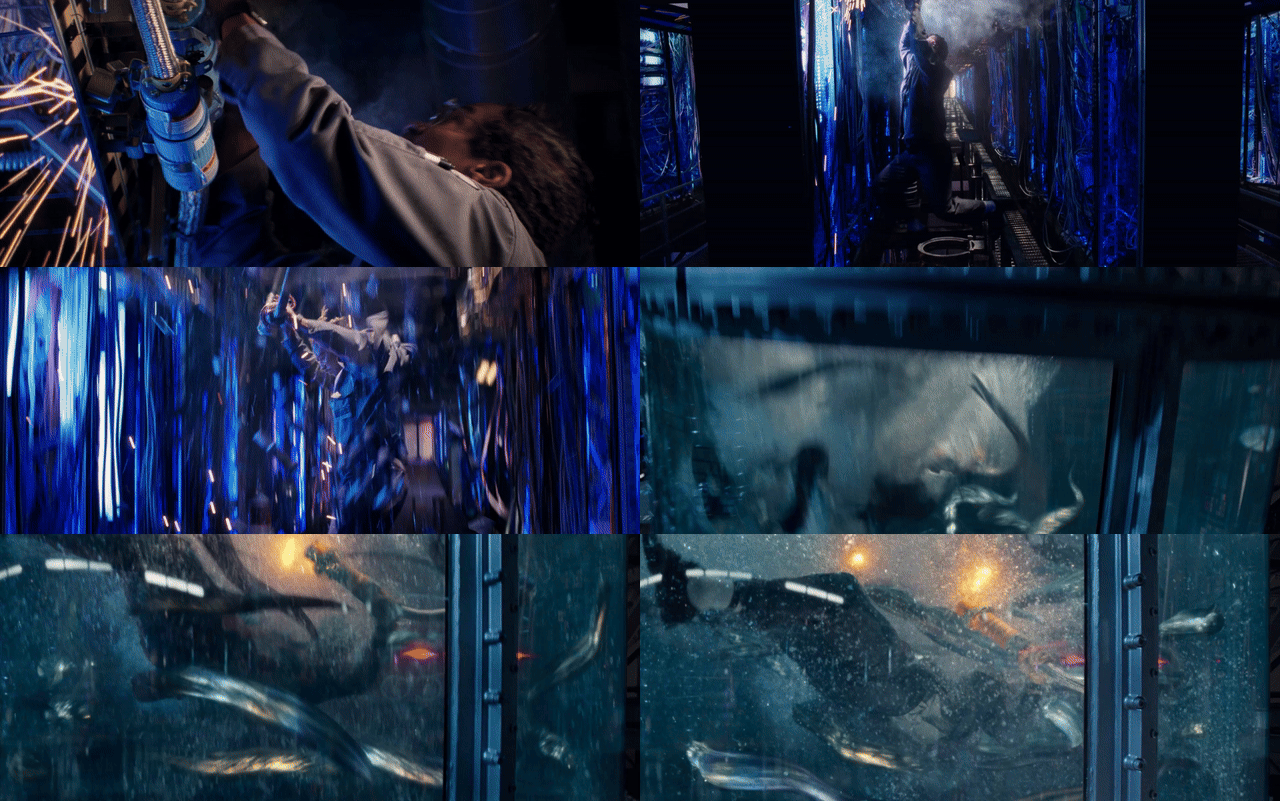
1 — «The Amazing Spider-Man: The Amazing Spider-Man» (2014, directed by Marc Webb)

2 — «Spider-Man» (2002, dir. Sam Raimi)
3 — «Batman Begins» (2005, dir. Christopher Nolan)
The character’s defense mechanism in response to this event is the formation of a new identity. This allows them to survive the experience, adapt to it, reevaluate themselves, and overcome feelings of helplessness or vulnerability. However, such a transformation leads to internal conflict, as the newly formed role contradicts the hero’s established self-perception.
«Bruce, who experienced the trauma of his parents' death in childhood, subconsciously seeks a model for normal existence through personality dissociation. His character’s wholeness shatters, revealing his duality: a carefree social playboy by day and a warrior obsessed with the idea of justice by night.»
— N.A. Tsyrkun, «Comic Book Superheroes and the Dark Side of Titanism»
From a narrative standpoint, the crisis develops through the sequential collision of identities with a constant «raising of the stakes.» The protagonist, attempting to balance two roles, begins to lie, disappear from the view of others at certain moments, be late, and break promises. Gradually, through such actions, the original equilibrium is disrupted—and this disruption fuels the film’s subsequent plot movements, making the character more complex and multifaceted.
This study examines how visual techniques can effectively demonstrate this phenomenon in superhero cinema. Chronologically, the research covers superhero films from the 1990s through the 2020s, as this period is characterized by the genre’s active development in cinema. The material is organized according to types of visual techniques.
The research hypothesis posits that techniques aimed at amplifying a character’s sense of instability are employed to visualize an identity crisis.
02. Mirrors and Reflections
One of the most common techniques is depicting the protagonist through reflective surfaces.
4 — «Spider-Man» (2002, directed by Sam Raimi)
«The joyous reception of one’s mirror image by a creature still immersed in motor helplessness and dependence on nourishment—which is the infant at this stage of infancy—will, in the exemplary situation, reveal, in our view, the symbolic matrix within which I settles in its primary form, before objectifying in the dialectic of identification with the other and before language fully recreates its function as a subject.»
— Jacques Lacan, «The Mirror Stage as the Forming Function of the Ego»
5 — Spider-Man: The Amazing Spider-Man (2012, Dir. Marc Webb)
A superhero or supervillain can be viewed as an «infant» from the perspective of Lacanian theory, as they are a subject continuously forming their own «ego.»
6 — «Venom» (2018, Dir. Ruben Fleischer)
The inability to recognize their body becomes a source of stress for the character, as it disrupts the person’s familiar self-perception. The protagonist, striving to restore the connection between themselves and their reflection, attempts to touch the mirror surface or feel their own face.
7 — «Venom» (2018, dir. Ruben Fleischer)
8 — «Spider-Man 3: Venom» (2007, dir. Sam Raimi)
9 — Spider-Man 3: Venom (2007, dir. Sam Raimi)
For example, water can also be used as a reflective surface. The difference from a mirror is that it is unstable and subject to constant distortion in the form of wave oscillations. This type of visual solution allows for an emphasis on the character’s doubts about their own actions and their emotional tension.
10 — «The Dark Man» (1990, dir. Sam Raimi)
11 — «Hulk» (2003, directed by Ang Lee)
12 — «Spider-Man: Homecoming» (2017, directed by John Watts)
However, reflection does not always function as a means of precisely reproducing a character’s appearance.
13 — «Spider-Man 2» (2004, dir. Sam Raimi)
In some cases, this visualizes an ideal image—a stronger, more cohesive, or authoritative figure—that the protagonist strives for. This allows us to demonstrate the gap between the character and the reflection they aspire to compare themselves to, as well as their own dissatisfaction.