Concept
Where does «Flowers Don’t Keep Quiet» draw its information from?
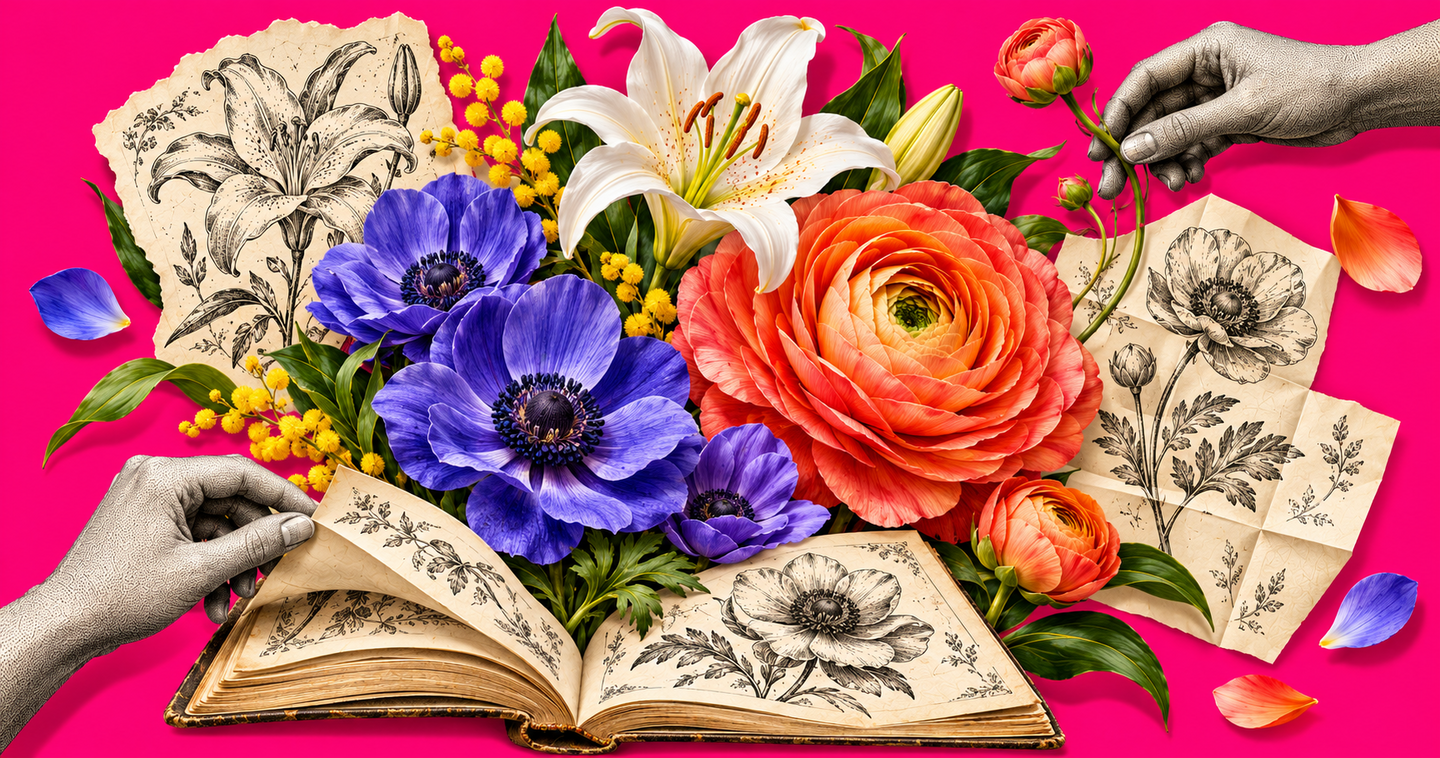
The media uses historical documents, research and botanical publications, museum collections, and audience data to prepare its materials. Floral dictionaries, books, postcards, and works of art form the basis of the stories, and reader questions help select future topics.
Each source plays a distinct role: a document preserves the mindset of its time, research helps explain it, and a personal story illustrates an individual’s experience.
Sources provide the foundation for publications. Editorial review helps distinguish confirmed facts from interpretations and common associations.
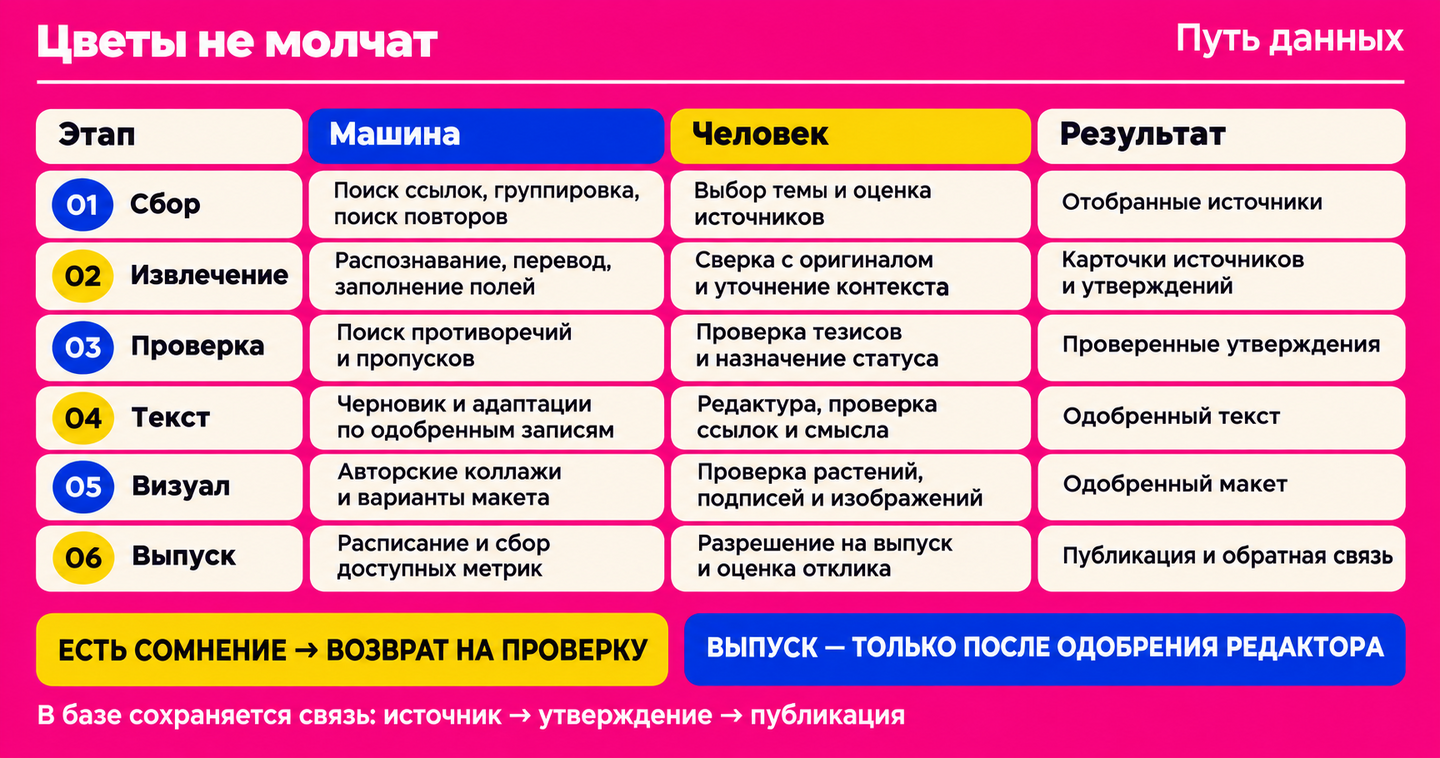
Data Schema: Human and Machine Processing
How does information become a publication?
In «Flowers Don’t Keep Quiet,» automated services help locate and organize materials, recognize text, prepare translations, drafts, and visual solutions. The human writer is responsible for selecting sources, verifying claims, providing historical context, and final editing.
The editorial database maintains a link between the source, the extracted claim, and the publication. This allows one to trace back to the original document and verify the foundation of the narrative.
Machine processing accelerates content preparation, while the editor determines what conclusions can be drawn from the gathered information. If there are doubts, the material is returned for review. The final decision to publish rests with a human.
Guidelines for Automated Services
Guidelines for Using Automation
Automated services assist media in sourcing information, drafting copy, and generating illustrations. Permissible tasks, limitations, and mandatory editor review are defined for each stage.
Special attention is paid to the accuracy of citations and translations, plant names, and image provenance. When summarizing text, references to the source, culture, and era must be maintained.
If data is insufficient, the service will flag the gap. Unverified information must not be presented as a definitive statement.
General Guidelines for Data Handling
What remains under editorial control?
1. Accuracy. Every factual statement must have a verifiable source. Quotes, names, dates, and plant names are cross-referenced with the original material.
2. Context. The meaning of a flower is linked to a specific culture, era, and set of circumstances. An interpretation from one dictionary is not presented as a universal rule.
3. Image Provenance. For historical materials, captions, references, and usage terms are maintained. Generated collages are labeled as original illustrations and are not presented as archival documents.
4. Personal Stories. Reader-submitted stories and images are used with appropriate consent. Unnecessary personal information is removed before sharing with third-party services.
5. Authorial Control. The editor reviews the final text and layout, approves publication, and makes corrections when errors are found.
«Flowers Don’t Stay Silent» uses automation to work with sources and tell stories while preserving accuracy and cultural context.