Media Goal Description
«The Designer’s Draft» is a media community for students and emerging professionals in environmental and interior design. The goal of this project was to create a live space where people who are studying and taking their first steps in the profession can connect—a place to gain practical knowledge, ask questions, share experiences, showcase their work, and find the right connections.
Often, a beginning designer needs less inspiration and more practice and community. Universities provide theory, and glossy media offers beautiful imagery, but much of the working process remains confusing and daunting: how to work with a client, which software to learn first, how to meet deadlines, or how to build a portfolio. «The Designer’s Draft» was created to help overcome these obstacles.
The name reflects the core concept: a draft is a stage of growth—a working version of a project that requires refinement and explanation. This project is intended to become a «third place» for designers and clients. Here, you can connect with like-minded peers if you’ve hit a roadblock, or conversely, if you enjoy helping and advising from the vantage point of years of experience.
Future Media Themes
Selected segment: Environmental and Interior Design. Narrow focus: Practice for Beginners (specialized programs, project management, and inspiration). Design is too broad a niche, making it difficult to distinguish oneself from glossy publications and educational platforms. The focused angle, however, allows one to understand the process from the inside out: which programs were used, what revisions were made, and what went wrong.
The main content is built around several categories:
Specialized Software — Reviews, comparisons, and life hacks for tools like AutoCAD, ArchiCAD, SketchUp, 3ds Max, and Revit. What to learn first, where to find practical experience, and how not to get lost in the interface.
Project Management — How to work with a client, prepare estimates, set timelines, present a concept, and draft contracts. This is what universities rarely teach, but what you will definitely need in private practice.
Inspiration — References, work analysis, trends, and designers' stories. But not as an end in itself, but as material for one’s own projects.
Analysis of mistakes and successful techniques in designers' work, along with an opportunity to showcase oneself on projects that are yet to be realized.
Format: Telegram Channel + Chat. The channel is for content display, while the chat is for communication, experience sharing, and answering questions. It is important that this medium is conceived not as a broadcast, but as a dialogue and a support tool.
Competitors and Analysis
During the analysis, three competitor categories were identified: direct, indirect, and potential. They were evaluated based on seven criteria:
Where they publish content (platforms)
Whether they duplicate information or adapt it for each platform
Visual design style (photos, video, motion)
Tone of voice
What the audience likes and dislikes
What tools they use (Stories, Reels, saved posts, chats)
What creatives they use in advertising
Analysis sources: searches on Telegram and VK, Wordstat, LiveDune, Targethunter, Adspoler services, and proprietary audience research.
Direct Competitors These are media outlets and channels that produce content on the same subject for the same audience.
Design Mate is a publication focusing on design, architecture, and interiors, featuring news, interviews, and author columns. It boasts an audience of approximately 23,000 subscribers. Strength: wide reach and recognition within professional circles. Weakness: It is a glossy publication geared toward finished projects and news, rather than practical advice for beginners, and it lacks a live chat feature.
Fragments (Yulia Kaptur) is an architect’s channel that curates fragments of projects, interiors, and urban spaces. It features very little text, relying primarily on visual content. Strength: the author’s strong visual sensibility and aesthetic. Weakness: It offers no practical content—only inspiration.
Dizayn.Interior.Art is a channel focused on trends, inspiration, and unique solutions. It is a direct content competitor in the realm of «inspiration.» Weakness: Its presentation is often superficial, lacking depth and practical application.
Indirect Competitors
These are those who solve the same need in a different way.
- Design Schools (Geometrium School, diskill, Detail Design School) are educational channels. These media outlets publish tips, life hacks, free lessons, and discuss neural networks for designers. Their strength lies in a systematic approach to learning. Their weakness is that they are the school’s product, not independent media—meaning the content often drives users toward purchasing a course. The authors' goal is not to benefit the audience, but to funnel them toward buying a promoted product.2. Designer YouTubers critique projects, offer vlogs, and provide practical advice. Their strength is depth and personality. Their weakness is that the format demands significant time commitment, and the Telegram audience doesn’t always follow along.3. Pinterest and Behance are sources of inspiration and reference materials. While they often don’t compete directly for attention within Telegram, they consume time that a user might otherwise spend in a channel.
Potential Competitors
These are entities that are not currently in the niche but have the potential to enter.
CRM and service providers for designers can begin creating content marketing and media for their audience.
Construction and furniture companies that already create content about design and renovation and could strengthen this focus.
Publishers and online platforms launching new products can establish their own media communities.
Conclusions and Insights from Competitive Analysis
The market is divided between «glossy» publications and «schools, ” but there is no safe space for discussion or experience exchange. Direct competitors are either aesthetically pleasing media covering finished projects or personal blogs, while indirect competitors are educational platforms that ultimately lead to course sales. No one makes live interaction and practical application for beginners the core of their product.
Furthermore, the tone of voice of competitors is often expert and detached, which creates a barrier for newcomers. The media we are developing can take the opposite position: an honest, supportive, and friendly tone.
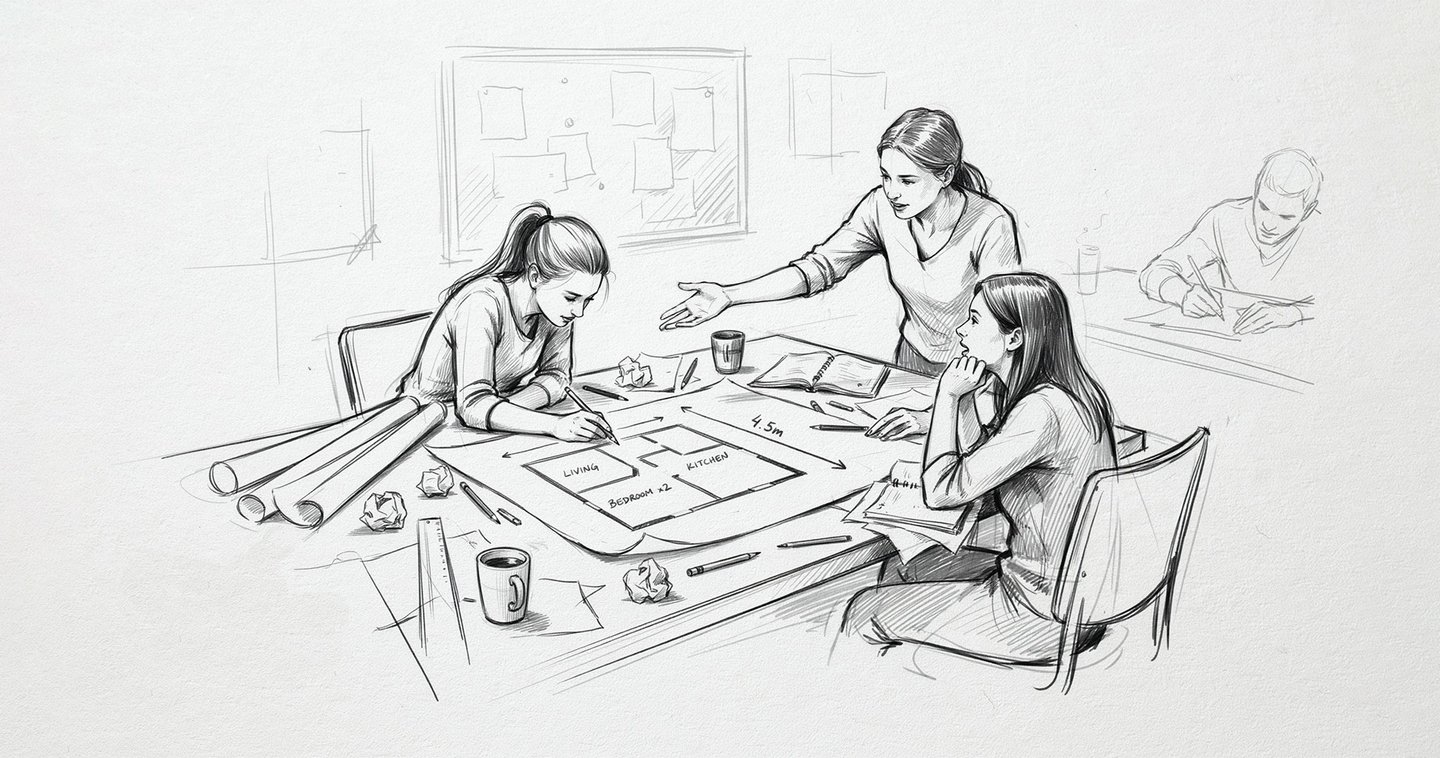
The visuals of competitors are glossy and polished. For contrast, we can utilize visuals of the „process”—sketches, rough drafts, program screenshots, and workspaces—as this is closer to professional reality and communicates that we are talking not just about the final result, but about the working process.
It is important to note that no one uses chat as part of their media. Comments exist, but genuine live discussion among subscribers is absent.
What we can borrow from competitors: From Design Mate: the structure of content sections and text quality. From Fragments: visual inspiration and conciseness. From the schools: systematic delivery of educational content. From YouTube bloggers: a personal tone and analysis of real-life case studies.
Distribution Channel
Telegram was chosen as the primary platform for «Designer’s Draft.» Primarily, Telegram is the environment where the project’s target audience already lives and actively interacts—namely, students, emerging designers, architects, and creative individuals who require vibrant communication and support. Furthermore, Telegram features a built-in chat, which allows the media to be conceived not as a one-way broadcast, but as an ongoing conversation. Equally important is that the barrier to entry on Telegram is minimal: there is no need to create a website, master complex layout, or understand SEO; one simply needs to start publishing content and engaging with the audience.Regarding supplementary distribution channels, these are viewed as additions to the primary platform. A VK community can serve as a secondary platform for community members. Pinterest can be utilized as a funnel, directing interested audiences to the main channel through visual references and curated selections.Thus, the media format is built around the «channel + chat» dynamic, where the channel handles articles, columns, and practical content, while the chat manages communication, questions, networking, and support. This specific environment—one that is desperately lacking for beginning designers—becomes the foundation of the project.
Target Audience Description
«Designer’s Draft» operates primarily in the B2C space, though certain segments exhibit B2B characteristics. Consequently, four distinct customer segments were identified.
Segment 1 (Design Students)
Anya, 20, is a second-year student in Environmental Design. She is working on her first projects but feels a gap between her university studies and real-world practice, and she is afraid of not finding a job after graduation. Her goal is to understand how the profession works so that she doesn’t look foolish during an internship. For this reason, she is looking for program reviews, project examples, and portfolio advice. She will join a future media group because glossy channels scare her, whereas a chat with «her peers» feels comfortable and useful.
Segment 2 (Beginner Designers)
Dima, 26, works in a studio or as a freelancer. He’s already taking on projects, but he’s drowning in chaos: clients keep changing the brief, budgets are drifting, and deadlines are constantly missed. His goal is to structure his workflow so he doesn’t have to redo everything three times. He’s looking for contract templates, checklists, and conflict resolution guides. He’s here for practical application and the chance to ask, «How do you guys do it?»
Segment 3 (Experienced Designers and Leaders)
Lena, 34, manages a studio or department, is looking for employees, wants to share her experience, and is tired of information overload. Her goal is to find people who genuinely think, rather than just draw. She seeks access to a beginner’s class and a platform for expertise.
Segment 4 (Adjacencies and Clients)
Oleg, 40 years old, either a business owner or a homeowner undergoing renovations, doesn’t understand how a designer works and is afraid of overpaying. His goal is to understand what he is paying for. He seeks transparency in the process and will come to understand the design workflow.
All four segments share a need for an environment where they can learn and connect without pretension. Students and beginners form the core, seasoned professionals add expertise, and adjacent fields expand the boundaries. This very combination is what makes «Designer’s Draft» a cohesive creative community.
UVP (Unique Value Proposition)
Based on a thorough competitor analysis, three unique selling propositions were formulated—each immediately apparent and clearly delineating how «Designer’s Draft» differs from its direct competitors.