As part of this project, I investigated the Braun SK4 turntable (Phonosuper SK4, 1956)—examining its history, the principles of its form-making, and its design language. I chose it because it is an object at the point where technology stopped masquerading as furniture. The radio is recognizable by its white casing, wooden sides, and transparent lid—which earned it the nickname «Snow White’s Coffin.» Based on my analysis, I created a 3D model of the device and a final visualization.
About the Structure
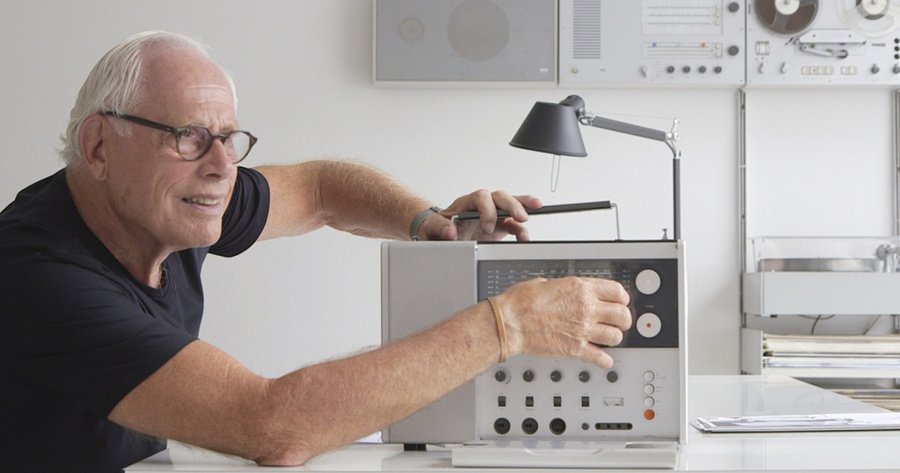
SK 4 — tabletop radio: a tube radio receiver, record player, and speaker housed in a single unit. It was produced by the German company Braun, with the casing designed by Hans Gugelot of the Ulm School of Design, and the transparent lid is generally attributed to Dieter Rams.
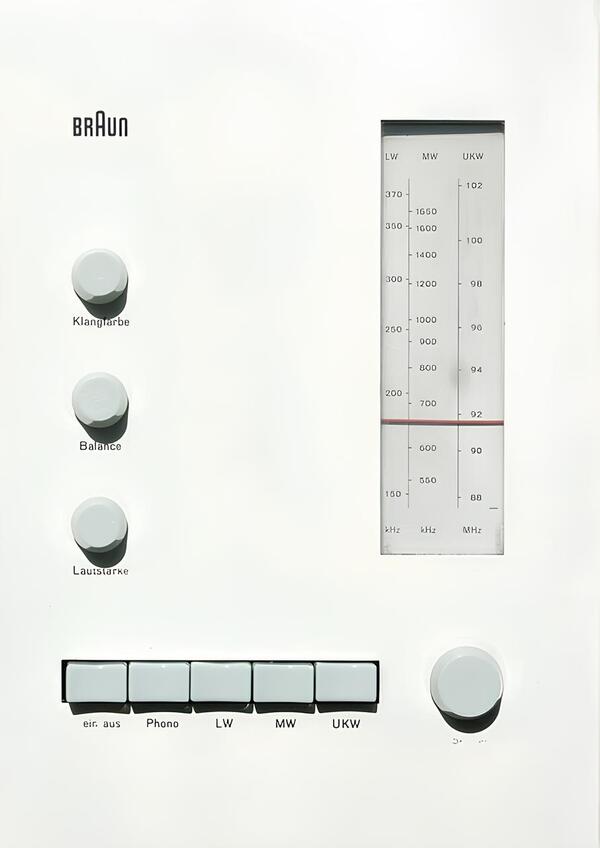
The original design was inspired by 1950s radio cabinets, featuring the same components: a receiver, a record player, and a speaker all together. The SK 4 retains this set of functions but completely redesigns the casing—replacing the floor-standing cabinet with a flat unit that can be placed on a table or dresser. The chassis houses a tube receiver, the tape transport mechanism of the record player, the speaker, and the transformer. All controls are moved to the top panel: the turntable and tonearm are on the left, and on the right are three knobs, five keys, and a tuning scale.
Historical Context
Until the mid-1950s, household audio equipment was designed to resemble furniture—featuring polished veneer, turned legs, fabric on the speaker cones, and cabinet doors. These devices were often hidden because technology was considered out of place in a living space.
In 1951, following the death of Max Braun, his sons Arthur and Erwin took over the company and began to revise the entire look of their products. Starting in 1955, the Ulm School of Design became involved, and Dieter Rams joined the firm. The SK 4 became the first item to fully showcase this new approach.
After the SK 4, a transparent dust cover became standard for record players, and the white body with gray controls established the recognizable Braun language for decades to come.
Original Device
SK4 doesn’t invent a new type of device; it strips away everything that made the conventional radio a piece of furniture. The main innovation is the transparent acrylic cover: it protects the turntable from dust but doesn’t hide the mechanics. For the first time, the object shows how it works.It solves the problem of excessive bulk. The radio is no longer a piece of furniture but an appliance that can be placed on any surface and moved.What sets it apart from competitors is the honesty of its materials: white painted steel sheet, wooden sides, and acrylic without imitations. The wood isn’t painted to look like metal, and the metal isn’t hidden under veneer.Its strength is its clarity. All controls are on top and divided into two zones: the mechanics on the left, the electronics on the right. The knobs are on a single vertical axis, the keys are in a row, and the scale is featured on a separate strip—labels are minimalist.Its weaknesses are the monophonic sound from a single speaker, the acrylic, which scratches over time, and the lamp heating, which required the back panel to be perforated.
Archetype and Construction Analysis
The form is based on a shell, not a box. The body is made of steel sheet bent into a P-shape radius, so the object has no sharp edges on the front or back. Two wooden side panels function as end caps and hold the entire volume.
The entire object is composed of two families of forms. Rectangular forms include the lid, top panel, sides, chassis, keys, and scale. Rotational forms include the disc, knobs, and tonearm pivot. The geometry of the detail is guided by action—what rotates is round; what is pressed or moved is rectangular.
The proportions are simple: the facade is approximately 2.4:1, the plan is exactly 2:1, and the side is nearly square. The grilles function as rhythm rather than decoration: horizontal slots on the front allow sound through, while even perforation on the back dissipates lamp heat.
Visualization
The model is assembled in Blender: the chassis has cut slots, the top panel features a recess for the disc, the mechanics include a tonearm and the turntable, and the cover is made of acrylic with wooden edges and hinges.