BIRKA
Медиа о винтаже и осознанном стиле
01 // Media Concept
Birka
— A city media platform focused on vintage clothing, secondhand shops, and discovering items with personality. We help you find interesting pieces, discover local boutiques, and build your own style without chasing fleeting trends.
Main Content Formats: store cards, city collections, educational carousels, find reports, vintage item stories, and posts based on subscriber requests and user recommendations.Main Platforms: Telegram—for timely posts, recommendations, audience engagement, and feedback collection; visual social networks—for carousels, discovery photos, and trend collections.
02 // Data Sources for Media
Source Handling Principle Automated services assist in gathering, sorting, and updating data, but information is only published after editorial review. This is particularly true for pricing, item availability, the authenticity of vintage pieces, and user reviews.
For Birka, information is drawn from both external sources and data that the editorial team collects independently. These can be divided into five main groups.
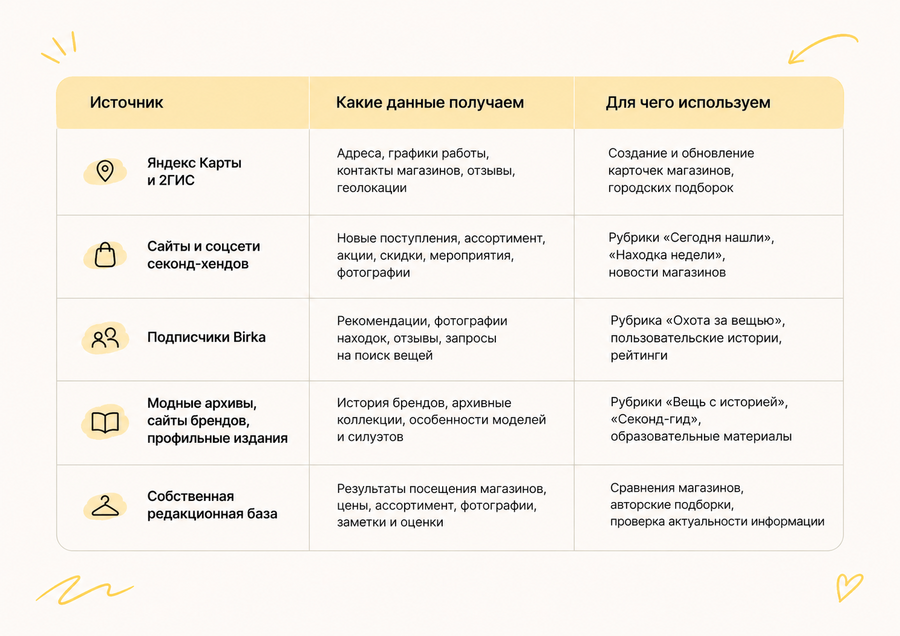
Additional Resources To analyze audience interests, you can use statistics from the Telegram channel, reactions, comments, and survey results. This data helps determine which clothing categories are most in demand, which publications generate interest, and in which neighborhoods readers want to see more recommendations.
03 // Data schema separated into human and machine processing
At the core of Birka’s work is a unified database encompassing stores, items, user requests, and editorial content.
Each store profile can include the name, address, geolocation, store format, price segment, primary clothing categories, discount information, the date of the last review, and a source link.
Example Workflow Diagram
Suppose an editor is preparing a publication for the «Three Places for One Thing» section—a roundup of stores where vintage jeans can be found.
- The automated service selects stores in Moscow from the database categorized as «jeans.»
- The system groups stores by price segment, district, and inventory.
- The editor verifies the relevance of the information, confirms the availability of the desired item category, and selects three stores.
- AI helps prepare the publication structure and short descriptions based on the verified data.
- The editor tailors the text to the Birka style, selects photographs, and publishes the material.
- After publication, subscriber reactions and recommendations are collected for future roundups.
This approach reduces the time spent on routine information processing while preserving the media’s editorial voice.
04 // Guidelines for Automated Services in the Schema
To work with Birka, it is proposed to utilize several automated tools. Each service has specific tasks and limitations.
4.1. Data Collection and Update Service
Tools: Google Sheets, Make (or a similar automation tool), official APIs if access is available.
Objective: Maintain an up-to-date database of stores and findings.
Working Guidelines: — Collect only open data from authorized sources, adhering to their terms of use. — Preserve the store name, address, operating hours, links, categories, and pricing information. — For every entry, cite the source and the date of the last update. — Review changes in the available data weekly, and time-sensitive information before publishing. — Do not automatically delete old information; instead, flag it for review. — If conflicts arise between sources, submit the entry to the editor. — Do not publish information regarding the availability of a specific item without recent confirmation.Outcome: A structured and regularly updated database of Birka stores.
4.2. AI Service for Information Classification and Search
Tools: ChatGPT or another language model.
Task: Analyze information and assist the editorial team in quickly finding relevant stores and items.
Workflow Guidelines: — Sort stores by categories: second-hand, vintage shop, consignment store. — Assign tags: «jeans, ” „leather jackets, ” „bags, ” „men’s clothing, ” „luxury, ” „budget segment, ” and others. — When selecting stores, take into account the user’s request, city, item category, and budget. — Use only information from the provided and verified database. — Do not invent stores, addresses, prices, discounts, or item availability. — If information is insufficient, note this and suggest the editor clarify the data. — Do not draw conclusions about the authenticity of a branded item based solely on a photograph.Outcome: Ready-made sets of records and recommendations for further editorial work.
4.3. AI Service for Content Generation
Tools: ChatGPT
Objective: To assist the editorial team in creating copy for Telegram posts, carousels, and city guides.
Editorial Guidelines: — Write in simple, friendly, and accessible language. — Avoid overly promotional phrasing. — Maintain the Birka style: an interest in individuality, the history of objects, and conscious consumption. — Emphasize practical utility: where to look, what to pay attention to, and what the item might cost. — Do not fabricate facts, brand histories, or specific item characteristics. — Do not label an item as rare, archival, or original without confirmation. — Do not present an estimated price range as a guaranteed price. — Do not publish fully AI-generated text without editorial review.Outcome: A text draft ready for editing.
4.4. Audience Analysis Service
Tools: Telegram analytics, Google Sheets, data analysis tools.
Objective: To understand audience interests and adjust the content plan.
Operational Guidelines: — Analyze views, reactions, shares, and comments. — Group subscriber requests by clothing category. — Identify the most in-demand features and topics. — Compare publication results across different periods. — Prepare a monthly report for the editorial team. — Do not collect personal user data unless necessary and with a proper basis. — Do not use automated analysis to publish subscribers' personal information.Outcome: Data for planning new content and refining editorial sections.
4.5. Automated Publishing Service
Tools: Telegram Bot API, scheduled posting services.
Objective: To publish finalized materials according to the editorial schedule.
Submission Guidelines: — Publish only materials approved by the editor. — Adhere to the publication schedule and order. — Verify the presence of text, images, and necessary links. — Do not publish unfinished drafts. — Notify the editor of any technical errors. — Do not alter approved text without prior consent.Outcome: Consistent publication of materials without the need to manually upload every post.
05 // Final Media Work Model
In Birka, automation is not used to completely replace editorial work, but rather to reduce the time spent on repetitive tasks: searching, updating, sorting, and initial information processing.
The Machine is responsible for structuring data, matching, drafting, analytics, and the technical publication of approved materials.The Human is responsible for veracity, evaluating items and shops, authorial voice, topic selection, engagement with publication subjects, and final editorial decisions.The project’s core principle: to automate routine tasks while preserving the human perspective on fashion and urban culture.
The result is media that merges structured data with vibrant editorial content, helping readers navigate the world of vintage and discover pieces with character.