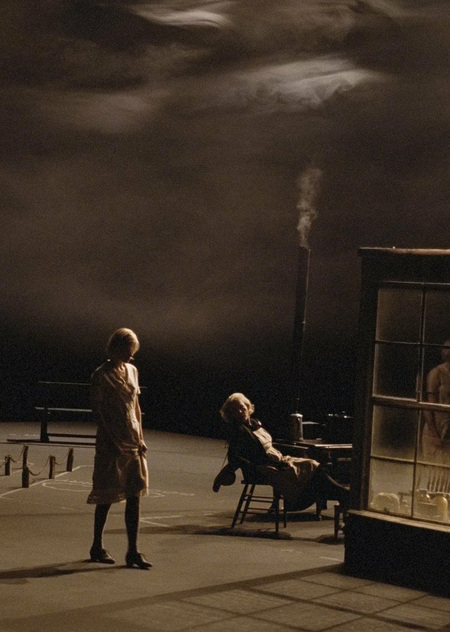
In this study, we will discuss a film that has garnered extensive analytical and thematic critique—a subject of love, controversy, and agreement. It is a unique project that employs virtually no set dressing to tell its story, with all action confined to a single, expansive stage. We are examining one of Lars von Trier’s most renowned works: «Dogville.»
Upon first viewing, the film left me with mixed impressions, yet it resonated with its atypical narrative style, which relies on minimal visual elements. This technique initially creates a divergence between what is presented and what is seen on screen, allowing the viewer to immerse themselves in the story in a rather «extreme» manner, though not completely.
In many ways, the film’s philosophy is built upon Bertolt Brecht’s theatrical concept of «alienation"—the distancing of both the actor and the spectator from the portrayed role.
In other words, this creates a distance between the viewer and what is happening on stage—a reminder that they are watching a play or a film, not real life. The absence of set design and other elements does not create an illusion of reality; rather, it supports the narrative of the story on an unadorned stage. Furthermore, other narrative tools, such as voiceover, sound design, and handheld camerawork, also remind the viewer that they are watching a work of art (or, according to the «Dogme 95,» not art). It creates the impression that by «cutting out» one mode of communication, the director deliberately emphasizes other, less visible ways to connect with the audience.
Voiceover is a vital element in film: it serves as commentary on what is happening on screen and provides the viewer with additional information about the characters and events. The voice is also used to build atmosphere and heighten the audience’s emotional response. For example, in certain scenes, the voice might be tense and threatening, inducing a sense of anxiety and increasing interest in the proceedings.
The camera operator’s work also consistently impacts the creation of the correct atmosphere between actors; for example, the camera might gently shake while tracking the characters, much like documentary filmmaking—which is interesting: imbuing life into something that is forbidden to emulate life itself.
Through the study of this topic, one can thoughtfully consider different ways of storytelling and how to make those narratives more effective. Is it possible to tell a complex, multi-structured story while disregarding visual cues and basic narrative tools? Is it possible to tell a story relying solely on something that is independent of the director, yet assists him in every way—the viewer’s imagination?
About the DirectorLars von Trier is a Danish director, screenwriter, and producer known for his provocative and experimental films.
Born in 1956, he began his film career at age 28 with the film «The Criminal Element». His most famous film, however, is considered «Dancer in the Dark» (2000), for which he won the Palme d’Or at the Cannes Film Festival.
Another seminal film by Lars von Trier is «The Idiots» (1998), which tells the story of a group of people who pretend to be mentally disabled in the name of conquering society and its norms. This film sparked considerable criticism for its radicalism but also cemented Lars’s status as a highly controversial and polarizing director.
Lars von Trier on the set of «Dogville»
«Dogme 95»Their experimental approach to cinematography and screenwriting led to the creation of an entirely new cinematic movement—"Dogme 95,» founded in 1995 by Lars von Trier and Thomas Vinterberg.
They established a list of mandatory rules for filmmaking; here are some of them:
1. Shooting must take place on location. Props and set dressing are not required;
2. Sound must never be created separately from the image, or vice versa (music should not be used unless it occurs during the scene’s shooting);
3. The camera must be handheld. Any movement or stillness achievable by hand is permitted;
4. The film must be in color. Special lighting is prohibited;
5. Optical effects and filters are forbidden;
6. The film must not contain superficial action (violence, weapons, etc., are prohibited).
and others.
The movement’s goal was to return cinema to its roots: simplicity and sincerity—to cut out anything unnecessary that might distract the viewer from the plot.
«Dogme 95» gained considerable popularity within the cinematic community and inspired many directors to experiment with the form and content of their films.
However, the film we will examine today follows these rules somewhat erratically and indirectly, although it visually supports the asceticism and restraint of the concept.
Of course, we are talking about «Dogville, ” a 2003 film shot in 4:3 format, with natural light, and without the use of artificial sets—a feature that defines the entire unrealized „USA: Land of Opportunity“ trilogy.
The Plot of DogvilleThe film begins with Grace Mulligan, the runaway daughter of a cartel boss.
In her search for refuge, she hides in the unknown city of Dogville, where she finds support from a young man who happens to pass by—Tom.
Tom suggests that she stay in the city and call all the residents to an urgent meeting. As a result of this, Grace realizes the necessity of earning the people’s goodwill so that her location will not be discovered.
She works tirelessly, helping every resident, which resonates with them. They agree not to betray her and even give her a small stipend—enough to buy the porcelain figurines she likes from one of the shops.
Grace’s assistance significantly changes people’s perception of her; one can sense the gradual and confident establishment of the young woman’s personal boundaries.
The climax of the events occurs when one of the townspeople, the gardener Chuck, rapes Grace, and she not only fails to resist but also does not prevent it, in deference to her piety.
Lars von Trier, Dogville, 2003 — Film Still
Following the events, Tom, who desires to be Grace’s companion, falls into helplessness and despair.
It seems as if he thinks more than he acts, which results in the cliché of victimizing a young woman—an event that has long ceased to be novel.
Tom himself refuses intimacy with Grace, explaining that this is not the proper place for their shared love.
They decide to let Grace escape the city, and they pay a representative from the «freight industry,» Ben, a total of ten dollars, five of which belonged to Tom’s father.
Ultimately, the girl fails to escape and is accused of stealing those five dollars; she is then shackled in a homemade restraint chain to limit her mobility, though this does not negate her daily labor for every resident of the city.
The film concludes with Tom committing a horrific act: he decides to hand the girl over to the cartel representatives. The townspeople also agree that the girl only brings trouble, and things have only gotten worse.
«Big Man,» who is the head of the cartel, is the girl’s father. After a final conversation about arrogance and kindness, the girl realizes how much the city has changed and orders it to be burned, and its inhabitants to be shot.
Key Locations in the Film and Their Set DesignsThanks to certain shots, we can see how this small town is laid out.
It contains everything necessary—from currant bushes blossoming in the spring to the central tower with a bell that chimes every hour.
Yet, it is interesting to figure out which facade elements the director chose to retain for identification.
Lars von Trier, Dogville, 2003 — Dogville (overhead view)
Church
This is where the townsfolk gather to discuss all the most important matters. The building is equipped with a large bell that Jeremy rings every time noon arrives.
Next to the tower is a local bulletin board, where a flyer with the word «missing» and the name Grace Mulligan has been posted.
Lars von Trier, Dogville, 2003 — View of the Church
Lars von Trier, Dogville, 2003 — Gathering of Residents
Ginger’s Shop
This small shop sells all sorts of things, including porcelain figurines that Grace really liked.
Its outline is marked by a large window frame that serves as the display window and is complemented by the characteristic sound of a little bell.
Lars von Trier, «Dogville,» 2003 — Ginger Shop
Lars von Trier, Dogville, 2003 — Ginger Shop
The Edissanov House
This is where one of the film’s main characters, Tom, and his father live.
The set features a writer’s desk and a pill organizer, necessary for the father’s struggle with his health anxieties.
We can also see a large safe in Young Tom’s room; later, it will play a key role in Grace’s escape from the city.
Lars von Trier, Dogville, 2003 — The Eddison House (overhead view)
Lars von Trier, «Dogville, ” 2003 — The Edissanov House
Chack and Vera’s House
Chack and Vera’s house is even more notable; its exterior suggests that Chack is an ordinary working man tending to his apple orchard on the edge of town, while the tall, multi-tiered bed reminds us of the children the family has.
The family hearth is guarded by a large, loud watchdog named Moses, positioned near the house entrance. This likely highlights the boisterous nature of its owners.
Moses has been given the honor not only of the apartments but of the entire town. By the sound of his barking, one can easily tell that something is wrong and unwanted guests have entered the city, just as happened with Grace at the beginning of the film.
In the main room stands a large slate board, which the children use to study spelling, Stoic philosophy, and the fundamentals of mathematics.
Lars von Trier, Dogville, 2003 — The House of Chuck and Vera
Lars von Trier, Dogville, 2003 — Moses' Booth
The Hansons' Haberdashery
This small shop sells household goods, including beautiful vintage tableware that has been artificially «aged.»
The Hanson family lives here: Bill, who aspires to be an engineer, and his parents, Mr. and Mrs. Hanson.
The setting highlights Mr. Hanson’s large lathe and Ben’s desk, where he constantly plays checkers amidst a pile of books.
Lars von Trier, Dogville, 2003 — Hansons Factory
Lars von Trier, «Dogville,» 2003 — Still from the film
Mackey’s House
No less interesting is the home of another Dogville resident—Mackey. This elderly man is blind, a fact he is afraid to admit to the other townspeople.
His house is virtually devoid of ornamentation, with the exception of large, heavy curtains that, he admitted in a conversation with Grace, «are not difficult to open for a reason.»
Additionally, his house naturally contains a comfortable sofa, which Mackey uses for almost all his free time.
Lars von Trier, Dogville, 2003 — The MacKay House
Lars von Trier, «Dogville,» 2003 — MacKay House