[ksenia torban] — multidisciplinary artist & visual researcher
Artist profile. Ksenia Torban (2004, Moscow).My artistic practice explores the coexistence of nature and technology, focusing on how living processes are recorded, modelled, transformed, and reimagined through human and technological intervention.Working across painting, speculative image-making, moving image, sound, ceramics, and systems of visual documentation, I investigate the relationships between organisms and their environments, the boundaries between natural and artificial systems, and the conditions that shape ecological coexistence.I explore how nature and technology participate in one another’s formation, creating new dependencies, structures, and possibilities for life.Education. DSHI № 11 | Fine Arts Program (2016–2021) HSE RL lyceum | design (2020–2022) HSE ART & DESIGN SCHOOL | illustration, design & contemporary art (2022–2027)
The presentation consists of two main blocks:
first, a solo exhibition proposal developed for a gallery context, followed by a curated selection of key works created throughout 2026; second, a broader overview of my artistic practice as a multidisciplinary artist and visual researcher, bringing together selected projects and research that reflect my conceptual interests, working methods, and exploration of different media.
MUSEUM OF NEW LOCAL FLORA
Proposed Solo Exhibition. [A speculative museum documenting the flora of an altered world]
Curatorial Statement. Museum of New Local Flora is an imagined local-history museum dedicated to the plant life of a world reshaped by a future ecological intervention. Its collection brings together speculative organisms whose morphologies reflect the consequences of human attempts to organise, restore, and sustain life. The project explores ecological coexistence of nature and technology through the creation of an alternative botanical collection. Each organism embodies a particular model of interaction between living systems, technological environments, and their surroundings. Their forms emerge from relationships of interdependence, selective permeability, resource exchange, disruption, and alternative modes of perception.
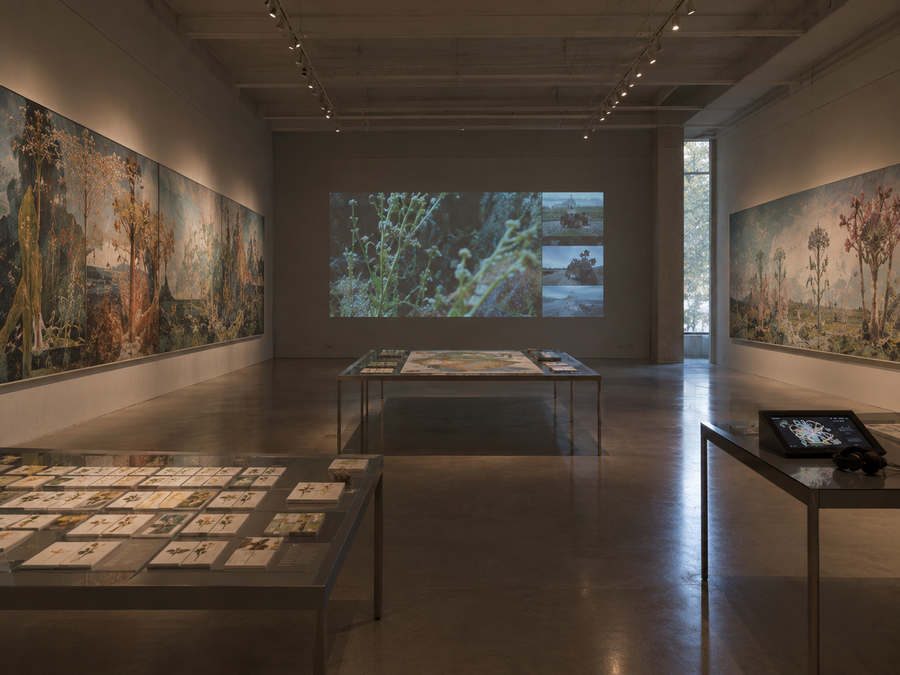
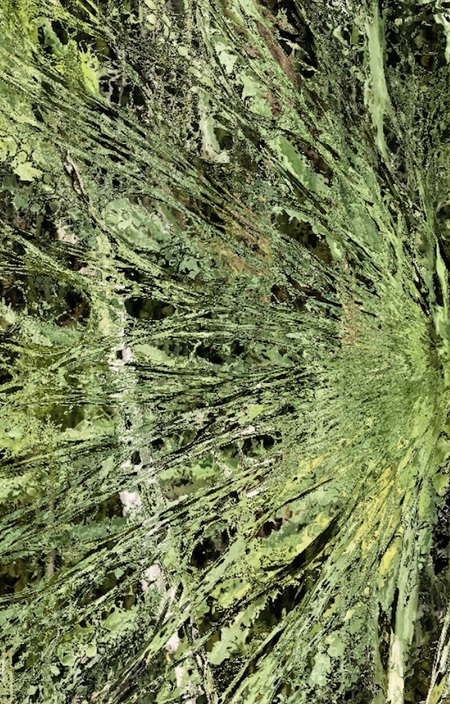
GENERATIVE VISUALISATION OF THE MUSEUM OF NEW LOCAL FLORA. Proposed Solo Exhibition.
All images and objects will be created in an intentionally absurdist and speculative manner, rather than following the naturalistic appearance of this reference image.
The conceptual foundation draws on ecological philosophies and interpretations of the work of Donna Haraway, Jane Bennett, Anna Tsing, and Maria Puig de la Bellacasa. Ideas of becoming-with, material agency, unstable ecological relationships, and ethics of care inform the development of the imagined flora. Rather than presenting an idealised vision of ecological restoration, the project examines its ambiguities. Attempts to protect, organise, and sustain life may simultaneously alter its conditions, redistribute resources, and produce unforeseen dependencies. The museum becomes a way to document and investigate these transformations, presenting speculative organisms as material expressions of different possibilities and limitations of ecological coexistence.
[conceptual] framework
Six principles of coexistence between nature and technology guide the development of the organisms and the exhibition’s visual language:
01. Boundary
The permeability between an organism and its environment. Boundaries are understood as active zones of exchange rather than fixed divisions.
02. Co-formation
The formation of organisms through interdependence. Their structures emerge through interactions between different components and environmental conditions.
03. Exchange
The movement and distribution of resources, energy, matter, and information. Different patterns of exchange produce particular morphological relationships.
04. Glitch
The consequences of disruption within an established system. Interrupted development, unexpected connections, and deviations become part of an organism’s morphology.
05. Translation
The transformation of ecological processes into images, models, signals, sounds, and material forms, with changes and losses occurring at every transition.
05. 06. Perception
The influence of different sensory capacities on the relationship between an organism and its environment. Alternative modes of sensing become conditions of growth and development.
Together, these principles form a framework for exploring how different models of coexistence can be expressed through speculative biological forms.
[exhibition] architecture
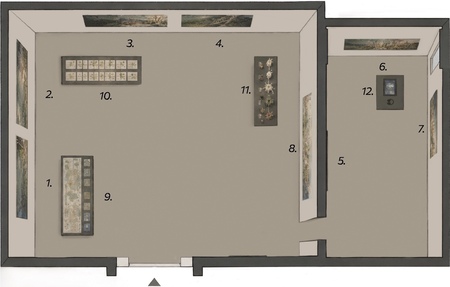
The exhibition recreates the organisational logic of a local-history museum. Its collection is structured through several interconnected forms of documentation, observation, and material representation. These elements form a unified archive of an imagined locality, in which visual, material, spatial, and sonic representations collectively construct the history of an altered environment. The proposed exhibition includes:
1–7. A series of seven paintings depicting speculative plant forms.
8. Generative video archives (projected field-video material).
9. A map of plant distribution & diagrams illustrating the plants' development cycles.
10. Catalogue cards documenting individual specimens.
11. Ceramic models of speculative organisms.
12. A sound collection based on the artist’s processing of bioelectrical signals from real plants.
Selected specimen sketches
[sound] installation
The sound component is based on the artist’s processing of bioelectrical signals from real plants. By introducing signals originating from living organisms into the museum’s collection, the project extends its documentary system beyond conventional visual representation. The sound collection establishes a connection between real biological processes and the speculative forms presented in the exhibition. Sound becomes another mode of approaching the living world, expanding the museum’s archive into an auditory register.
[project] identity
The project is conceived as an adaptable exhibition proposal. Its final arrangement, display structures, and technical requirements can be developed in dialogue with the architecture of the host gallery.
The design component extends the museum’s visual language beyond the exhibition space. It includes a proposed visual identity, posters and invitations, digital communication and social media materials, and printed promotional and informational objects. The visual system draws on the aesthetics of local-history museums, scientific documentation, botanical classification, and archival systems, creating a coherent identity for the project.
SELECTED WORKS