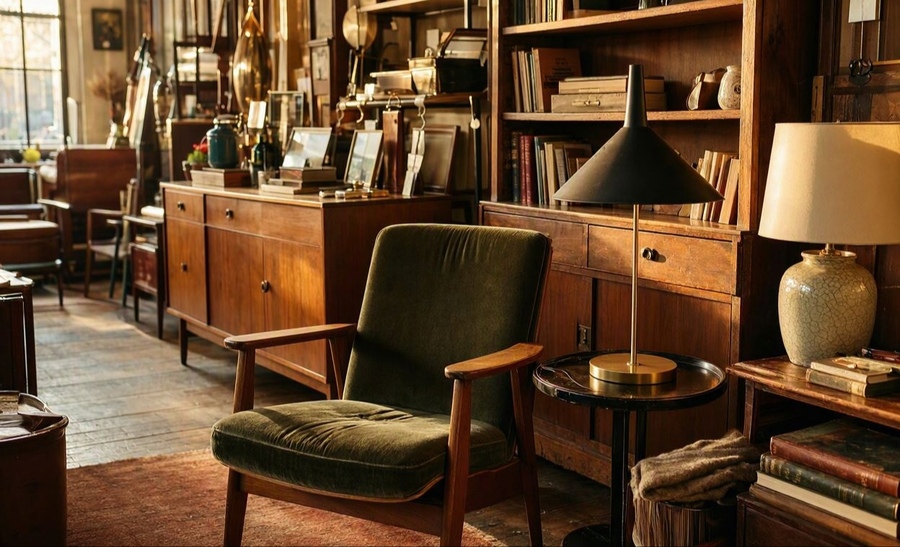
Artefact is a media platform focused on the value and culture of antique design, featuring a smart valuation tool. It is a digital catalog dedicated to the world of vintage designer furniture and interior objects. Here, we don’t sell—we tell stories, showcase pieces, and provide appraisals.
The Goal of Media
To make the antique design market transparent, accessible, and technologically advanced—freeing collectors from subjective valuations and risks, and rescuing unique pieces from oblivion. To create the premier media resource for design heritage, where catalogs with current pricing are updated in real-time, and a smart AI camera helps everyone determine the true value of their furniture—without experts, intermediaries, or cost. So that every owner of a vintage item knows its worth, and every connoisseur understands what they are paying for.
Themes
Segment
Design, interior, and collectible art.
- Antiques and vintage (furniture, lighting, decor).
- Interior design (professional and amateur).
- Art collecting and investment.
Niche Topic
Not «everything about antiques”—specifically:
· How much it costs—current market prices, auction results, and trends. · Why it costs so much—pricing factors: designer, era, rarity, condition, and provenance. · How to determine the value of your item—an AI camera as a tool for instant appraisal.
Focus Periods and Styles:
· Bauhaus and Functionalism (1920s–1930s). · Art Deco and Modernism (1920s–1940s). · Scandinavian Modern (1950s–1970s). · Italian Radical Design (1960s–1980s). · Postmodernism and Memphis (1980s).
Key Figures:
Le Corbusier, Mies van der Rohe, Alvar Aalto, Hans Wegner, Arne Jacobsen, Joe Colombo, Ettore Sottsass, Gaetano Pesce, Carlo Mollino.

Competitor Analysis
Direct Competitors: Data and Expertise.
• Artnet Price Database (Fine Art & Design) The largest database of auction results (over 4 million entries, data since 1985). It covers design and decorative arts, allowing searches by period, category, and designer. Analysis: Artefact’s advantage lies in its presentation format—“living» media (catalogs, analytics): engagement, interactivity, and an AI tool that makes «dry» data visual and immediate.
• WorthPoint The largest aggregator of prices for antiques and collectibles (around 1 billion results). It includes not only auction data but also data from online platforms, featuring visual search and a claims database (281,000+). Analysis: A direct competitor in terms of database scope. However, its positioning is more as a «research tool» rather than a media outlet. They do not focus on designer furniture with the same aesthetic emphasis as the School. Artefact offers users a «repackaging» of data into visually appealing content (catalogs, object stories).
Indirect Competitors: Quick Valuation.
• Furniture Identifier & Value and Antique Scan Applications with similar functionality: you take a picture of furniture—and you receive its style, era, material, and an estimated value (usually a range). They often utilize comparable sales data. They operate on a subscription basis (starting at $4.99/week). Analysis: Their weakness lies in a lack of depth and context. They provide a number, but they do not tell the story. «Artefact» provides not only a «price» but also context: why this item is worth so much, how it fits into the market, and how its value has changed.
• Antique Valuator «Cheaper than an appraiser. More honest than a dealer.» The focus is on speed and distrust of traditional players. Analysis: It directly addresses user pain points. However, such applications are often criticized for inaccuracy when dealing with rare items. «Artefact» is managed by experts who meticulously select materials and information, which is also validated by a tested AI assessment.
Distribution channel
Telegram Channel.
Post Formats: · Photo + number — minimalism. · Carousel cards — for catalogs and comparisons. · 15–30 second video — camera panning → evaluation result. AI demo in action. · PDF catalog — monthly, a downloadable file with a full selection and pricing.
Tone and Style: · Calm, expert, non-snobbish. · We don’t «sell,» we «show value.» · Language: «This chair is not just furniture. It’s Bauhaus from 1928. And here is what it costs today.»
Telegram Group
Role: A space for live conversation. Here, the audience feels like part of a connoisseur club rather than passive readers.
Format: An open group with rules and moderation.
Events: Story exchange, price comparison, community support, experience sharing, networking, polls, and debates.
Mechanics: «Rate My Item»: A user posts a photo, the community guesses the price, and then the AI camera provides the answer. «Guess the Price»: The admin posts an item without a price. The person closest to the correct amount earns a status in the group. «Found for Pennies»: A flash mob—show your best bargain found for minimal money. «Member Marketplace»: A dedicated thread for buying/trading among members. «Question to an Expert»: An invited appraiser answers questions once a week.
Target Audience
The «Artefact» audience consists of enthusiasts, designers, and owners of vintage items. We speak to them in the language of media, not databases.
«The Heir with the Attic»“I want to understand what is junk and what is treasure.».
A person, aged 35–55, has inherited an apartment or house furnished with belongings. They are not knowledgeable about antiques but suspect there are valuable items among the possessions.What they seek in media:
· Simple explanations: «Here is a chair, and here is why it is worth €2000.»
· An instant valuation tool (AI camera).
· Stories from similar people: «Found it in the attic—sold it for…»
«The Collector Hunter»“I need to understand the trends: what is rising, what is falling, what to buy right now.»
An individual aged 30–60 who is passionate about 20th-century design. They frequent flea markets and auctions, and monitor 1stDibs and eBay. They already have a collection but want to grow it.What they seek in media:
· Auction digests featuring real results.
· Analysis: «Scandinavian modern has grown by 15% in one year.»
· A community of like-minded individuals—for sharing experiences and discoveries.
«Interior Designer»“I need a source of inspiration and knowledge so that I can speak the same language as my clients”
A person aged 28–45 who works with private clients. They are looking for vintage accents for projects. They need items with history, but the budget is limited.What they are looking for in media:
· Price catalogs—to use as an argument for the client.
· Stories of objects—to sell not just an item, but a legend.
· An appraisal tool—for a quick on-site check.
«The Aesthetic Enthusiast»"I want to understand what is beautiful and why"
A person aged 25–45 who is interested in design but is not a collector. They follow ArchDaily and Dezeen and look at interior design. Vintage is part of their aesthetic.What they are looking for in media:
· Beautiful visuals—catalogs, photographs.
· Stories: «who designed this chair and why it changed design.»
· Light formats: «price of the day, ” polls, short posts.
Unique Selling Proposition
Artefact—the only medium that doesn’t just tell you about antique design but instantly names the price of any item. Point your camera—discover its value. Read the catalogs—understand why that is.
The main tool is the AI camera, «The Appraisal.» Point your smartphone camera at any piece of interior decor, and the neural network will instantly:
- Identify the style, era, and probable designer.
- Analyze the condition and rarity.
- Show the current market value with a link to similar lots in our catalog.
This is not an appraisal for sale, but a guide for the collector. You can find out the value of your item as easily as checking the weather.
Three Pillars of Our Unique Selling Proposition1. Instant Valuation via AI Camera
Auction databases are just archival searches. App-based estimators are content-free utilities. Artefact is a medium with tools built in.2. Timely Pricing as Content
We don’t just publish articles about design. We publish catalogs featuring real, updated pricing. Every post delivers not only aesthetics but also hard data. This makes the content valuable, not just beautiful.3. Context Over Raw Data
We provide history + figures + explanation. The user doesn’t just learn that a chair costs €2000. They understand why: the designer, the era, the rarity, the condition, the trend.
Artefact: Your Pocket Antiquarian