Concept
Investigating habitual actions through imagined spaces. Reading, resting, waiting, and other activities are recontextualized using a trained generative model in the aesthetic of architectural engraving.
Source Images
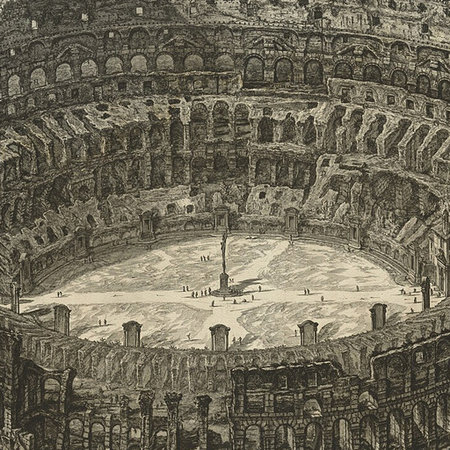
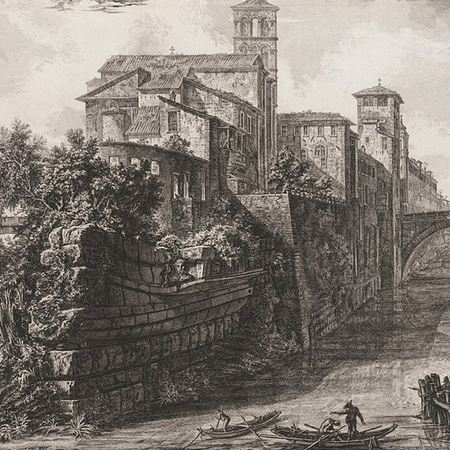
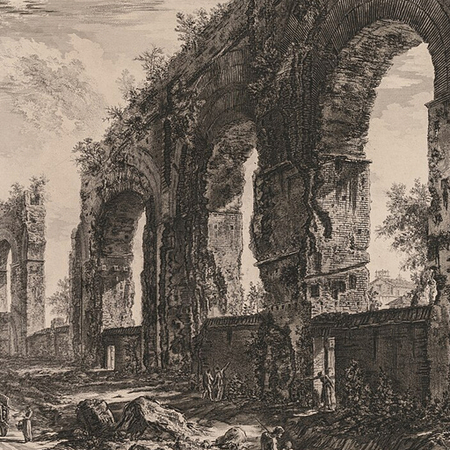
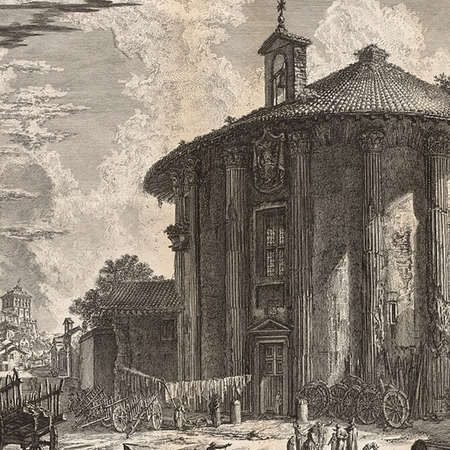
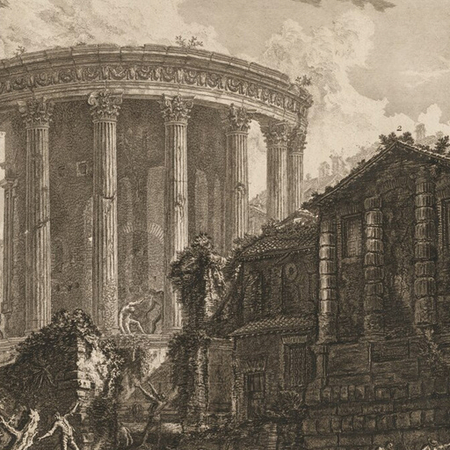
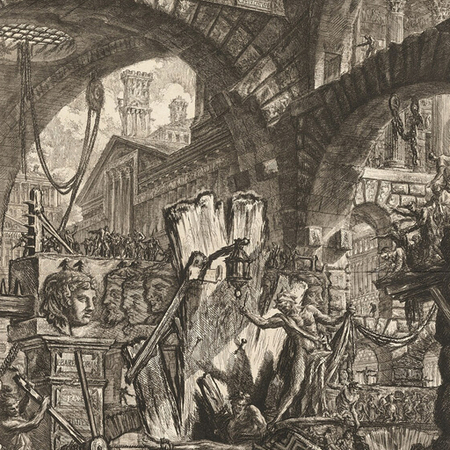
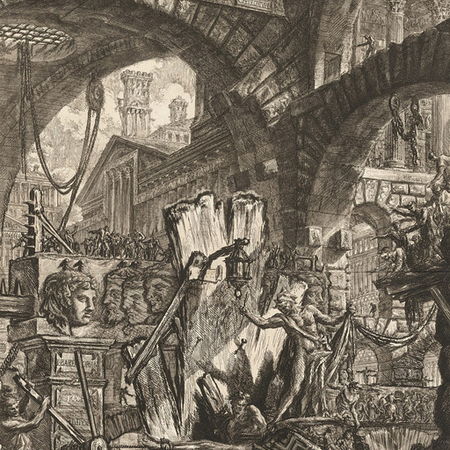
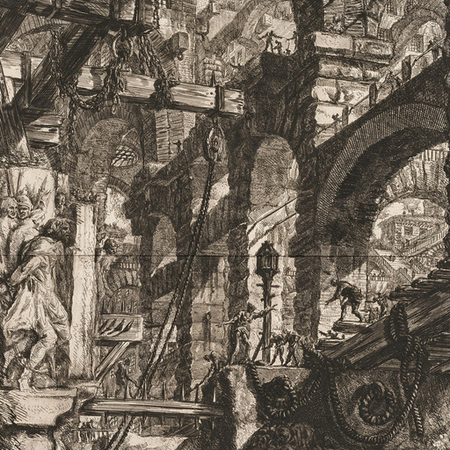
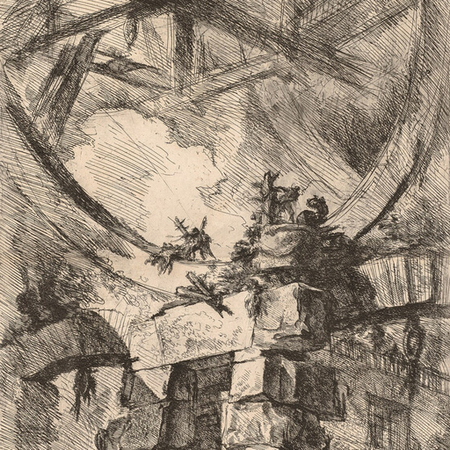
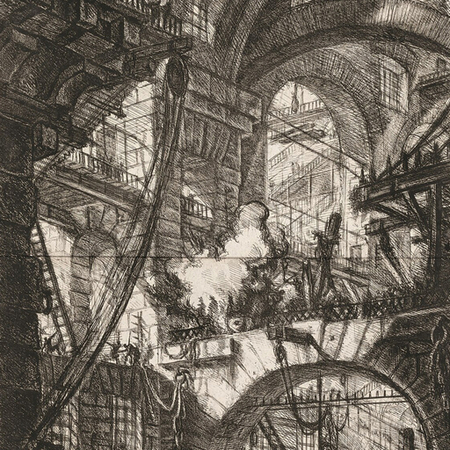
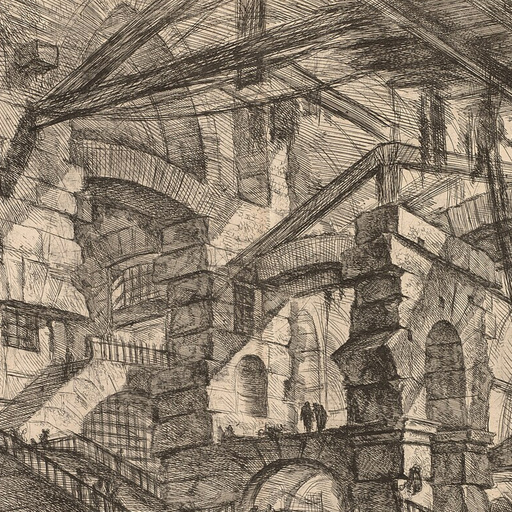
Sources and Usage Rights: Ten reproductions of engravings by Giovanni Battista Piranesi from the series «Views of Rome» and «Imaginary Prisons» were selected for educational purposes.
Images from the Cleveland Museum of Art collection were downloaded from Wikimedia Commons under the CC0 1.0 license. Attribution and links to the originals are provided in the dataset materials.
Resulting Image Series
Based on six thematic prompts, a series of images was generated:
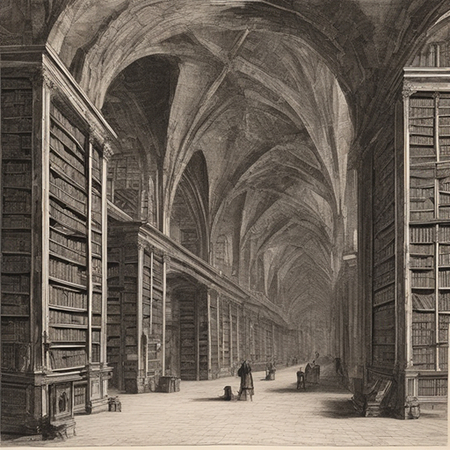
- «Between Pages”—A library with high shelving and vaulted ceilings stretching into the depth of the hall.
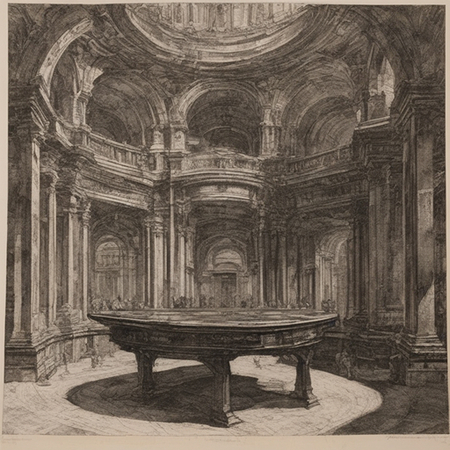
- „Time at the Table”—A round table in the center of a monumental interior featuring columns and arches.
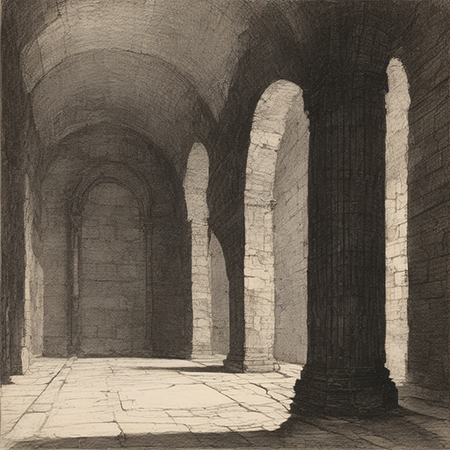
- „Quiet Hour”—An empty stone hall filled with sunlight and deep shadows.
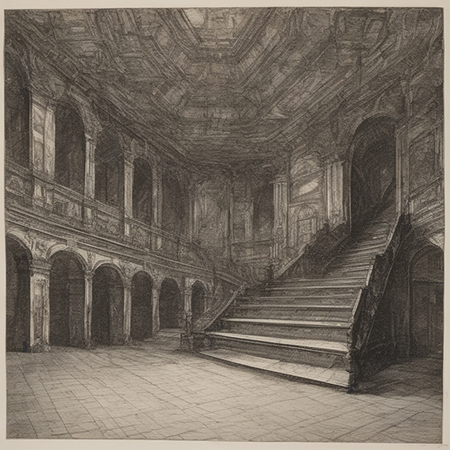
- „To the Next Step”—A staircase and galleries that transform the transition between floors into a space of waiting.
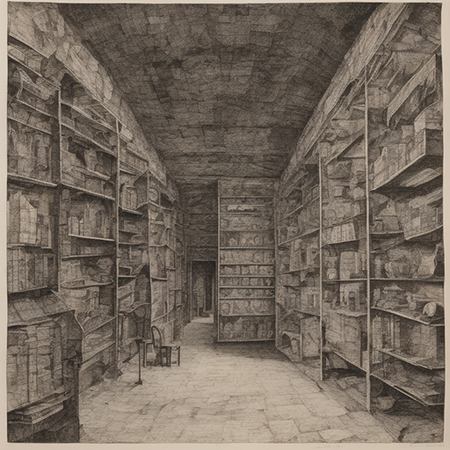
- „To Be Postponed”—A narrow passage between shelves filled with accumulated objects.
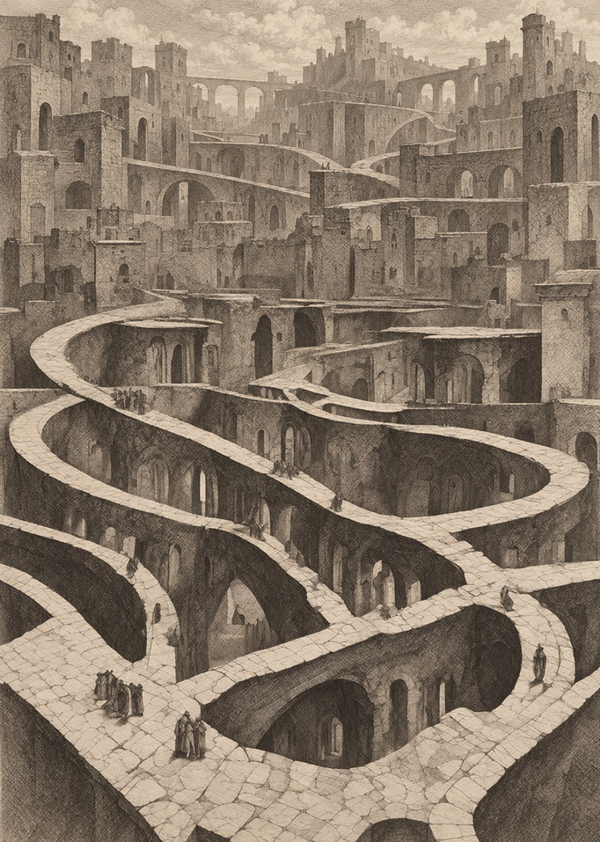
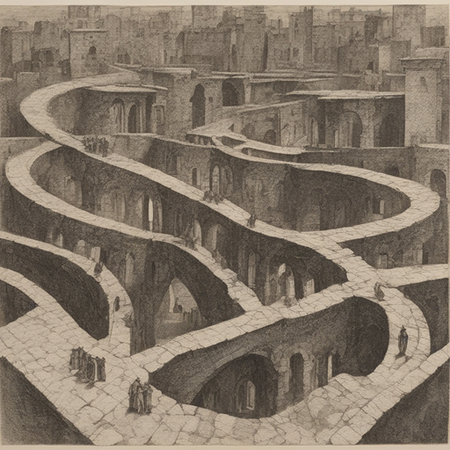
- „In Circles”—Intertwined passages above arches and courtyards, forming a complex route.
The series is unified by a muted color palette, dense cross-hatching, and the texture of architectural engraving.
Detailed commentary
The work explores how familiar human activities can form the basis of imagined spaces. The final series presents a library, a hall with a table, a quiet room with arched openings, a staircase hall, a storage room, and a pedestrian walkway system.
The initial concept is conveyed through architecture: reading is linked to the library, storage to the shelving, and strolling to the intersecting routes. Rest and waiting are expressed through emptiness and lighting. Since the cup, bed, and bench derived from the prompts did not receive a clear depiction, the emphasis shifted from everyday objects to the spaces of daily rituals.
Transferred stylistic characteristics:The series exhibits characteristic traits of architectural engraving: dense cross-hatching, fine detailing of surfaces, deep shadows, and a subdued gray-brown palette. Repeating arches, columns, and vaults create a complex perspective. Small human figures in isolated scenes emphasize the monumental scale of the structures.These features link the results to the training dataset—engravings by Giovanni Battista Piranesi. Nevertheless, the images represent new compositions, rather than a literal reproduction of the chosen source works.
Visual Analysis of the Series:1) «Between the Pages» — towering shelves and repeating arches draw the gaze deep into the library. Small figures of people underscore the hall’s height. The ritual of reading unfolds through the space of books and accumulated knowledge. The composition is characterized by strong perspective and a regular rhythm of vertical elements.2) «Time at the Table» — a large round table occupies the central position among columns and decorative arches. Its shape becomes the main compositional focus. The connection to tea time is maintained at the level of a meeting place, even though the act itself and the teaware are not clearly depicted. This scene is defined by its focus around a single object.3) «Quiet Hour» — a massive column, arched openings, and light patches on the floor form a tranquil composition. There are fewer object details here than in the library or archive. Rest is interpreted as an opportunity to pause within empty, quiet space. The image creates a visual pause within the series.4) «To the Next Step» — a staircase ascends along the right side of the hall toward a dimly lit upper level. Galleries and openings complicate the space. The theme of waiting arises from the position before the ascent: the direction of movement is visible, but its continuation is not fully revealed. The diagonal of the stairs lends the scene greater dynamism.5) «Postpone» — shelves filled with objects surround a narrow central passage. The density of the fill illustrates how the accumulation of things gradually defines the arrangement of the space. Compared to the library, the space appears tighter, and the objects less organized. This scene is most directly linked to the ritual of storage.6) «In Circles» — curved passages pass over arches and interior courtyards. The overhead view allows several directions of movement to be seen simultaneously. Small figures of people help gauge the scale. The walk is presented as an exploration of a complex route where the process of movement itself is important.
Technical Implementation
Training and Generation:Stable Diffusion XL 1.0 was trained using DreamBooth LoRA on 10 images of 512×512 over 100 steps. The overall caption included the designation RITUALINK and architectural engraving. Individual captions and BLIP were not used.Variations were created for each scene using LoRA strengths of 0.0, 0.7, and 1.0 while keeping the prompt and seed identical. Generation parameters: 768×768, 30 steps, guidance 6.0. The 0.7 variations were selected for the main series.
In the control images, even without the LoRA influence, architectural spaces and engraving characteristics set by the text prompts are already present. After connecting the adapter, a warmer tone, dense hatching, and heterogeneous texture become more noticeable. At a strength of 1.0, details merge more significantly with shadows in some scenes. Variations at 0.7 maintain clearer readability despite the pronounced graphic processing.
No additional retouching, neural network upscaling, or ControlNet were applied. The final image variations were saved immediately after generation.
Evaluation of the Result:
The series maintains a unified visual presentation, yet it varies in the arrangement of spaces: the depth of the library, the central composition of the hall with the table, the emptiness of the quiet room, the staircase’s diagonal, the cramped storage area, and the open view of the passageways.
The architectural atmosphere and graphic characteristics of the chosen direction are conveyed most convincingly. The connection to specific rituals within the space requires naming and explanation. Further work could enhance the presence of everyday objects and human actions while preserving the discovered style.
Description of Generative Model Application
— Stable Diffusion XL 1.0 was used for training via DreamBooth LoRA on architectural engravings and generating the final series.— ChatGPT / Codex was utilized for concept development, code preparation and prompt engineering, sourcing original materials, and writing project texts.DreamBooth LoRA is a model adaptation technique. BLIP and other generative image enhancement tools were not applied.