Dadaism emerged in 1916 amid the backdrop of World War I as a reaction to the crisis in European culture and traditional notions of art. Artists rejected academic rules, ideals of beauty, and rational logic, turning instead to chance, absurdity, and experimentation with everyday objects.
This timeline tracks the evolution of Dadaist artistic methods—from chance compositions and readymades to photomontage, assemblage, experimental typography, and camera-less photography. The featured works illustrate how artists progressively redefined the role of the author, artistic material, and the artwork itself.
I. Rejection of Artistic Rules. 1916–1919
In the early stages, Dadaists began to re-examine the very principles of creating a work of art. Instead of accurately reproducing reality or adhering to a meticulously planned composition, they turned to randomness, simple forms, and pre-existing imagery. Art gradually ceased to depend on the artist’s traditional mastery.
01. «Slacklining Acccompanies Itself with Its Shadows»: Chance as an Artistic Method
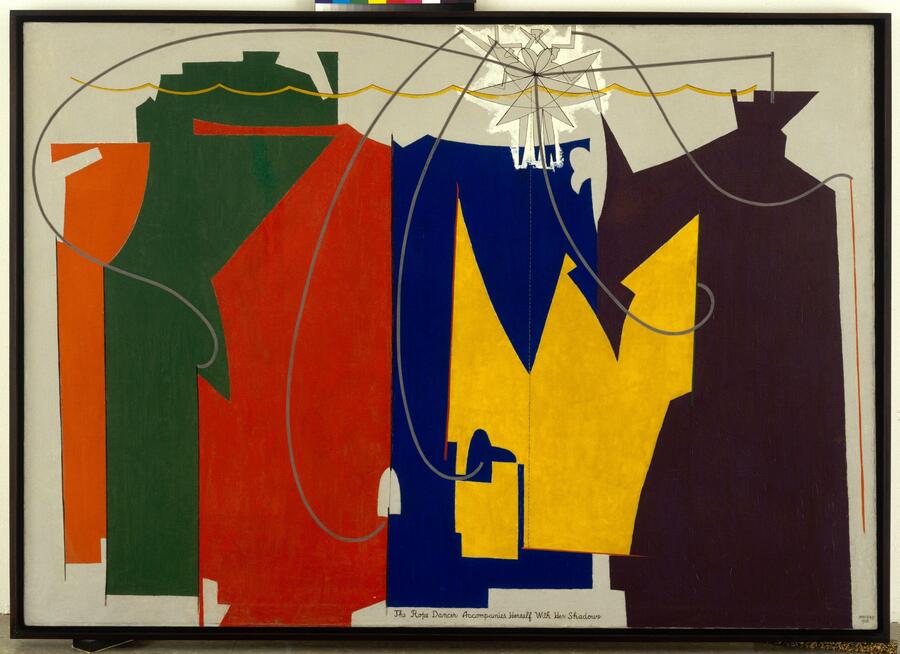
«The Tightrope Walker Accompanies Himself With His Shadows» Man Ray, 1916
Man Ray’s painting originated from the impression left by a tightrope walker’s performance he witnessed in a variety show. Initially, he attempted to convey her movement using figures cut from colored paper. However, the random arrangement of the remaining paper scraps proved more compelling than the intended composition and became the foundation for the final work.In the upper section of the painting, a small figure of the tightrope walker is rendered with delicate gray and white lines. Her legs and skirt are depicted in several positions simultaneously, as if the artist is trying to merge different moments of movement. Lines of the ropes radiate from the figure, dividing the space into large, colored sections. These lines resemble shadows that might have appeared during the performance.The composition is driven not by the figure’s contours, but by the interplay of color planes. These planes vary in size and shape, partially overlap one another, and create a sense of motion. Meanwhile, the tightrope walker figure almost dissolves against the background of large, abstract elements. The artist rejects the conventional method of depicting movement through successive poses and precise spatial rendering. Instead, he incorporates these serendipitously formed shapes into the artistic concept.
02. «Collage of Squares Arranged by Chance»: Deconstructing Traditional Composition
«Collage with Squares Arranged According to the Laws of Chance» Hans Arp, 1916–1917
Hans Arp’s collage is composed of irregular rectangular fragments of blue and white paper arranged on a monochrome surface. The work lacks a discernible subject, recognizable objects, or a central figure. The entire image is built upon the interplay of simple geometric forms. The fragments vary in size, orientation, and distance from one another. Some are positioned almost parallel, while others are noticeably offset or rotated. Because of this, the composition appears simultaneously random and quite balanced. Light and dark areas alternate, creating a calm visual rhythm without strict symmetry.
The artist experimented with the principle of random element placement, allowing them to form a composition without a pre-established order. However, the relative orderliness of the collage demonstrates that randomness does not necessarily exclude the author’s involvement. Unlike Man Ray’s paintings, where random shapes helped convey movement, here they become the main content of the work. Arp shows that an image can exist without a narrative and be constructed solely on the relationships between color, form, and negative space.
03. «Fountain»
«Fountain» Marcel Duchamp, 1917. Historical photograph by Alfred Stieglitz.
Marcel Duchamp’s «Fountain» is an ordinary industrial urinal, turned relative to its usual orientation and signed with the pseudonym R. Mutt. In 1917, the artist submitted it to the exhibition of the Society of Independent Artists in New York, but the work was rejected.
The object’s appearance remains virtually unchanged. Its smooth white surface, rounded edges, and symmetrical form preserve the characteristics of an industrial item. However, altering the item’s position strips it of its conventional function. It is no longer perceived as part of plumbing fixtures but becomes an independent object that the viewer must contemplate.
Of particular significance is the absence of traditional artistic treatment. Duchamp does not carve the form from stone, nor does he mold or embellish the surface. His primary act becomes the selection of an object and its relocation into an artistic space. This technique is called the readymade—transforming a ready-made item into a work of art through the artist’s decision. Duchamp questions the notion that art must necessarily be beautiful, unique, or handmade.
If Arp changed the process of composition itself, Duchamp takes the next step by rejecting the necessity of creating a new object. The focus shifts away from the work’s appearance to the question of why one object is deemed art and another is not.
04. «Dada Movement»: The Mechanization of Artistic Language
«Dada Movement» Francis Picabia, 1919
In Francis Picabia’s work, «Dada Movement,» he depicts the artistic movement in the form of an electrical schematic. Instead of conventional figures and artistic symbols, he employs lines, conventions, labels, and elements reminiscent of a technical drawing.
The composition is built upon a system of connections. Fine lines link individual notations and signs, forming a structure akin to an electrical mechanism. The white space of the sheet plays a significant role, allowing even small elements to remain clearly discernible. The image appears precise and logical, even though its subject matter relates to art rather than the actual function of a machine. Picabia uses the recognizable language of technical graphics to illustrate the connections between artists and artistic movements. The very idea of representing an artistic movement as an electrical circuit carries an element of irony: complex cultural relationships are transmuted into a conventional mechanical system.
The work demonstrates how Dadaists began incorporating visual forms borrowed from science and technology. The familiar technical sketch is transformed into an artistic statement, and its strictness contrasts with the absurd premise of the work.
05. «L.H.O.O.Q.»: A Parody of the Artistic Canon
«L.H.O.O.Q.» Marcel Duchamp, 1919
To create «L.H.O.O.Q., ” Marcel Duchamp used a printed reproduction of Leonardo da Vinci’s „Mona Lisa.“ The artist added a mustache and a small goatee to the depicted woman, and placed the letters L.H.O.O.Q. at the bottom—which, when pronounced in French, forms an obscene phrase.The core composition of the work remains almost unchanged. The woman’s pose, her facial expression, the position of her hands, and the landscape in the background are all preserved. Duchamp does not entirely destroy the original image; rather, he introduces several minor alterations. The drawn mustache and goatee conflict with the calm expression and the familiar image of the „Mona Lisa.“ A comedic effect arises, undermining the solemn reverence for the famous work.Unlike „Fountain, ” where an ordinary object was elevated to the status of art, here an already recognized masterpiece becomes material for a conceptual joke. Duchamp demonstrates that even the most famous works can acquire new meanings if the method of their presentation is altered.
II. Art from the Everyday. 1919–1921
In the works of this period, the use of real-world objects, newspaper clippings, advertising imagery, and various everyday materials becomes particularly noticeable. Artists cease to view traditional paint and canvas as the sole means of creating art. Simultaneously, collage and assemblage begin to be used not merely as formal experiments, but also as a means of social commentary.
06. «The Mechanical Head»: Human as Machine
«Mechanical Head» Raoul Hausmann, 1919
«The Mechanical Head» is a wooden mannequin head for wigs to which various objects are attached: measuring tapes, clock parts, printing press elements, and other small details.
The basis of the work resembles a human head but lacks individual features. The face appears static and almost vacant. Instead of expressing emotions, the artist uses mechanical elements placed in various areas of the surface. The measuring tape, clock parts, and protruding objects disrupt the smooth form of the wooden head, making it resemble an unusual apparatus.
The contrast between the simple, rounded form of the head and the multitude of small details is particularly noticeable. Some elements possess strict geometry, while others jut out, disrupting symmetry. Because of this, the sculpture appears simultaneously as a human image and as a collection of technical instruments. Hauser employs the technique of assemblage—creating an artwork from several ready-made objects. Unlike traditional sculpture, where form is created from a single material, here each element retains its original appearance.
Hauser’s work can be interpreted as a critique of a society in which humans increasingly depend on machines and rules. The artist substitutes the inner world of a person with external mechanisms, illustrating dehumanization.
07. «Rotation»: Transforming Waste into Artistic Material
«Rotation» Kurt Schwitters, 1919
Kurt Schwitters' work, «Rotation,» is a composition crafted from wood, metal, cardboard, fabric, wire, cord, and other found materials. These elements are affixed to a painted surface and protrude from it, transforming a flat image into a relief. The composition is built upon the intersection of straight and curved forms. Rings, arcs, and elongated details guide the viewer’s gaze in a circular path, creating an impression of continuous motion. This is further enhanced by the contrast between large, rounded shapes and small fragments distributed throughout the work.
The differentiation of textures plays a crucial role. Smooth metal sits alongside rough wood, and soft materials contrast with rigid components. Light reflects differently off the surfaces, meaning the work is perceived not just as an arrangement of forms, but as a collision of diverse materials. Schwitters utilizes discarded and damaged objects typically not associated with artistic creation. Real-world items replace the drawn elements of the composition.
Unlike Hausmann’s «Mechanical Head,» there is no recognizable human figure present here. The core content becomes the juxtaposition of the materials themselves. The artist demonstrates that even thrown-away objects can possess form, rhythm, and expressiveness.
08. «Sliced with a Kitchen Knife by Dada…»: Photomontage as a Political Statement
«Slashed with a kitchen knife by Dada…» Hannah Höch, 1919
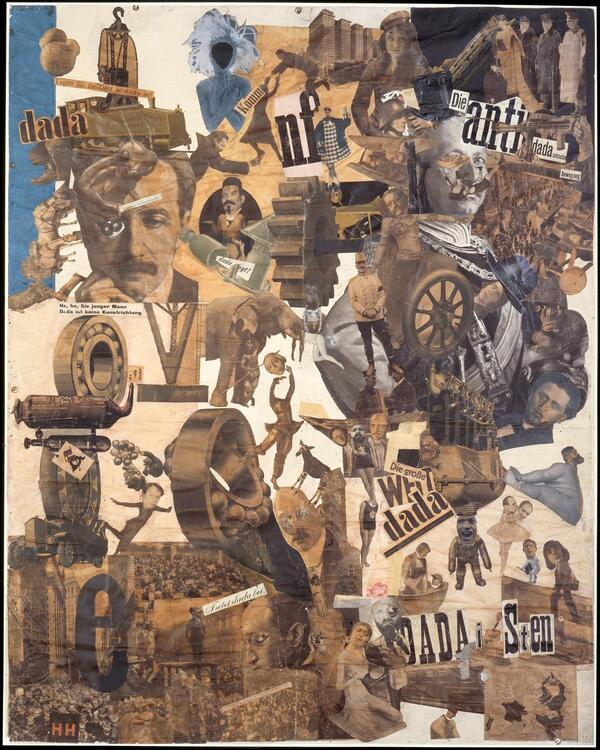
Hannah Höch’s work, «Cut with a Kitchen Knife Dada Through the Last Weimar Beer-Belly Cultural Epoch of Germany, ” is a large-scale photomontage composed of newspaper photographs, magazine clippings, captions, and mechanical elements.The composition is filled with numerous small details. Faces of politicians, dancers, machines, and fragments of human bodies are combined in unexpected juxtapositions. Some figures are notably enlarged, while others are reduced in size or partially obscured by neighboring images. These variations in scale disrupt the conventional perception of space. There are virtually no empty areas in the work. The images abut and overlap tightly, creating a sense of movement and disarray, yet within this chaos, several visual pathways emerge for the viewer’s eye.The mechanical details hold a special place. They merge with human figures, transforming politicians and public figures into strange hybrid forms. Through this method, Höch satirizes representatives of power and illustrates the instability of German society following the First World War. The work also includes images of women—dancers, athletes, and public figures—through whom the artist addresses the evolving role of women in society.Unlike the abstract collages of Arp, Höch’s photomontage consists of recognizable images. She utilizes photographs from the mass media to subvert their original meanings and forge a new political statement.
09. «The Hat Makes the Man»: The Absurdity of Everyday Imagery