Navigation
1. Concept 2. Ancient Greek Temple 3. Etruscan Temple 5. Roman Temple 6. Conclusion 7. Bibliography 8. Image Sources
Concept
Many people confuse Greek and Roman temples, and few know about Etruscan ones. In this work, I will illustrate how their architecture evolved. While Greek temples could be walked around, Roman temples were designed so that their primary view was exclusively from the front. This reflects the difference between two great eras. To conduct a visual analysis, I am using photographs of the Temple of Poseidon in Pesthum, the Maison Carrée in Nîmes, and a model of an Etruscan temple from the Villa Giulia Museum. To ensure a direct comparison of form, all images will be rendered in black and white. My work will be based on the studies of Musatov, Robertson, and Boethius.
The central question is: how and why did the temple transform from a volumetric sculpture into a facade on a podium?
My hypothesis is that the Etruscans developed a convenient scheme featuring a high base, and the Romans subsequently added Greek columns to it. The key difference lies in perception: the Greeks built for a circular viewing experience, while the Romans built to be viewed from the front, thereby showcasing the grandeur of the empire.
The objective of this study is to visually demonstrate the transformation of the ancient temple and to explore the reasons behind that change.
CLASSICAL ANCIENT GREEK TEMPLE
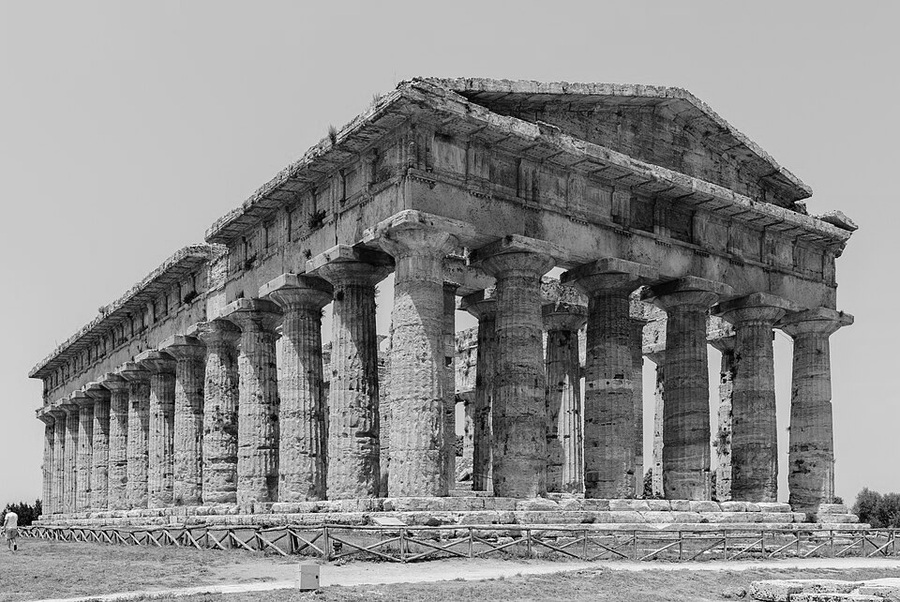
Temple of Poseidon (also known as Temple of Hera II) in Paestum, Italy. 5th century BCE.
Temple of Poseidon (also known as Hera II Temple) in Paestum, Italy. 5th century BCE https://it.wikipedia.org/wiki/File:Hera_temple_II_-Paestum-Poseidonia-July_13th_2013-_07.jpg?utm_medium=organic&utm_source=yandexsmartcamera