Angelic Wings in Pre-Renaissance and Early Renaissance Italian Painting
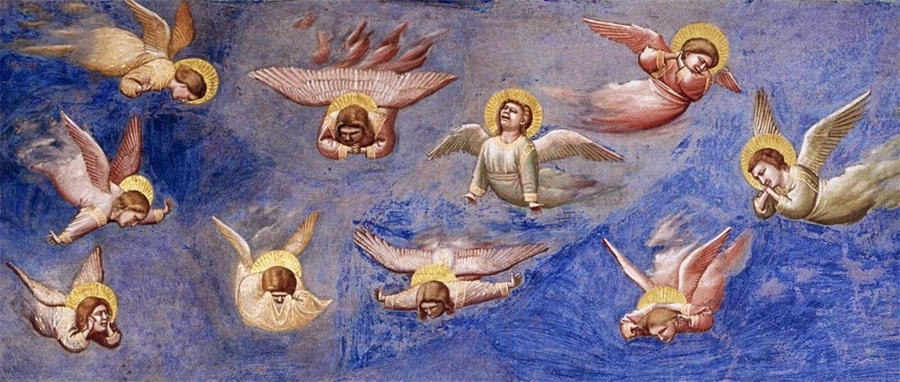
Fragment. Giotto di Bondone. Fresco in the Scrovegni Chapel, circa 1305.
Navigator
- Concept (including research question, hypothesis, material selection principle, and categorization)
- Introduction: Angels in 13th–15th Century Italian Religious Painting
- Image Technique and Artistic Approaches
- Ornamentality and Decorativeness of Angelic Wings
- Symbolism of Color
- Unconventional Solutions
- Conclusion
Concept
The center of this visual study is the depiction of angel wings in Italian painting from the 13th to the 15th centuries.
The image of the angel is one of the most crucial components of all Christian religious art. Their wings are one of the most striking and recognizable attributes by which we immediately understand that we are looking at a divine messenger.
Proto-Renaissance art (Trecento and Quattrocento) is characterized by a gradual move away from medieval models and the beginning of new ideals and artistic approaches for the coming era, which will be further developed during the Early Renaissance (Quattrocento). Interest in antiquity, the shift toward the Humanism of the Renaissance—with its focus on the individual and its pursuit of realism—gradually permeates, but does not yet prevail in art. Religious themes still hold a dominant position in painting. Angels remain an integral part of this art, most frequently appearing in scenes of the Annunciation, the Coronation of the Virgin, and depictions of the Madonna and Child.
Research Question
How did Proto-Renaissance and Early Renaissance artists depict angel wings—what artistic means did they use to convey their ethereal nature, and what symbolism did they associate with their color, form, and ornamentation?
Hypothesis
The depiction of angelic wings in Italian painting from the 13th to 15th centuries served not only as a means to denote a character’s affiliation with the celestial realm but also as a distinct expressive element. Despite the existence of specific iconographic traditions and symbolic meanings, the angelic plumage remained a space for individual artistic vision.
Material Selection and Categorization Principles
For this study, works of Italian painting from the 13th to 15th centuries were selected. These pieces allow for an examination of diverse artistic approaches, the expressiveness of the wing imagery, the variety in color and decorative solutions, and the tracing of stylistic changes throughout the period under review.
The structure of the research revolves around specific distinguishing features of angel wings that I found worthy of separate attention. First, we examine artistic techniques and decorative solutions, followed by the symbolism of color, and the final section presents the most unusual depictions of angels.
Giotto di Bondone. «The Burial of the Virgin» c. 1310.
Introduction
In Christian tradition, angels are envisioned as incorporeal spiritual beings who serve as messengers of God, possessing both intellect and free will. Their true nature does not involve a physical body; they lack physical elements such as bird-like wings. Nevertheless, angels can appear to humans in various forms so that the observer neither fears them nor fails to recognize them as a divine herald. The characteristics of these embodied forms symbolically reflect certain distinguishing traits of the angels. In this context, we will focus on wings, which are not meant as a literal anatomical feature but rather as a conventional visual attribute symbolizing the angels' capacity for instantaneous, lightning-fast travel from one point in creation to another. Throughout the Middle Ages and the early Renaissance, artists interpreted this attribute in diverse ways. The depiction of angelic wings by artists is heavily influenced by the era, the religious tradition, the rank of the messenger depicted, or the individual vision of the master. It is these specific aspects of the portrayal of angelic wings that will be the subject of my research.
Fragment. Annalo Gadde, «Madonna and Child on Throne, with Twelve Angels and Blessing Christ, ” c. 1387.
Imaging Techniques and Artistic Approaches
Excerpt. Tommaso Mazzaccio, «Expulsion from Paradise,» c. 1420s
Speaking about the technical characteristics of Pre-Renaissance and Early Renaissance paintings, it is worth noting that tempera was the leading medium in Italian easel painting of that era. Because it dried quickly, it was more challenging for artists to achieve smooth blending of tones. Volume and chiaroscuro transitions were created by sequentially layering thin coats of paint and using short brushstrokes, which made rendering depth and realism significantly more difficult. At the same time, the Gothic tradition instead demanded decorative quality, expressive lines, and meticulous attention to detail. Therefore, when examining the angel wings in the masters of the Quattrocento, we can be amazed by the delicacy of the plumage and the skill of the artists.
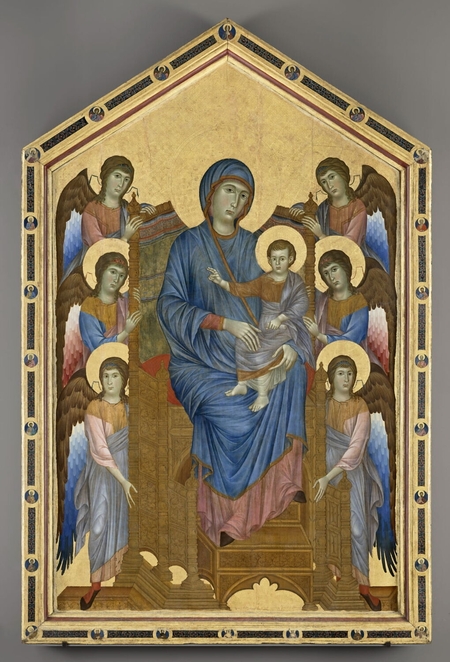
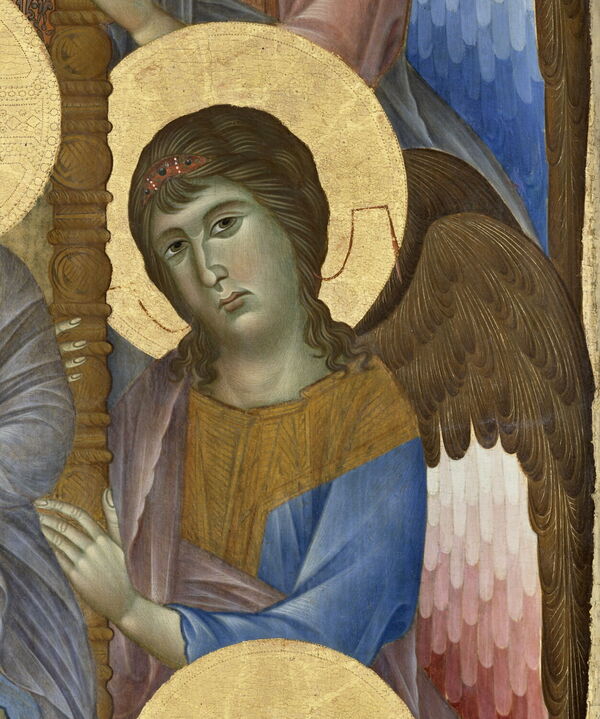
Chimaobue «Maesta» 1270–1300
During the Proto-Renaissance in Italy, two main painting schools existed: the Florentine (Cimabue, Giotto) and the Sienese (Simone Martini, Duccio).
Each school/city had its own stylistic characteristics.
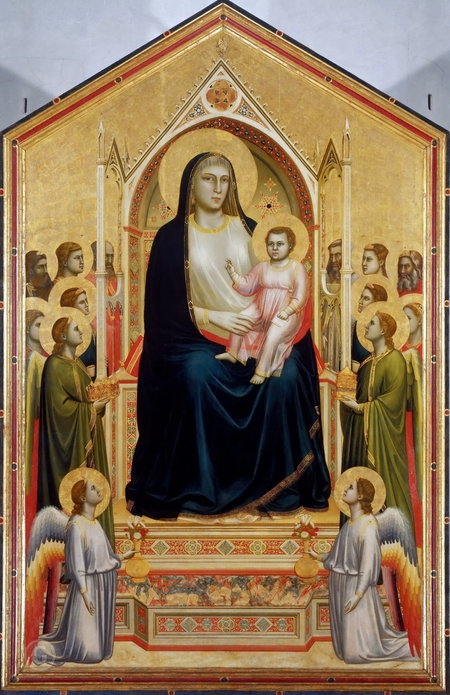
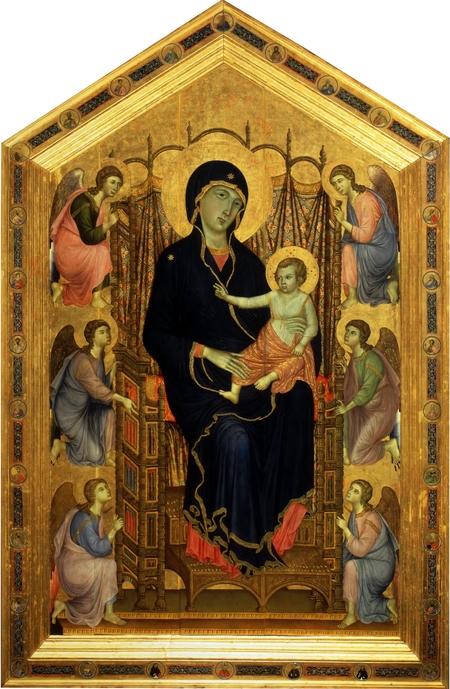
Left—Giotto «Maestro,» 1300s; Right—Duccio «Maestro,» 1270–1310s
When comparing works from the Florentine and Sienese schools, differences in the depiction of angelic wings become apparent. In Sienese painting, the influence of Byzantine tradition remains stronger, manifesting in the decorative and stylized representation. In the Florentine school, however, there is a gradual growing interest in plastic volume and a more naturalistic rendering of form.
Master from Chita-di-Castello — «Master with Madonna, Child, and Four Angels, ” circa 1290
Fragment of Giotto di Bondone’s «Polyptych, ” 1330s
However, it would be inaccurate to claim that some masters depicted wings in detail, meticulously rendering individual feathers, while others treated them merely symbolically. Much depended on the artistic intention of the creator, the overall composition, and the nature of the piece itself. For instance, in Giotto’s Polyptych from the 1330s, the angels' wings are rendered quite schematically, contrasting with his «Maestà,» created around 1300.
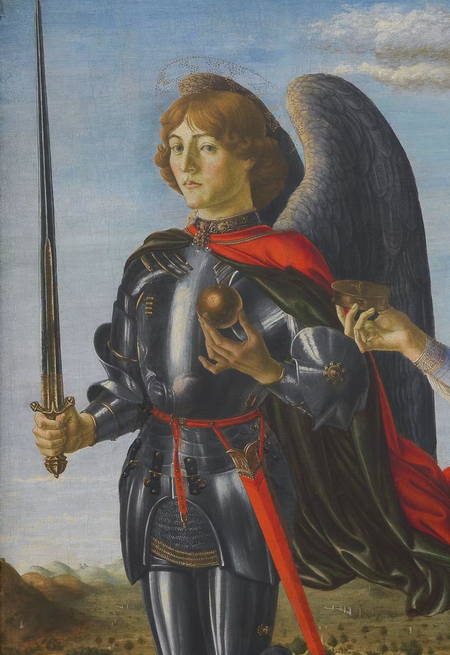
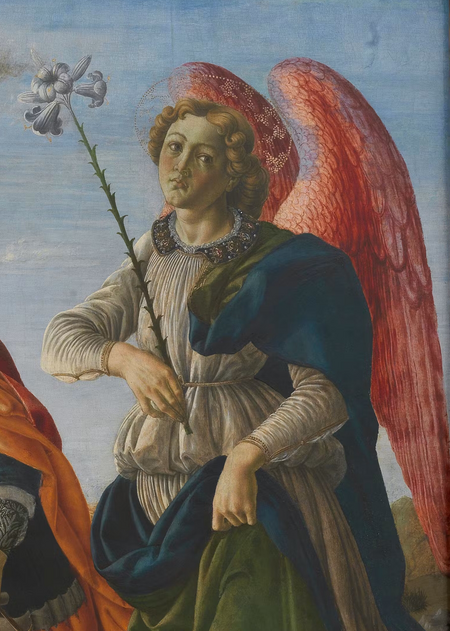
Excerpt. Francesco Botticelli, «The Rape of Proserpina» (originally «Tavia and the Three Archangels»), 1467.
By the 15th century, naturalistic tendencies in Italian painting become increasingly pronounced; however, this does not signify the complete displacement of Gothic traditions: decorative elements and conventionalized representation continue to coexist alongside new artistic approaches in some areas.