
It’s such a fine line Between a good man and a bad one
«Jekyll and Hyde» is a highly successful Gothic musical composed by Frank Wildhorn and librettist Leslie Bricasso. The musical’s plot is based on a classic English novella and tells the story of Dr. Henry Jekyll, who grapples with crossing the boundary between good and evil.
I specifically chose this musical because I have been a fan of it for a long time. The data used for the analysis consists of the lyrics from the arias, which were available in the public domain online, and I compiled them personally into a CSV file. Since I wanted a list of arias that fully captured the musical’s plot, I sourced the texts from two different versions.
Because the analytical work focused on the text, I immediately thought that I could count the number of words. Linear or bar charts are well-suited for this type of data, so there will be quite a few of them. I also wanted to create a word cloud chart and a pie chart for a more visually compelling presentation.
Stages of Work
The formula HJ7 was chosen as the visual inspiration for the project, and Dr. Jekyll resolves to test it on himself. It is most often described as a green liquid, so the project is presented in several shades of green. Black and white serve as accent colors, representing the endless struggle between good and evil.
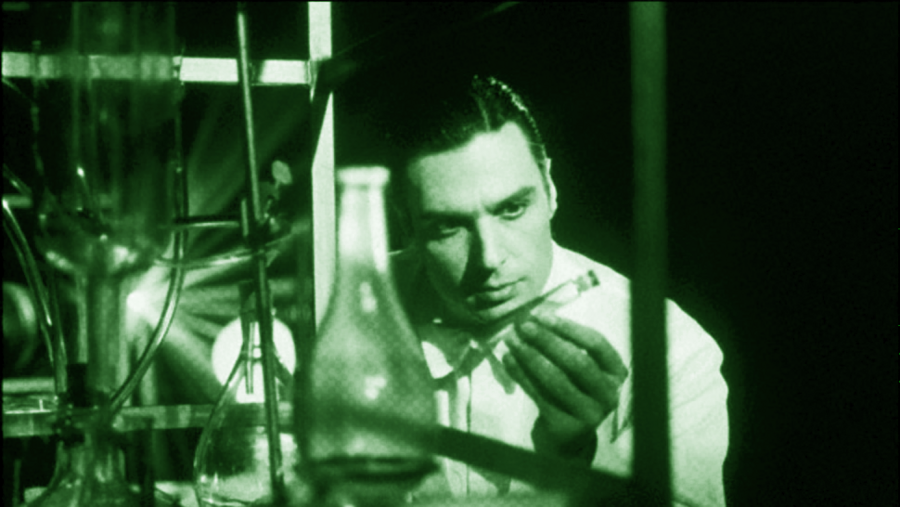
Robert Cucchioli as Dr. Jekyll

Metrika was chosen for the text styling. I was drawn to this typeface for its elegance, yet it offers substantial functionality—it supports both Latin and Cyrillic scripts. Diagrams and code snippets will also be presented using this font.
Once the design was established, it was time to process the data. First, I decided to count the frequency of word usage. Furthermore, to make the word count more insightful, I separated the dialogue by character, allowing me to calculate the word frequency used by each character in the subsequent analysis.
After presenting the data in a digestible format, I implemented a set of stop words to filter out conjunctions, prepositions, and articles from the list of most popular words. With these initial counts complete, I began creating the first visualizations.
Schedule #1: Word Usage Frequency Across All Arias
By analyzing the most frequently used words, one can observe the contradictory nature of the musical’s soul. On one hand, it is a dark story, replete with violence, which is reflected in the most common word, «murder.» On the other hand, it is a story about a dreamer-idealist who aimed to eradicate evil from the human spirit, which is reflected in the words «see,» «know,» and «way.»
Word cloud of frequently repeated words throughout the entire musical
To clearly demonstrate the multifaceted nature of the musical, a «word cloud» was created, displaying the 50 most popular words. Additionally, the words are colored in a random shade of green because three shades were insufficient for such a cloud.
Chart #2: Frequency of Word Usage by Character
After creating a diagram of the most popular words, I became interested in the differences between the characters. The first characters to whom personalized lists of popular words were created were Jekyll and Hyde.
The differences are apparent to the naked eye. Jekyll strives for knowledge; he thirsts to solve the mystery of good and evil, reflecting deeply and dwelling within himself (know, see, find, inside). One might also say he is quite religious, which is surprising for a scientist willing to conduct experiments on himself.
Hyde, although the embodiment of evil, embodies the energy of life, demonstrating how captivating evil can be (feeling, alive, live). It seems Edward Hyde particularly enjoys speaking about himself in the third person—his first and last name are among the most frequently mentioned words.
In the second diagram, I gathered the important secondary characters.
The ensemble is included for a reason. In the musical, the city plays a significant role in the narrative. The citizens react to events, are horrified by Hyde’s actions (murder), and contemplate duplicity and the infinite social façade.
To my surprise, Jack Jekyll’s friend John Atherton has very little involvement in the arias; his vocabulary list is quite modest. He supports Jekyll and tries to open his eyes (see, way).
Emma is a dreamy, romantic girl. She speaks frequently about love and dreams (love, dream).
Lucy, however, strives for a new life, and although she mentions love, it is far from her primary focus.
Schedule No. 3: Characters' «Screen Time»
The role of Jekyll and Hyde is considered incredibly challenging for an actor to perform. This is supported by a word count chart for each character. Jekyll leads in terms of word count, and when Hyde’s lines are added, the total is nearly twice that of the ensemble.
It is surprising that the ensemble plays such a significant role in the production; in terms of word count, they rank second.
It is also surprising that Hyde speaks no more than Emma, even though his presence feels far more substantial.
A pie chart was used to clearly demonstrate the percentage ratio among the characters. To avoid cluttering the image with excessive text, characters with few lines were grouped into «Others.»
Conclusion