Concept
AESTHETIC DNA — a digital media platform exploring various manifestations of art: film, music, fashion, photography, and visual art. The project is built around a personal recommendation system that helps users discover cultural objects not just by title, but through associations, color, mood, and aesthetic characteristics. The media merges works from different artistic disciplines, uncovering the connections between them.The Project’s Main Goal — to help the user discover new things based on their individual taste, push beyond familiar interests, and gain a deeper understanding of their own aesthetic preferences. Through searching, recommendations, and content interaction, the user gradually forms their Aesthetic DNA—a personal taste profile that aids in finding unexpected cultural connections and works that can become new favorites.
Data Sources
1. Cultural Databases and Online Archives
The primary source of information regarding artworks, authors, and artistic movements.These are digital catalogs, libraries, and archives containing data on films, music albums, artworks, photographs, and other cultural objects. They help build content foundations, fact-check information, and find pieces for recommendations.Source Examples: — IMDb — information on films, directors, actors, genres, and release dates. — The Movie Database (TMDB) — movie descriptions, posters, genres, keywords, actors, and visual assets. — MusicBrainz — information on artists, albums, music releases, and genres. — Discogs — details on music albums, artists, styles, and editions. — Google Arts & Culture — museum collections, artworks, artists, and thematic materials. — The Metropolitan Museum of Art Collection — images and information about artworks. — Europeana — archival materials, photographs, artworks, and historical documents. How to Use Them: finding works for thematic collections, gathering basic information on authors and their work, building curated collections, and linking objects by genre, era, movement, and other characteristics.2. Specialized Platforms and Catalogs
Resources for finding visual, musical, and thematic associations.Beyond reference databases, media requires platforms that allow you to explore works through mood, visual style, genre, and user preferences.
Examples: — Are.na — visual collections, thematic selections, references, and associative links. — Pinterest — visual references, color palettes, aesthetics, mood boards, and imagery. — Letterboxd — user film lists, reviews, thematic collections, and ratings. — Last.fm — music preferences, similar artists, and genre connections. — Rate Your Music — music genres, ratings, user lists, and thematic collections.
How to use them: to search for unexpected connections between works, explore user collections, find new topics for publications, and shape recommendations based on aesthetic similarity.
3. Online Media and Editorial Publications
Sources for discovering relevant themes, timely phenomena, and expert context.When preparing materials, the media can consult specialized publications that explore art, film, music, fashion, and visual culture.
Examples: — Dazed — visual trends, fashion, music, photography, and new creators. — i-D — photography, fashion, visual aesthetics, and creative personalities. — NOWNESS — short films, video features on art, design, fashion, and music. — The Face — music and fashion trends, interviews, and visual research. — It’s Nice That — illustration, graphic design, photography, and creative projects.
How to use: To find topics for editorial content, monitor emerging creators, study the context of artworks, and gather expert opinions. Importantly, the media’s publications must be based on original analysis and authorship, rather than merely retelling others' work.
4. User Platforms and Communities
Sources for studying audience interests and discovering new associations.Platforms where users independently rate, discuss, and curate works will play a vital role.Examples: — Reddit — thematic communities covering film, music, art, and fashion. — YouTube — music videos, video essays, interviews, and user-generated playlists. — TikTok — visual compilations, aesthetic trends, and musical and cinematic associations. — Telegram — thematic channels and communities focused on art, film, music, and photography. — Comments, reviews, user lists, and collections on specialized platforms. How to Use: Identify topics that genuinely engage the audience, explore user-driven associations, uncover unexpected connections between works, and track how people articulate their own aesthetic preferences.6. Proprietary Database and User Feedback
The key source for personalization This is the most critical dataset for AESTHETIC DNA, as it is what will differentiate the media from a standard information resource or thematic blog.The system will gradually gather data on user interaction with works and use it to generate personalized recommendations.What data can be collected: — liked works; — saved pieces and personal collections; — «Like,» «Not for Me» ratings; — search queries and selected tags; — colors, moods, and visual motifs of interest; — transitions between related works; — selected categories: film, music, fashion, photography, art. How to use it: to analyze preferences, identify recurring interests, and build an individual aesthetic profile—Aesthetic DNA. For instance, if a user frequently saves films with a cool color palette, experimental music albums, and nocturnal city photography, the system can suggest other pieces with similar visual and emotional characteristics.Data schema divided into human and machine processing
Humans are responsible for the creative search, interpretation, and verification of information, while machines handle the collection, systematization, analysis, and processing of large volumes of data. It is crucial to distinguish between objective characteristics (year of creation, author, genre) and subjective characteristics (mood, associations, aesthetic similarity). The former can be primarily collected automatically, whereas the latter require editorial interpretation and can be supplemented by algorithmic analysis.
The Final Distribution Principle: — Human: Seeks meaning, forms ideas, verifies information, interprets works, and creates original content. — Machine: Collects, cleanses, classifies, correlates data, identifies patterns, and personalizes recommendations. — Collaboration: Transforms disparate information into a system of cultural connections upon which AESTHETIC DNA operates.This division allows for the preservation of the authorial character of the medium while simultaneously leveraging the possibilities of automation to scale the database of works and enhance personalized recommendations.
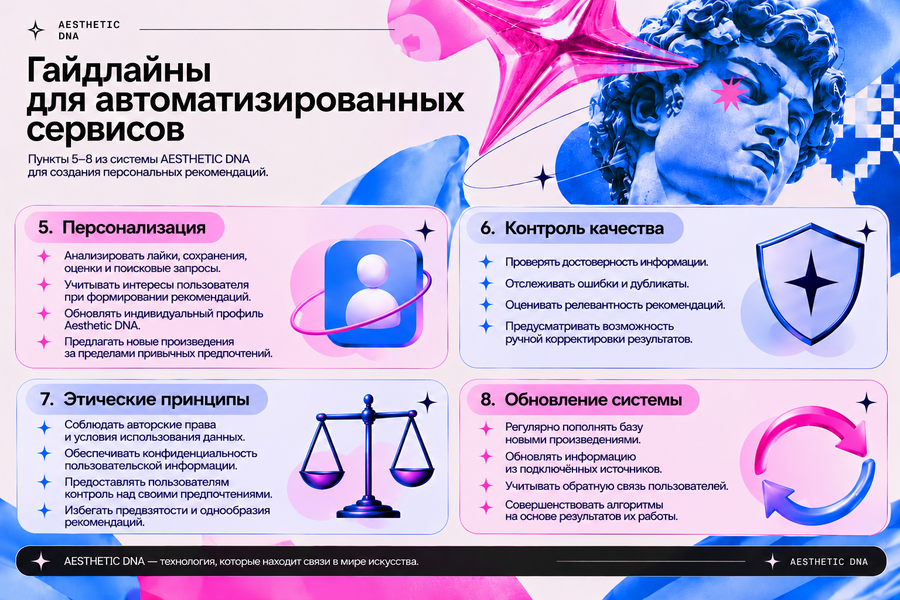
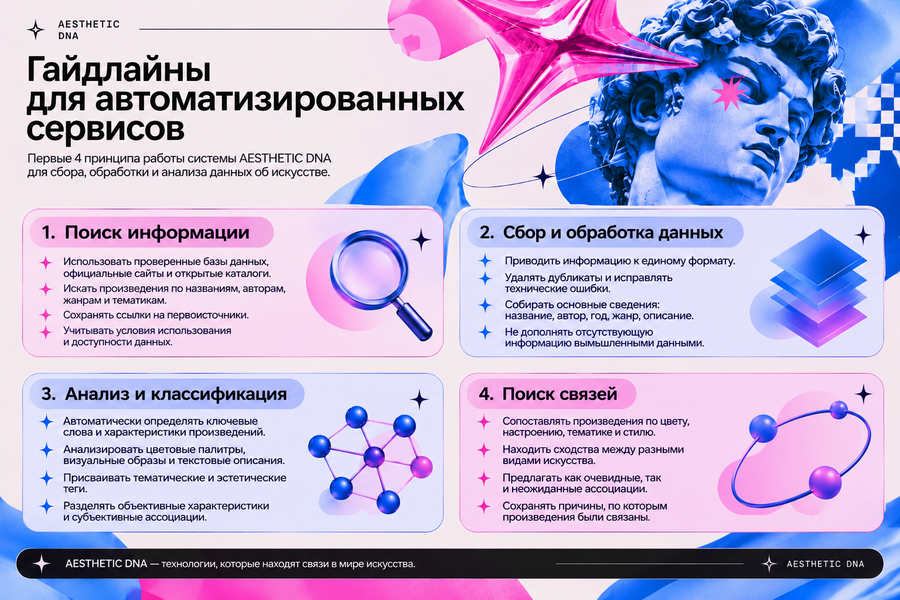
Guidelines for Automated Services
The AESTHETIC DNA automated services are used to collect, process, and analyze information about works of art, find connections between them, and generate personalized recommendations.