The touch of documentary and artistic worlds often leads to disputes and conflicts. Is it possible to be objective in the art of the document? What happens to the document when it hits the field of modern art?
My interest in the issue of the possibility of a document in the arts began with the concept of cinéma vérité, a direction that emerged in France in the 1960s, which blurred the boundaries between reality and the simulation of reality, and it was during that historical period that the interest in documentation was enormous. Of course, it was not the first big turn of art towards the document, but in the early 20th century, the avant-garde art was much of a document, but it had other goals. In the 1960s, however, there was a need to update the language (of art, among others), to turn to reality. In the face of the general democratization of society, the arts have been neutralized by artistic expression (and images in particular). It was a process of overcoming the art (the well-established way of being art), which also took place through documentation. The increased attention to documentation has led to artificially raised importance (not a document!) i.e. the principle of documentation. In this text, all discussions will be structured around how the document (s) function in the art.
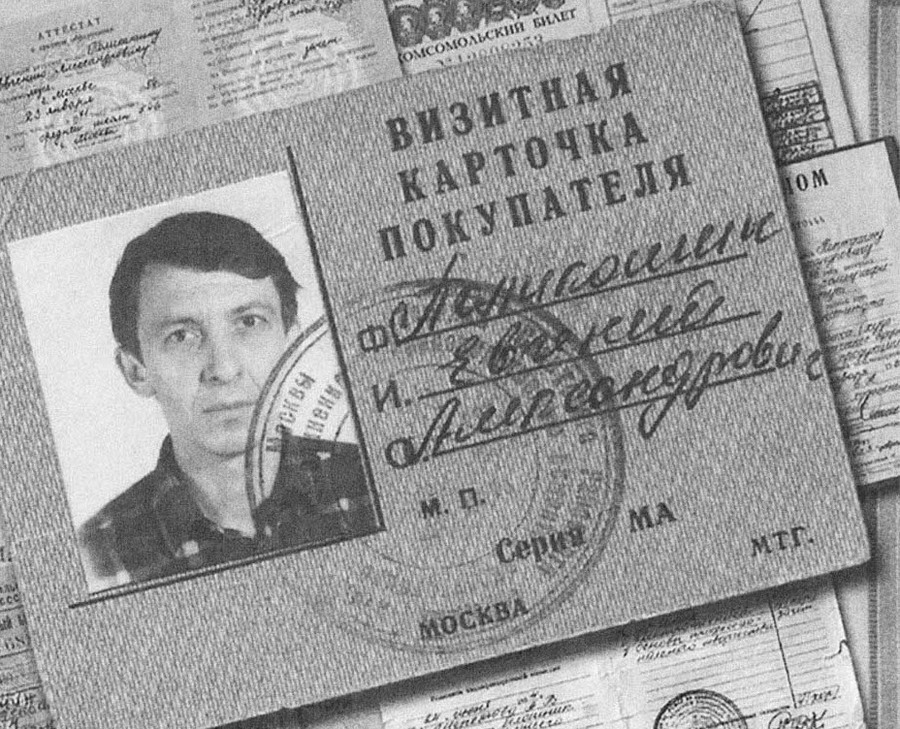
A part of the cover of the book «The Status of the Document: Final Paper or A Disposed Certificate?»
In parallel, the story is that cinema and photo-documentology have begun to be used actively in ideological wars, which have only improved throughout the twentieth century. In the information war, any image becomes a weapon, but the document here is the one that suffers the most. Against this background, there is a re-examination of how people perceive the document. It is during a period of active visual propaganda that re-thinks of the documentary image — it often becomes imposed, also in a certain (comprehensively) contextual frame. It is often impossible to understand who the context in which the image is perceived is, because of this mistrust, aimed precisely at the document as the closest / understandable segment in the foggy ideological chain. During the same period, the document was apropriated by artists. The document is gradually becoming a self-sufficient way of artistic expression than artists are actively using, but this situation creates new contradictions that arise in the art and documentation, new disputes and ways and conditions of crossing these systems and, in general, the possibility of such intersections without absorbing each other.
To work with the sources, I chose two texts from Oleg Aronson’s «Moral Document» and «List of Time». Film editing and documentation», a small piece of David Jozelit’s article «On aggregates», Okvi Envezor’s article «Documental genre/realism: biopolitics, human rights and the figure of truth in modern art» and Heathto Steyerle’s article «Uncertainness of Documentaryism».
The working definition of the document for this text is to consider the document as a case of image mode, with certain (specific nature of the document itself) ways of targeting it to reality and to the viewer.
Oleg Aronson ___________________ Any document is based on fiction
Film from «Nunuk from the North»
He points out that «the effects of film documentation are stronger than the document», i.e. the image of documentation, which is often indistinguishable from the document’s originality by the audience. Another idea that I would like to extend to a broader understanding of art (not just film) is that «a document is not registered, but is produced by some film gesture» [Aronson, 2008], creating a document, the author in any case «produces» it by means of a set of well-established images, techniques, technologies, tools, and if the author is an artist and the document is placed and/or moved into the field of modern art, there are additional systems of images that are unpificial exclusively documentary. Thus, the document is increasingly growing in layers of space within which the interpretive potential of subjectivity can and will be developed, with the presentation of a «one version», with moral appreciation, with the loss of the value that the document is originally supposed to possess.
*Lelie gave it to me. Uddtøm / Donos facility, 2023
Lelie’s Darali «Aid» / «Dosnos», 2023
This art project is an example of working with a word as a document. An artist and writer, Darali Lelie, referred to the context of another dictionary, «Komi oerminologija Slovar», released in Syktyvkar in 1934, and, in fact, established the new political and linguistic reality of the Comi at the time of the 1920s and 1930s, a period of massive repression by the comics of intellectuals. [Gavrilova, 2021]
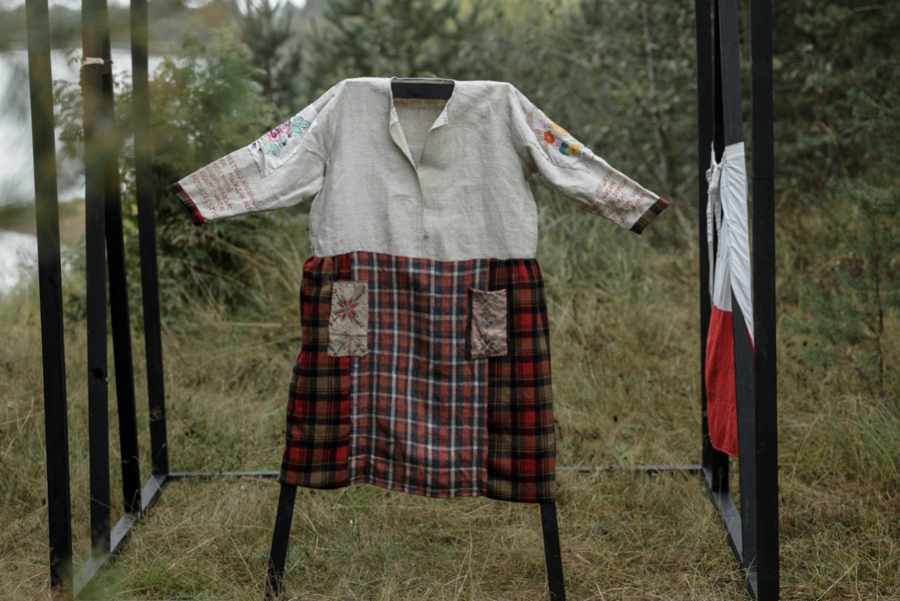
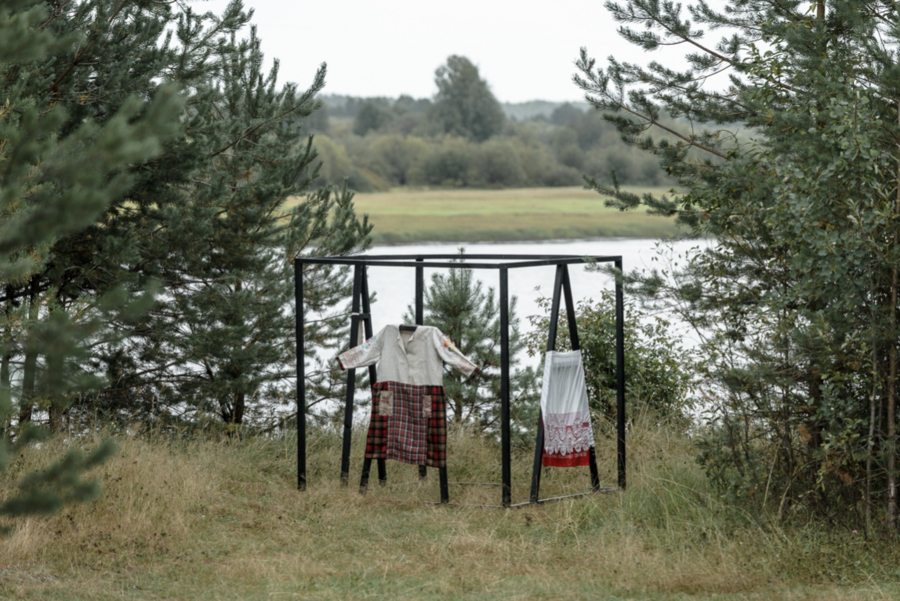
Although this art project is primarily created in the context of the criticism of colonialism, the scope of the text as a document (fixing specific historical events in a particular geographical area) and the use of certain (specific events, time and space) elements of clothing and tissues makes it possible to refer the draft to the subject under consideration. Sophia Gavrilova writes about this installation: «The artist’s installation shows a change of language through textiles and a change of costume: for example, a camp robe embroidered from the elements of national clothing, and a partially made from the house of the prisoner’s heir to the prisoner, turns out in a frightening way that camp life through universalized clothing destroys national identity.»
Lelie’s Darali «Aid» / «Dosnos», 2023
David Jozelite ___________________ Temporality as a special characteristic of the document
Once again, the idea arises that the document, in an attempt to «document» (the primary and most natural function), in an attempt to seek the truth, never reaches it because it is essentially a fiction, and if Aronson’s falsifying nature of the document is politically driven, that condition refers to the temporal nature of the document.
Okvi Envesor ___________________ The ethical foundation of the documentary defeats the primary purpose of the genre as such
Envesor’s work focuses on the relationship between documentary genre and modern art. The author defines documentary genre as a new way of artistic thinking about reality:
«As such, the documentary genre takes a unique position: it takes part in a tautological game, both by documenting, analysing, showing and determining, both by aesthetic means and without resorting to them» — Envesor, 2015, [149]
And it seems to me that the process of definition here is the most important, because by documenting, we are in any case making some statement that proves something. At the very least, because when the author documented a piece of reality, only he had access to it, the viewer who perceives the result of the documentary artist in any case sees only the «surface» / partial truth, or it is better to say one of all kinds of words about the particular reality that the artist has encountered. «Documentistics» refers to the author as a set of models that are aimed at and drawn from the «real» world, «there is a correlation with reality» [Envesor, 2015, p. 148].
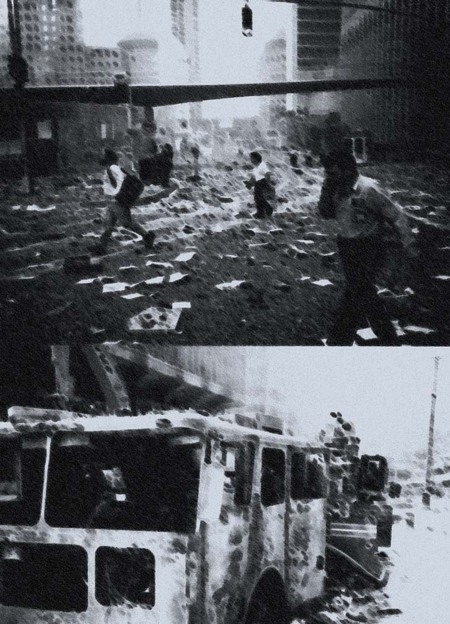
Documentary Photo from The September 11 Photo Project
In any case, the production of images is simply specific to «processed», and no image can fully represent reality. Once again, it is appropriate to note the partiality/fragileness of the document.