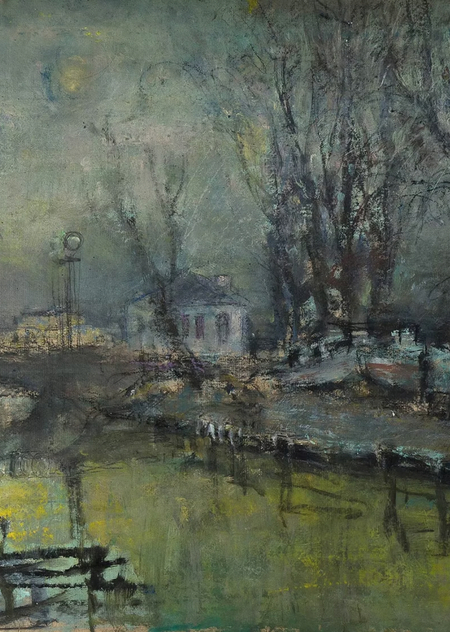
Как разные сюжеты связаны одним художественным языком.
Atmosphere, light, blur, and motion in the works of Sergei Bakin
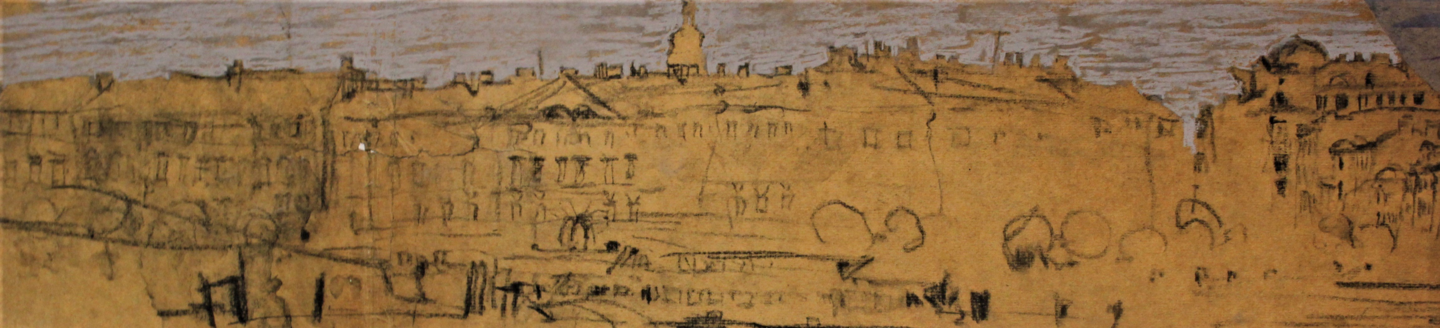
Sergey Bakin, Graphics: Boom Paste. 20,7×86 cm, 2001.
Research Structure
(1) Introduction (2) Research Concept (3) Visual Analysis of Works ㅤㅤ(3.1) Ballet: Movement over Stasis ㅤㅤ(3.2) St. Petersburg: City as State of Being and ㅤㅤㅤㅤㅤㅤㅤMemory ㅤㅤ(3.3) Carnival: Movement, Crowds, and Color ㅤㅤ(3.4) Portrait: The Individual Between Recognition and ㅤㅤㅤObscurity ㅤㅤ(3.5) Fashion: Silhouette, Fabric, and Motion (4) Conclusions (5) Bibliography and Image Sources
Введение
Leningrad artist Sergey Bakin
Sergey Bakin — a painter, graphic artist, and costume designer whose work prominently features urban landscapes, ballet, and human figures.
Born in Leningrad in 1957. He graduated from the Secondary Art School at the Academy of Arts and later from the V. I. Mukina Leningrad Higher Art and Industrial College with a specialization in «clothing modeling.» For over seven years, the artist worked as a designer at the Leningrad Model House, after which he dedicated himself to painting.
Concept
In painting, an image does more than just convey the external appearance of a person, an object, or a place—it communicates a specific state: the condition of light, the state of movement, the fleeting nature of a moment, and even the atmosphere of a memory. In such works, what is depicted is not as important as how it is depicted: the sharpness of the contours, the interaction between light and color, the role of the brushstroke, and the relationship between figures and the space in which they are situated.
It is this particular aspect of Sergei Bakin’s artistry that sparked my interest in exploring it. His paintings reveal various facets of movement, the expressiveness of the human figure, the technique of line work, and the selection of colors. What unites these pieces is not so much the subject matter as a unique perception of what is being depicted: an attention to plasticity, light, color relationships, and the variability of the visual image. The mood and tone of his work are singular.
How exactly can painting convey the sensation of movement—holding it not in one precise posture—and how might the blurring of the image, the fuzziness of the contour, introduce a new chromatic dimension to the viewer’s perception? I want to see how that indistinct contour can become not a deficiency of the image, but an artistic device that transmits dynamism, emotional state, and the transience of what was observed.
Sergey Bakin is of interest to my visual research due to the diversity of his creative themes and the specifics of his painting technique. Ballet allows for the examination of human body movement and the expressiveness of gesture, as captured in a single moment. The St. Petersburg landscapes envelop the city as if it were a memory. His portraits offer an opportunity to explore how Bakin presents emotion to the viewer, while his fashion sketches will reveal his origins and how his characteristic line quality was evident even back then. The plasticity of the silhouette, the nature of the line, and the movement of fabric—all of this proved valuable to the artist in the future.Bakin’s professional experience in clothing modeling is also noteworthy. For over seven years, he worked as a fashion modeler at the Leningrad Fashion House. This fact raises a logical question about a possible connection between his experience with costume and his painterly attention to the human figure. I won’t delve into that now, but I will explore it in more detail later.The choice of this artist stems from the opportunity to trace how similar artistic techniques manifest across different thematic areas and help create a distinctive visual image.
The core concept of this study is an investigation into how Bakin renders atmosphere—as a result of the interplay between light, color, blur, and movement—in his painting and graphic works. Within this research, atmosphere is understood as the overall visual and emotional impression created in the viewer upon perceiving the artwork. This feeling is shaped not only by the narrative but also by artistic techniques: the quality of the brushstroke, the level of detail rendering, the balance between light and dark areas, the color palette, and the interaction between the figure and the background. In this study, I will present concepts of atmosphere from various sources and artists to determine their applicability to Bakin’s oeuvre. The research will be structured around an analysis of five thematic areas: ballet, St. Petersburg landscapes, carnival, portraiture, and fashion sketches. Each area will allow for an examination of distinct aspects of Bakin’s artistic language.
Sergey Bakin, Graphics: Fontanka Boom.past. 41,7×78.4 cm. 2011.
Вопрос
How does Sergey Bakin use light, blur, and movement to create atmosphere in his works, and how do these techniques manifest across the different thematic directions of his art?
Гипотеза
The atmosphere in Sergey Bakin’s works is created through the interaction of light, color, the character of the brushstroke, and the degree of image detail. These elements allow the artist to convey not only the external appearance of a person or space but also a sense of movement, the transience of a moment, and emotional state.
Yet, the same artistic techniques can serve different functions depending on the theme of the work—conveying the plasticity of dance, the variability of urban space, the dynamism of a crowd, or the expressiveness of the human figure.
Objectives: To identify and analyze the characteristics of Sergey Bakin’s visual language through selected works, paying particular attention to the role of light, blur, and movement in creating atmosphere.
Visual Analysis of Works
движение вместо позы
Ballet:
Sergey Bakin, painting: «Tiredness.» 80×60. Canvas, oil. 2002. // «Dancer.» 70×50. Canvas, oil. 2003.
Ballet holds a significant place in Sergey Bakin’s creative work. In the pieces I have chosen, the artist addresses not only stage dance but also rehearsals, warm-ups, rest, and the social interactions of the dancers. Sergey Bakin’s works in this and subsequent sections are drawn from his personal favorites—the pieces he considered his best.The selection of subjects allows for an examination of ballet not exclusively as a purely visual art concerned with beauty and the precision of movement, but also as daily life, encompassing physical exertion, fatigue, concentration, and anticipation.Dance exists in time, in motion: one body posture gives way to another, a gesture continues, and balance is constantly shifting. Bakin, conversely, works with static imagery. The blurriness of silhouettes, the dynamic, rushed brushstrokes, and lines perfectly convey movement and life. These works are beloved by many viewers and form some of the most frequently exhibited pieces in his collection.
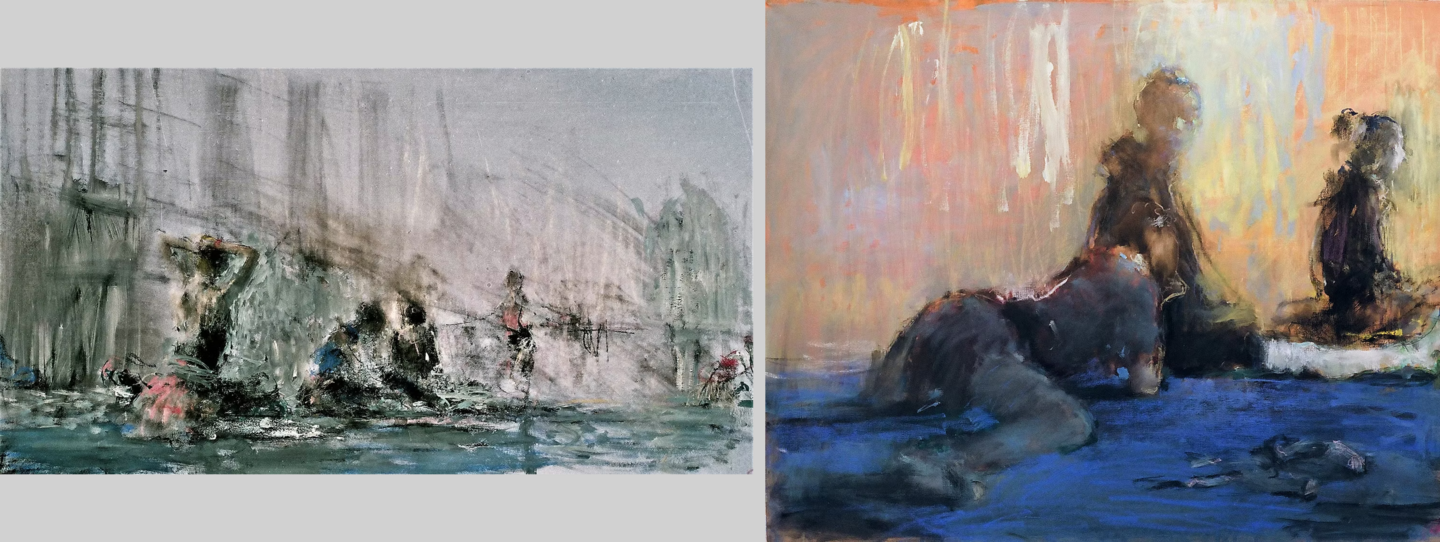
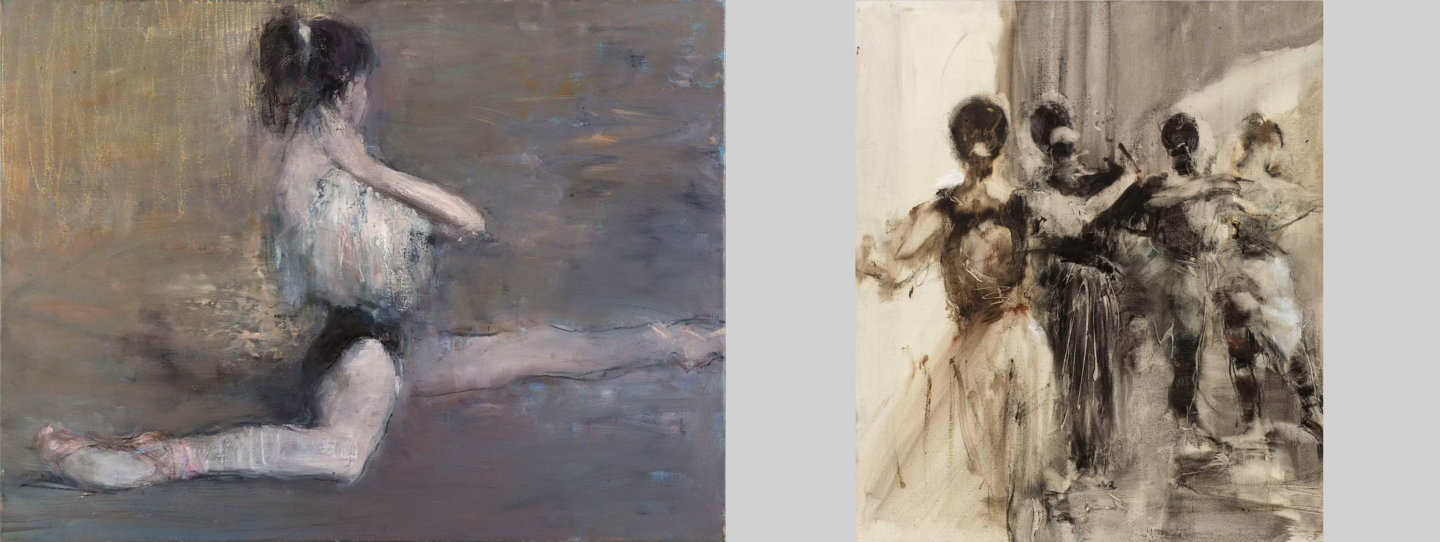
1. Sergei Bakin, painting: «White Dancer». 60×80. Canvas, oil. 2017. // «In Rehearsal.» 70×60. Canvas, oil, pastel. 2013. 2. Sergei Bakin, painting: «Before Rehearsal.» 60×90. Canvas on cardboard, oil. 2003. // «Scene in Rehearsal.» 60×70. Canvas, oil, pastel. 2003.
Works such as «Warm-up» (2003), «In Rehearsal» (2002, 2005, 2013), «At the Ballet Barre» (2017), and «Movement» (2021) (some images slightly lower) allow us to examine various situations related to physical preparation and dance practice. The titles themselves suggest several states of life in ballet: immediate movement, preparation for it, and the repetition of dance elements. For the average viewer, ballet is often associated with grace and the stage. Bakin depicts not only the finale of preparation and the stage, but also the labor, presenting it with great tenderness, haziness, and vitality.It is important to note how he organizes the human figure’s position and conveys bodily plasticity. The characters rarely look at us; they are in the moment, absorbed and focused on the task. In this way, the moment in time is conveyed to us, the viewer.
Sergey Bakin, painting: «By the Window.» 40×30. Cardboard, oil. 2013. // «While Reading.» 50×60. Canvas, oil. 2003.
Sergey Bakin, graphic: «Motion.» Paper, pastel. 100×70. 2021. // «At the Ballet Apparatus.» Canvas, pastel. 60×70. 2017.
If linear perspective illustrates the change in the apparent size of objects based on distance, aerial perspective illustrates how the clarity of objects changes for the same reason. Although our vision prevents us from seeing distant objects as clearly as close ones, aerial perspective is based on an important fact: all media deemed transparent slightly obscure the image. Thus, the atmosphere is always partially translucent to varying degrees.
— Theory of Colours, Johann Wolfgang von Goethe, 1810 г.
Sergey Bakin, Painting: «In the Ballet Hall.» 60×105. Cardboard, oil, pastels. 2002.
To elaborate further on the behind-the-scenes aspects, this is explored in the works «Fatigue» (2002), «Before Rehearsal» (2003), «By the Window» (2013), and «After Reading» (2003). Rest, waiting, pausing, and concentration—these are all profoundly human and everyday activities that draw us close to the lives of dancers and ballerinas, rather than establishing a rigid distance, inviting us to immerse ourselves in their mood. Ballet, in this context, is presented not merely as a sequence of movements, but as a specific state of being.
These pieces offer an excellent introduction to Bakin’s style and his techniques. The ballerinas' faces are not highly detailed, but their mood can be perceived through their bodies, the direction of their movements, their relaxation or tension, and, of course, the overall atmosphere. The figures in the background subtly dissolve, and the silhouettes become slightly indistinct—this can be interpreted as movement or depth within the painting. This artistic technique allows for a softer transition and interplay of tones and brushstrokes. The contours of the figures are softened, and individual forms blend into one another, visually emphasizing the transience and instability of the moment. However, at times, specific elements stand out more due to their level of refinement or the contrast in color, which gives the paintings a strong character.
Equally important is how he utilizes light in his work. He directs the viewer’s attention and shifts the dynamic of the piece, amplifying it. The artist skillfully transitions from warm tones to cool ones, while also working with reflections on the floor, establishing significant depth and a palpable sense of presence in the space. As mentioned before, the atmosphere is luminous, which perfectly suits Bakin’s oeuvre.
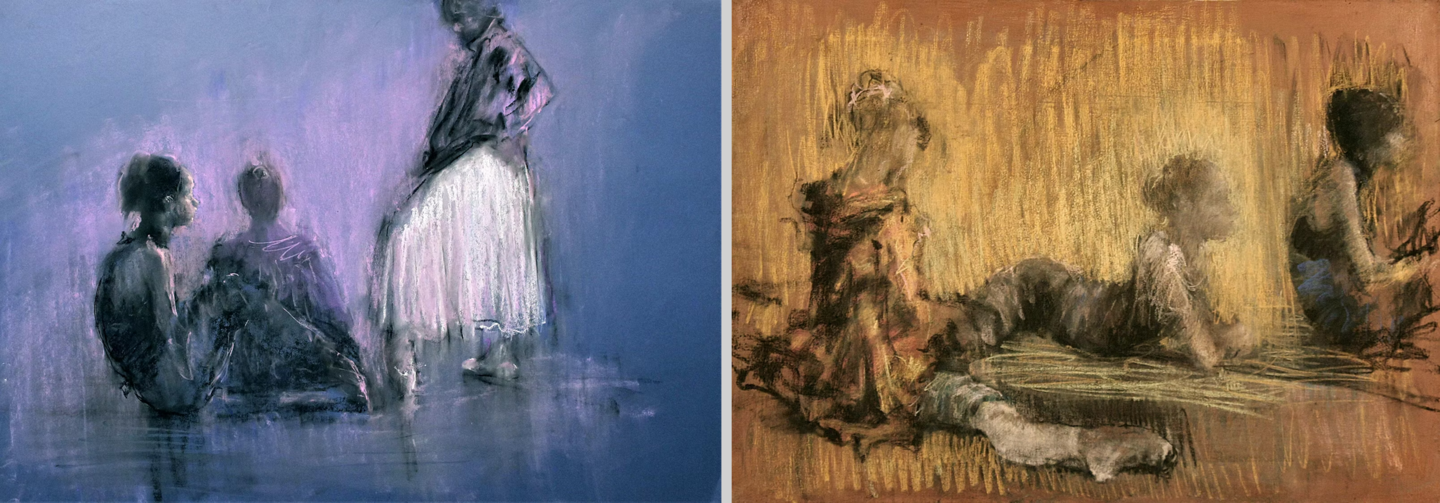
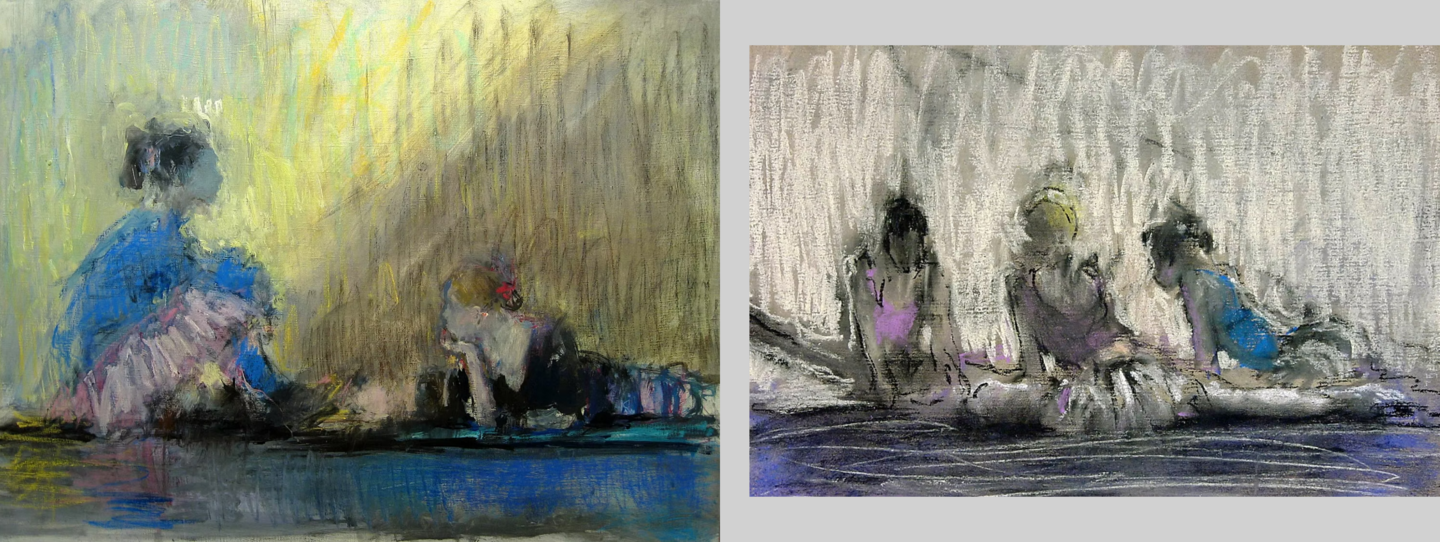
1. Sergey Bakin, graphics: «Girlfriends.» Paper, pastel. 50×70. 2002. // «Gossips.» Paper, pastel. 50×70. 2006. 2. Sergey Bakin, graphics: «Conversation.» Paper, pastel. 70×100. 2021. // «During Rehearsal.» Canvas, pastel. 60×90. 2005.
In this selection, I have presented both oil paintings, some incorporating pastels, and independent pastel graphic works. There is an obvious difference, of course, but the lightness and color remain. When examining the graphic works, pay attention to the role of line, shape, and silhouette. Their lightness, the dynamism of quick lines that merely suggest the silhouette, is delicate. And the choice of pastel as the primary medium is ideally suited for blending. There is no other material capable of producing that haze characteristic of Sergey Bakin.
Sergey Bakin, graphic: «Dasha». Canvas, pastel. 60×80. 2005. // «In Rehearsal.» Paper, pastel. 55×80. 2002.
Sergey Bakin, graphic work: «Warm-up.» Paper, pastel. 50×70. 2003.
Sergey Bakin, Graphics (1) and Painting (2): «At the Ballet Machine.» Canvas, pastel. 60×70. 2017. // // «During Rehearsal.» 70×60. Canvas, oil, pastel. 2013.