
Navigation
Introduction
1 Christianity 2 Islam 3 Buddhism 4 Hinduism 5 Shintoism 6 Analysis of Attendance at the Morning Liturgy in the Church of the Dormition of the Most Holy Theotokos
Conclusion
Introduction
Humans began to listen to the world before they learned to explain it. Even before the advent of philosophy, science, or writing, sound affected the body: it frightened, gathered people together, induced trance states, and helped people cope with the fear of nature and death. The rhythm of footsteps, the beating of the heart, breathing, thunder, the sound of water—all of this became the first forms of experiencing the world through hearing.
Religion grasped very early on what psychology, acoustics, and neurophysiology would later study: sound has the power to manage human attention. It alters breathing, synchronizes movement, evokes emotional tension, or calms the mind. This is precisely why almost every religious tradition creates its own sonic architecture—a system of voices, pauses, rhythms, and vibrations through which humans learn to sense the world.
What is particularly fascinating is that European musical culture grew directly out of religious practice. The modern system of major and minor, tonality, chords, and harmony was formed within the ecclesiastical tradition. Medieval monasteries were not only places of prayer but also unique musical laboratories. There, hymns were transcribed, methods for precisely recording sound were sought, and a system of intonation was established.
It was within the Catholic environment that the familiar European notation originated. Guido d’Arezzo created the staff and the solmization system, which predates the modern «do-re-mi.» Moreover, the Gregorian chant became the foundation of the entire Western musical tradition.
But religious sound was never merely music. It was always a way to transform a person’s state of being.
The theme of sound in religion sits at the intersection of cultural studies, anthropology, philosophy, musicology, and perception research. Although religious traditions are often analyzed through texts, dogmas, or visual symbols, sound remains one of the primary tools for influencing human experience.
Religious sound is not solely an aesthetic element. It shapes states of attention, regulates breathing, synchronizes body movements, fosters a sense of collectivity, or conversely, immerses a person in internal concentration. Through repetition, rhythm, pause, resonance, and the acoustics of space, religion influences the perception of time, space, and the self.
The timeliness of this topic is also linked to contemporary interest in sound practices—meditation, sound healing, neuroacoustics, ASMR, and studies on music’s impact on the psyche. Many of these practices effectively employ mechanisms that have existed within religious traditions for millennia.
Examining five religions through the lens of sound allows us to view religion not just as a system of beliefs, but as a system for organizing human sensory experience.
I selected five specific religions because I hypothesize that each utilizes sound in a distinct way, forming its own model of human perception and the world.
This research is based on several theoretical approaches:
Phenomenology of Perception. A study of human bodily and sensory experience.
Anthropology of Ritual. An examination of religion as a system of bodily and collective practices.
Sound Studies. An interdisciplinary field investigating sound as a cultural phenomenon.
Musicology and the History of Sacred Music. An investigation into the development of notation, church singing, and ritual music.
The research structure is built on a comparative principle. Each religion is analyzed through the same categories:
- Introductory Characteristics of Religion
- Sound Instruments and Practices
- Space and Architecture
- World Perception Model (how religion shapes the way one listens)
- Human Sounding Model (how a person «sounds» within a religious system)
The key research question
How do world religions use sound to manage human attention, body, and perception?
Hypothesis
Sound in world religions is not a secondary element of ritual, but an independent technology for influencing the human mind and body. Each religion creates its own acoustic model of perceiving the world.
1 Christianity
Guidon’s hand from an Italian liturgical book. Codex from 1450–1499.
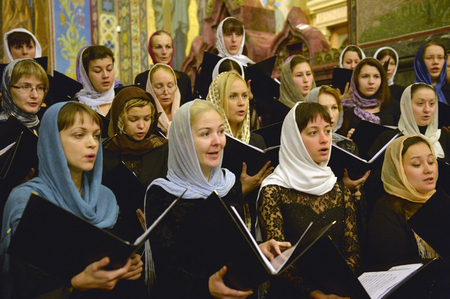
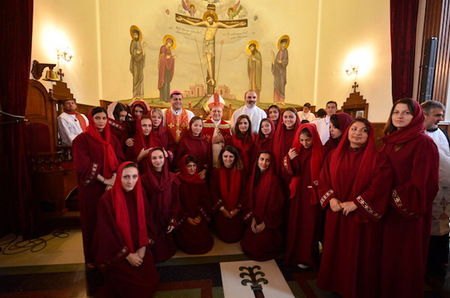
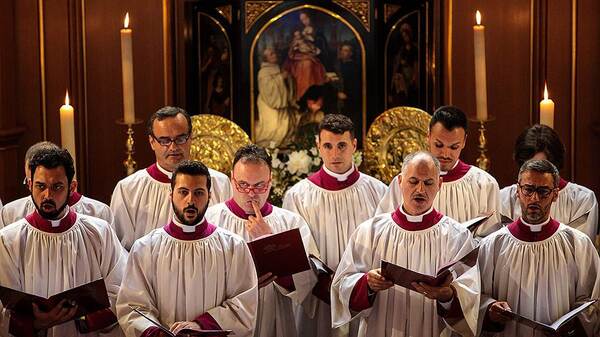
Christianity is built around the concept of community, so sound is inherently collective here. Prayer, choir, scripture reading, and bell ringing create a shared acoustic space within which the individual feels part of the church. In Christianity, sound helps synchronize people’s attention, breathing, and emotional state during a ritual.


3rd Century. Ancient Greek Letters, 8th–9th Centuries. Ephonetic Notation
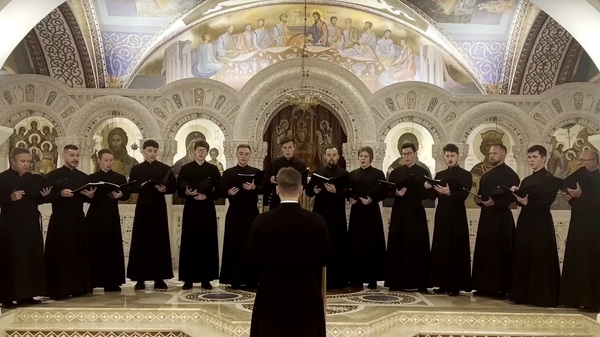
The human voice remains the primary instrument of Christianity. In the Orthodox tradition, the choir is especially significant: polyphony creates the effect of a shared breath, individual voices cease to be discernible, and transform into a unified sonic stream. This is why Orthodox music is almost always choral—here, the importance lies not in individuality, but in the collective sound of the community. In the Catholic tradition, the organ plays a vital role. Its low frequencies generate powerful vibrations that humans feel physically, through the body and space.
The evolution of Christian music gradually led Europe to the necessity of fundamentally restructuring its sonic system. With the advent of polyphony and the organ, human hearing began to perceive certain intervals as dissonant. This issue became particularly acute during the Renaissance, as instrumental music began to develop rapidly. Within the framework of church musical practice, temperaments—a system of averaging intervals that allows sound to achieve harmony—emerged. The word temperamentum translates to «calming.» Thus, Christianity influenced not only the religious experience of the individual but also the formation of the European model of hearing.
One of the oldest manuscripts of the Gregorian chant, early 10th century
It was within the church environment that the European musical system was formed. The Gregorian chant became the foundation of the Western musical tradition, and medieval monasteries transformed into spaces for musical experimentation. The invention of the musical staff and Guido d’Arezzo’s solmization system allowed sound to be fixed and complex chants to be passed down between generations.
In the Orthodox tradition, there existed sign notation, a specialized system for recording church chanting, where sound was perceived as part of the ritual action rather than as an independent musical composition.
Example of rubrication notation with cinnabar markings, from the book «Circle of Church Ancient Liturgical Chant in Six Parts,» 1884.
Church bells in Christianity serve to structure space and time. They extend far beyond the confines of the sanctuary and become an integral part of daily city life. Bells signal the start of a service, a holiday, mourning, or an emergency.
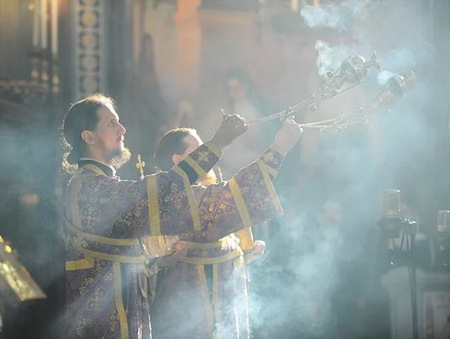
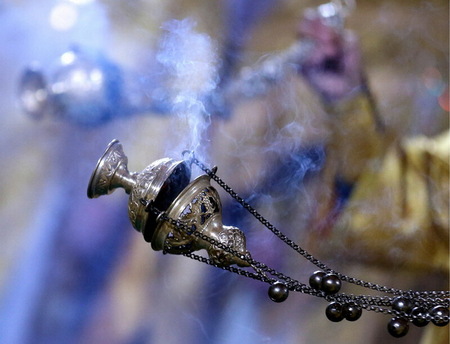
Even secondary sounds within the service hold significance. The ringing of the censer, the footsteps of the clergy, the rustle of robes, the bows, and the pauses all shape the overall acoustic texture of the ritual. In Christianity, a person sounds within the context of others. Their voice, breath, and movements gradually synchronize with the collective rhythm of the service, and individuality dissolves into the shared soundscape of the church.