The City as a Sonic Environment
Try stopping reading for a few seconds and simply listening. Most likely, quite a bit is happening around you: a car drives by outside the window, the ventilation system is running somewhere, a door slams, voices are heard, the computer is humming. We barely notice most of these sounds. Our perception constantly highlights certain sounds while relegating others to the periphery of our attention. We notice what seems important in a specific situation, while many other auditory cues remain almost imperceptible—otherwise, daily life would become a continuous stream of acoustic information, making it difficult to navigate. But if you change the way you listen—the familiar space seems different. If you truly listen, the city reveals another dimension—the soundscape. It is composed of the movement of vehicles, human voices, signals, the hum of machinery, random noises, and the brief pauses in between. The station, the courtyard, the shopping center, or the promenade—each has its own distinct sound, one that changes throughout the day along with the city itself. Some sounds become so deeply ingrained in everyday life that they become part of the memory of a place. But as transportation, technology, and urban infrastructure change—the sound environment changes with them: familiar sounds disappear, and new ones emerge in their place. This auditory environment began to be described using the concept of a soundscape. It allows us to perceive a place not as a collection of individual sounds, but as an integrated and constantly evolving acoustic environment.
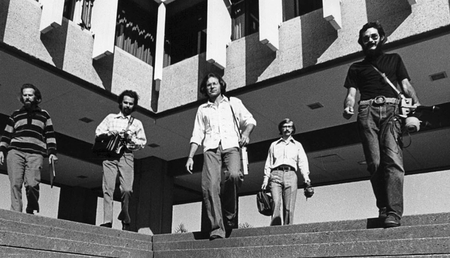
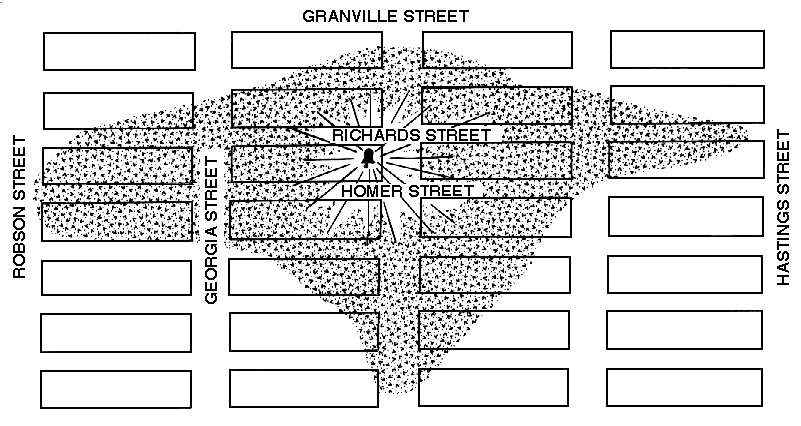
Participants in the World Soundscape Project at Simon Fraser University, 1973 / Acoustic profile map of St. Rosary Cathedral bells in Vancouver, 1973.
Toward the late 1960s and early 1970s, this very approach to the sound environment became the subject of dedicated study. Canadian composer R. Murray Schafer established the World Soundscape Project at Simon Fraser University—a project in which participants recorded and studied the everyday sounds of cities and other places. The research group included Bruce Davies, Peter Hughes, Barry Truax, Howard Brumfield, Hildegard Westerkamp, and other researchers. They were interested not only in what sounds could be heard in a particular location, but also in how they were distributed in space, which ones formed a constant background, which ones stood out and became recognizable markers of a place—and how all of this changed over time. One striking example of this work is the map created in 1973 as part of a Vancouver soundscape study. It marked the acoustic profile of St. Rosario Cathedral bells—the area within the city limits where their chimes could be heard. Sound here literally takes on a spatial form: it can be charted and you can see what portion of the city it covers. The result is almost another map of the city—not of streets and buildings, but of zones of audibility.
The sound card can have an even more literal embodiment. In the installation Soundcities — Herd Above the Noise by British artist Stanza, a map of a city transforms into a physical structure made of wires, cables, and hundreds of small speakers. Field recordings made in different cities around the world are played through these. Stanza sources the material for the installation from his own project, Soundcities, which he began in 2000. This is an open archive of urban sounds: it collects recordings of streets, transport, voices, machinery, and other everyday noises from dozens of cities. For Stanza, a city exists not only as a visible space but also as a complex sonic environment—complete with its own rhythms, recurring signals, and ever-shifting background. In Soundcities, these sounds are no longer tethered to a single point on the map; they can be distributed throughout space, combined with one another, and new sonic versions of the city can be assembled from them every time.
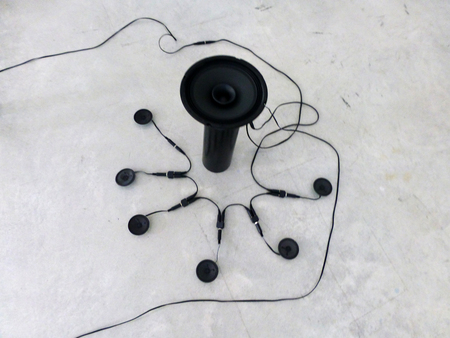
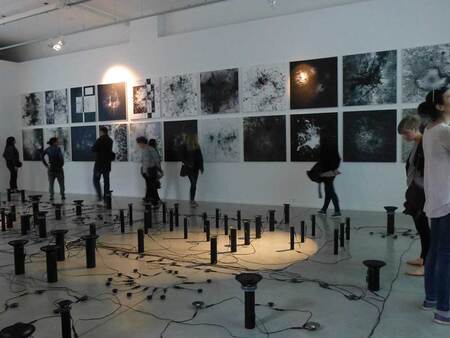
Stanza. Soundcities — Herd Above the Noise. Interactive sound installation.
Why do people listen to the sounds of ATMs?
The city has sounds that are impossible to perceive without specialized equipment. This is what German artist Christina Kubisch explores in her series, «Electrical Walks». Participants receive special induction headphones and venture out into the city, listening closely to ATMs, electronic displays, security systems, transport infrastructure, and other technical devices. The headphones capture electromagnetic fields and convert them into audible sound. As a result, familiar urban objects unexpectedly begin to «sound”—they pulse, hum, click, and arrange themselves into rhythmic patterns. This is no longer the usual street noise, but another acoustic layer of the city—one that exists constantly, even if the human ear does not directly perceive it. The listener actively determines how their walk will sound. Simply getting closer to a device, stepping away, turning one’s head, or crossing to the other side of the street—and the soundscape shifts. An ordinary route transforms into an exploration of the invisible infrastructure permeating the city.
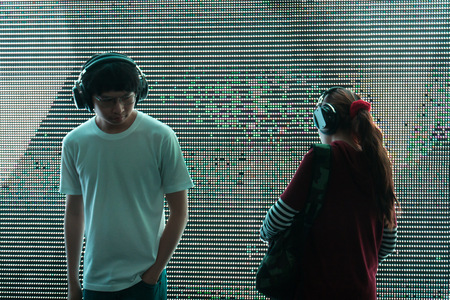
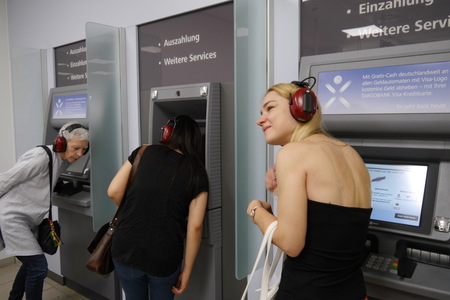
Kristina Kubish. Electrical Walks. Investigating electromagnetic fields in urban infrastructure using specialized headphones.
A space that needs to be heard
Hans Op de Beeck. The Silent Room, 2019. Shodoshima, Japan.
In Hans Op de Beek’s «The Silent Room, ” sound becomes an integral part of the work. The installation, created in 2019 on the Japanese island of Shodoshima, occupies the former building of a soy sauce producers' association. Initially, the visitor removes their shoes, sits down, drinks tea, and then enters an almost monochromatic space—this area features a pond with water lilies, flowering trees, stones, a library, a piano, and figures of children with their eyes closed. The title is misleading: the room is not silent. Op de Beek specifically composed a soundscape of sounds and musical motifs for it, which plays inside the installation. The music here does not illustrate individual objects or tell a narrative; rather, it sustains a state of focus and deceleration, which is the entire purpose of the space’s design. Such a piece cannot be grasped with a single glance. It must be experienced through time—you must be inside, acclimate to the setting, and begin to distinguish what initially seems like mere „background noise.“ Here, listening becomes as vital a mode of perception as sight.
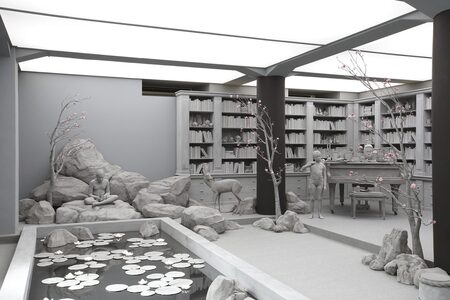
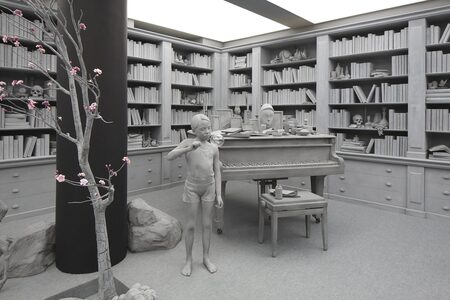

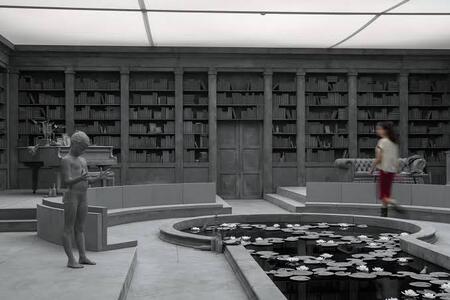
Hans Op de Beeck. The Silent Room, 2019. Shodoshima, Japan.
Algorithmic Soundscape
A photograph is silent on its own, but we often almost automatically complete it acoustically. A bustling intersection evokes the sound of cars and sirens in our imagination; a forest suggests the rustle of leaves and the calls of birds. In the project Imaginary Soundscape by the Qosmo studio, this correspondence between image and sound is constructed algorithmically. The system analyzes the image and searches the sound library for a field recording that, based on its calculations, could correspond to it. As a result, the photograph receives a presumed soundscape—not a recording of a specific place, but an algorithmic version of how it might sound. This distinction is particularly interesting here. The algorithm does not «hear» the depicted space, nor does it reconstruct its actual sound. Instead, it matches visual cues with existing recordings and suggests the most appropriate combination. Therefore, the resulting soundscape speaks not only to the image itself but also to the connections between the visual and sonic that are embedded within the system. The soundscape turns out to be not only what can be heard in a certain place, but also what can be hypothesized, modeled, and reassembled.
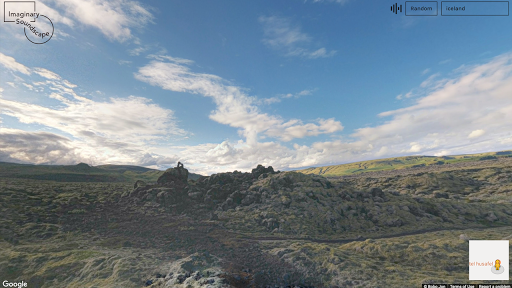
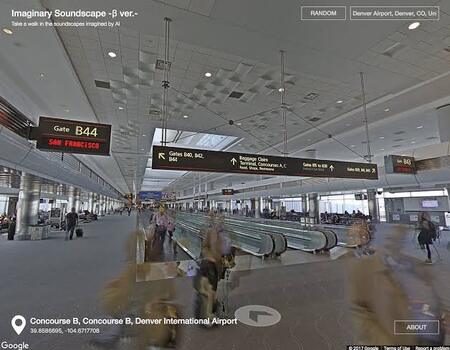
Qosmo. Imaginary Soundscape, 2017. The system correlates the visual scene with one of over 60,000 sound fragments.
Soundscape as Score
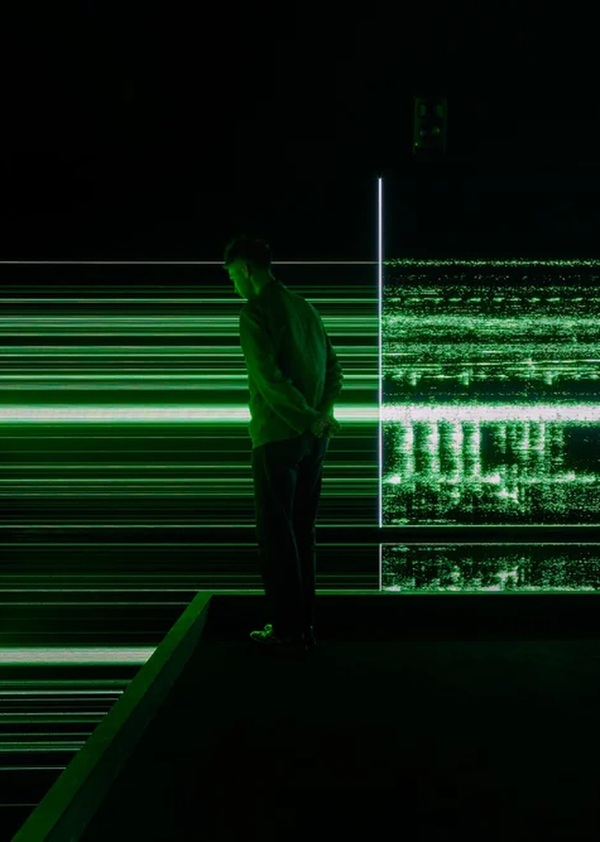
Bernie Krause and United Visual Artists. The Great Animal Orchestra, 2016. Immersive sound installation.
Recorded sound can not only be preserved but also translated into a visual form. In the installation The Great Animal Orchestra by Bernie Krause bioacoustics and United Visual Artists Studio, the voices of animals, birds, and insects are transformed into moving sonograms—they are distributed across the screen according to frequency and time, forming a complex pattern of the soundscape of an ecosystem. The work is based on Krause’s many-year archive of recordings of natural soundscapes from around the world. Seven territories were chosen for the installation—from North America to Central Africa and the ocean. They can be listened to and observed simultaneously as sonograms: each new sound leaves its own visual trace. However, this «polyphony» has another dimension. By comparing recordings of the same locations made in different years, Krause discovered how their acoustic richness changes: some sounds disappear along with the alteration of ecosystems and the reduction of biodiversity. The soundscape becomes a kind of archive—through it, one can judge not only how a place sounds but also what is happening to it.

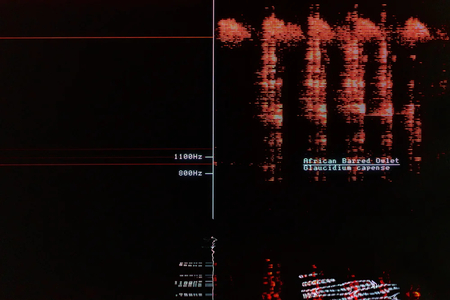
Bernie Krause and United Visual Artists. The Great Animal Orchestra, 2016. Immersive sound installation.
We are accustomed to perceiving sound as something fleeting—it emerges and vanishes immediately. But the soundscape shows the opposite. Sound can be recorded, mapped, transformed into a route, and made visible—serving as evidence of how the surrounding world changes.
Bernie Krause and United Visual Artists. The Great Animal Orchestra, 2016. Immersive sound installation.