Navigation
1. Concept 2. Iconographic Origins of the Gupta Style: From Kushan Mathura to Classical Synthesis 3. Two Faces of Classicism: The Mathura School and the Sarnath School 4. Architecture of the Gupta Era: From Cave Temples to Stone Sanctuaries 5. Colors of Eternity: The Frescoes of Ajanta and the Birth of Classical Painting 6. Iconographic Code: From Symbol to Anthropomorphic Form 7. Buddha and Vishnu: The Unity of Canon Amidst Theological Differences 8. Conclusion. Findings
Concept
The iconic representations of the deities of the Gupta era—such as the Buddha, Vishnu, and Bodhisattvas—occupy a significant place in the history of world art. It was during the 5th century that the canonical forms developed, which continue to define our understanding of classical Indian art. This study examines the formation of this visual language. From diverse traditions—the archaic plasticity of Mathura, the Hellenized realism of Gandhara, and local aniconic cults—a new, cohesive style emerged. The sculpture, architecture, and painting of this period did more than just adorn temples and palaces; they became vehicles for complex theological ideas. The frescoes of Ajanta, the Dashavatara temple in Deogarh, and the Buddha statues from Sarnath—each of these monuments is not merely a remarkable work of art but also a key to understanding the worldview of the era. These images are not simply illustrations accompanying texts; they are a reflection of Indian civilization, capturing the moment when earthly beauty began to be perceived as an expression of divine perfection.
Existing interpretations of Gupta-era art often view this period as a time of cultural flourishing. However, the question of how various artistic traditions—such as the plasticity of Mathura, the art of Gandhara, and early aniconic forms—were synthesized into a unified system of sacred imagery takes on particular significance.
The empirical foundation of this study comprises various visual sources from the Gupta era. These include monumental sculpture (the renowned Buddha statues from Sarnath and Mathura), architectural monuments (the Ajanta cave complexes, the Dashavatara Temple in Deogarh), fresco paintings (the narrative cycles of Ajanta), and elements of architectural decoration. The chronological framework spans the late Kushan period (3rd century CE), the zenith of the Gupta dynasty (c. 320–550 CE), and the early post-classical phase. This type of periodization and material selection allows for the reconstruction of iconographic traditions that preceded the Gupta style (the Mathura and Gandhara schools), traces the mechanisms of their synthesis in the 5th century, and determines which specific elements of the established canon were formalized as normative for subsequent artistic tradition.
The study is structured in three parts, organized according to chronological and comparative principles. The first part is dedicated to the iconographic origins of the Gupta style: it analyzes the core visual themes, compositional schemas, and symbolism characteristic of Mathura Kushan sculpture and the Hellenized Gandhara school. The second part examines the formation of the classical canon during the Gupta period itself: it identifies the distinctions between two leading schools (Mathura and Sarnath), investigates the transformation of the representation of corporeality and the semantics of the sacred, and analyzes the transition from aniconic symbols to the anthropomorphic depiction of the deity. The third part focuses on the architectural and pictorial innovations of the 5th century—cave temples, early stone sanctuaries, and the frescoes of Ajanta. The key objective of this section is to understand how a new sacred space and a visual language for conveying emotional states (bhava) were formed, as well as to assess the extent of the influence of Gupta iconographic and stylistic models on the development of Indian art over the next one and a half millennia. The methodology is grounded in comparative iconography, formal-stylistic analysis, and a semiotic approach to visual data.
The central question guiding this research is: How did the classical visual iconography of divinity and the unified artistic canon of Indian art develop during the Gupta period?
Iconographic Origins of the Gupta Style: From Kushan Mathura to Classic Synthesis
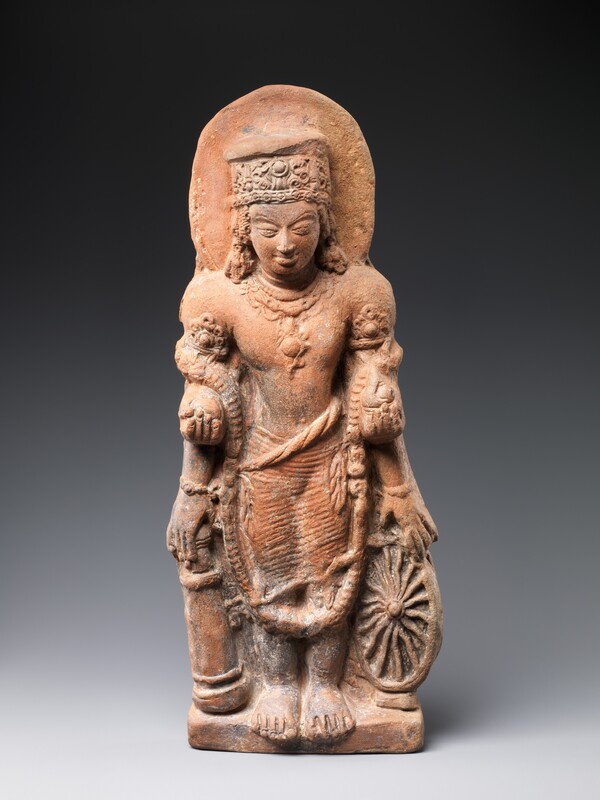
Image Origin: During the Kushan period (1st–3rd centuries CE), two main traditions for depicting the Buddha developed. Mathura (North India) presented a powerful, body-oriented plasticity, inherited from local fertility cults. Gandhara (the territory of modern Pakistan) developed an Hellenized realism, emphasizing anatomical accuracy and drapery reminiscent of Greek examples.
Traditionally, the art of the Gupta era is viewed as a moment of flourishing Indian artistic culture. Of particular importance is the question of how this classical visual language developed. The foundation of Gupta art was a complex synthesis of earlier artistic traditions—the plasticity of Mathura and the Hellenized art of Gandhara. It was precisely the combination of corporeal expression, material form, and the pursuit of spiritual idealization that enabled the creation of a new divine image, which would subsequently become canonical in Indian art.
The earliest examples demonstrating the characteristics of the Gupta style include the Buddha statues discovered in Sarnath (5th century), the Vishnu sculptures from Deogarh, and architectural decoration fragments found in Mathura.
Buddha Statue from Sarnath V. Museum in Sarnath. Sandstone
Vishnu, reclining upon the serpent Sheshnaga, on the wall of the Dashavatara temple of Vishnu.
Two Facets of the Classic: The Mathura School and the Sarnath School
There are two key directions within Gupta-era sculpture, each aiming to create an exemplary statue of the Buddha, yet achieving it through different paths. Comparing these two artistic traditions reveals the process of classical style formation.
Mathura Style: This school draws upon the traditions of Kushan art. The 5th-century Mathura sculptures of Buddha are characterized by an impressive, athletic physique (broad shoulders, developed chest), drapery folds that emphasize the body’s contours, and a face with full cheeks and wide-open eyes. This imagery embodies the Buddha-king, yet retains a connection to the material world.
Sarnath Style: In contrast, the Sarnath school presents a completely different approach. The robes (sanghati) transform into semi-transparent, «damp» garments. This technique does not hide the body but rather emphasizes its ideal proportions, yet without the overt muscularity found in Mathura figures. The body appears as a smooth form. The face gains serene features: a downward gaze and a gentle, enigmatic smile. This is the image of the ascetic Buddha, already withdrawn from the realm of worldly affairs.
The contrast between the Mathura and Sarnath schools allows us to examine two distinct approaches to understanding the sacred image. The Mathura tradition retains a connection to the physicality and corporeal power of the figure, while the Sarnath school strives for maximum spiritual abstraction and inner tranquility. Thus, the difference between the schools lies not only in artistic style but in the very interpretation of the divine nature itself. It is the interplay of these opposing principles that shapes the classical ideal of the Gupta era.
Statue of a Standing Buddha, circa 5th century CE, Gupta period. Presidential Secretariat, Rashtrapati Bhavan.
The Archaeological Museum of Sarnath, featuring the Buddha from Sarnath, dating to around the 5th century CE.
Architecture of the Gupta Era: From Cave Temples to Stone Sanctuaries
It was during the Gupta era that the transition occurred from cave complexes carved into rock to the first freestanding stone temples.
Cave Temples (a tradition dating back to the 2nd century BCE): The Guptas continued to create magnificent cave complexes (Ajanta, Ellora). Their significance lies in forging a «transitional» space between the external, profane world and the internal, sacred realm. The First Stone Temples: The temple at Bhitargaon (brick, but with stone cladding) and the Dashavatara Temple at Deogarh (stone). It was in Deogarh that the garbhagriha type first took shape—a dark, square chamber where the statue stood in complete isolation, accessible only to the gaze of the priest or the meditative observer.
The transformation of the architectural environment during the Gupta period is linked to a new understanding of sacred space and the role of the cult image within it. The shift from cave temples to freestanding stone sanctuaries reflects the aspiration to create a more organized and symbolically structured system of human and divine interaction. The formation of the garbhagriha and the vertical composition of the temple became not only an architectural innovation but also a means of emphasizing the unique nature of the sacred space.
Ajanta Cave Temple, Cave 19, 5th Century. Facade with a Chaitya.
Dashavatara Temple in Deogarh V. One of the first stone temples featuring a garbhagriha.
Colors of Eternity: The Frescoes of Ajanta and the Birth of Classical Painting
A unique instance where we have received not only sculpture but also monumental painting from the classical period.
Technique: Tempera on dry plaster, but with a unique binder secret that allowed the colors to retain their vibrancy for one and a half thousand years. The palette includes earthy tones (ochre, umber), red, blue, and green.
Subjects: Jataka tales—stories from the previous lives of the Buddha. But the main focus here is not the narrative, but the principle of depiction. The Ajanta painting creates a «flowing» world: bodies curve into complex angles, and figures seamlessly transition into one another.
Aesthetic Program: The emergence of the concept of bhava—an emotional state that the artist must convey. In the Ajanta frescoes, we see not just illustration, but an attempt to depict an experience: suffering, compassion, joy. Painting becomes a means of transmitting feeling (rasa).