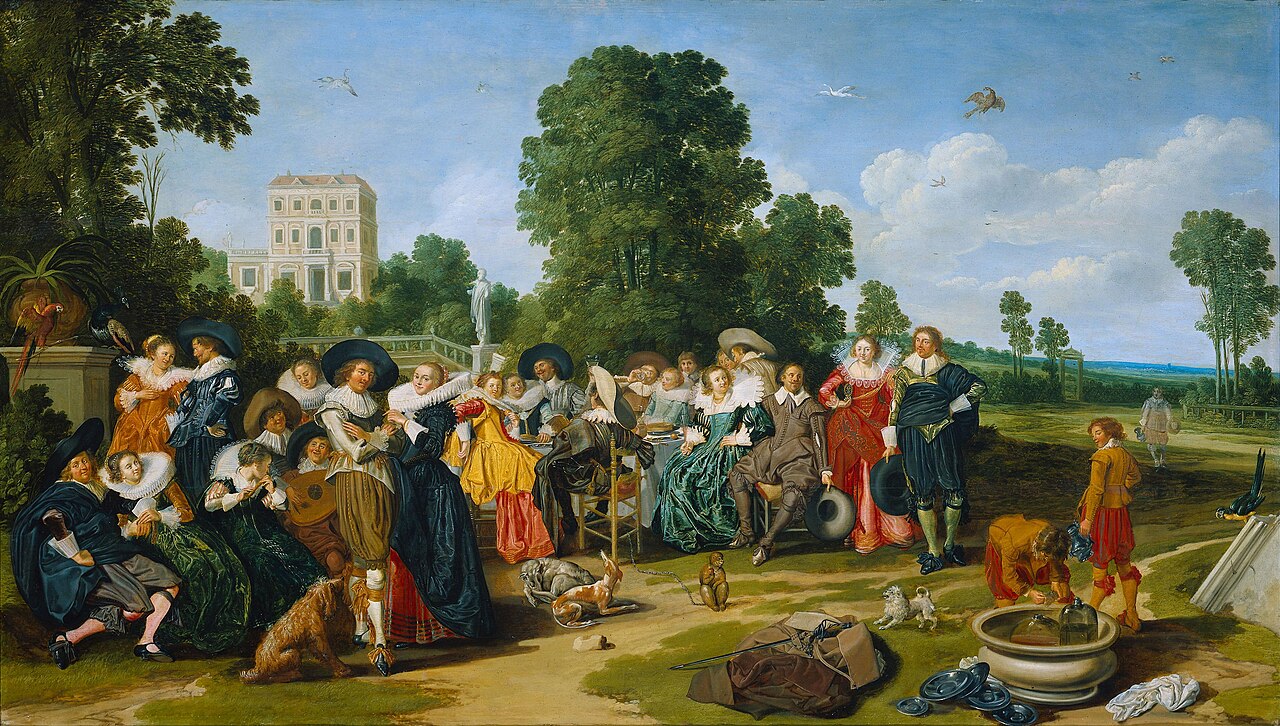
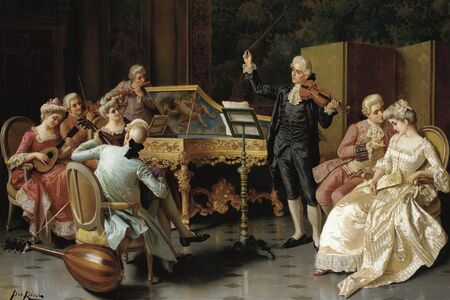
The HSE Art and Design School at the Faculty of Creative Industries, in collaboration with the State Institute of Art History of the Russian Academy of Arts, presents the tenth special edition of the HSE University Journal of Art & Design—an electronic scientific journal dedicated to 17th-century European art. In December 2024, the XI annual scientific conference, «Rothenberg Readings, ” was held at the State Institute of Art History and was entirely dedicated to a comprehensive examination of 17th-century culture. Art historians have rightly dubbed it the first modern (moderno) century. This era introduces the Early Modern period, marking a stage shift and the conclusion of the archaic stage of development, which encompasses primitive times, Greco-Roman antiquity, the Middle Ages, and the Renaissance. Beginning in the latter half of the 16th century, the transition toward the bourgeois order commences, passing through the periods of the Early Modern (17th–18th centuries), the Modern (19th century), and contemporary (20th–21st centuries). The 17th century was characterized by significant cultural transformations that spanned all spheres of art. „Europe around 1600“ was defined by the further process of breaking down what had previously appeared to be a single artistic process into distinct styles, movements, and directions that differed not only formally but also ideologically.
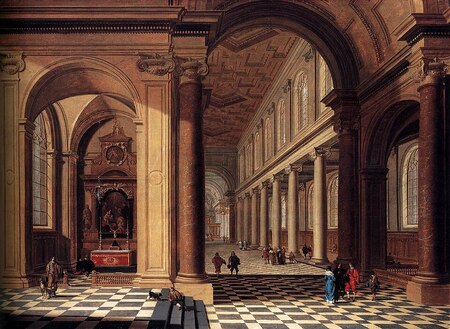
In the new issue, the focus of the researchers is not only the transition from Mannerism to Baroque but also the contemplation of the crisis in older classical stylistic norms and the birth of new aesthetic ideals within the emerging field of Realism. All these intersections and connections—the unseen and the hidden—are within the purview of our authors, whose perspective defines the representative strategies of contemporary art history. Before us is a visual laboratory of the seventeenth century and a reinterpretation of formal pursuits through the lens of aesthetic pluralism and interdisciplinary dialogue. Viewing the seventeenth century as a time of dramatic rupture with tradition, the authors demonstrate that art first recognized its own autonomy; the struggle between styles was not a symptom of decline but became a symbol of the birth of that very «modernity that shaped current visuality.»
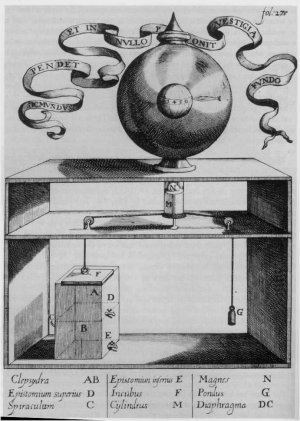
The publication opens with L. V. Kirillina’s article, «The Musical Cosmology of Athanasius Kircher, ” in which the author reflects on the German polymath Athanasius Kircher (1602–1680) and his two-volume work, Musurgia universalis (1650). This work was the most comprehensive compilation of musical knowledge, summarizing all achievements in music history and theory up to the mid-seventeenth century. While developing his concept, Kircher drew upon the works of predecessors—Johannes Kepler’s Harmonices mundi (1619) and Maria Mersenne’s Harmonie universelle (1636). Although Kepler’s treatise was on the inquisitorial banned list, preventing Kircher from citing it directly, the author focuses primarily on the second part of the treatise, which discusses the philosophy of music and Kircher’s unique musical cosmology. By comparing the cosmos to a vast „ten-register organ“ and God to the greatest organist (organoeda), Kircher perceives the universe as a perfect musical composition permeated by „symphony“ (the consonance of everything with everything else). Despite its fantastic and mystical nature, Kircher’s musical cosmology helps to understand the aesthetic principles that guided Baroque composers, including Bach and Handel.
Afanasy Kircher. Engraving of the frontispiece for the first part of Musurgia universalis. 1650
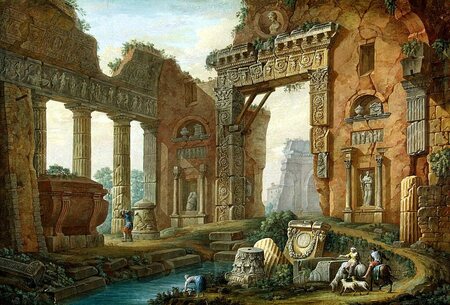
In the article, «Charles-Louis Clerisse, Nicolas Poussin, Cassiano Dal Pozzo, and the Traditions of Studying Roman Antiquities,» by E. A. Yefimova, a group of drawings depicting ancient architectural details is examined: bases, capitals, entablatures, as well as reliefs of pedestals and tripods, which circulated in European architectural graphics from the 16th to the 18th centuries. Drawing on unique archival materials from the collection of the Library of Arts in Berlin (Inv. Oz 114) and others, the author introduces an unexplored source into scholarly discourse—a collection of 17th-century drawings from the scientific library of the State Hermitage Museum, known as the Destailleur C album (Inv. St-14742/3). By substantiating the link between the drawings in this album and the group of graphic examples under consideration, she posits a hypothesis regarding its origin within the close circle of Nicolas Poussin and Cassiano Dal Pozzo. The paper presents interesting speculations about the possible patron of this album and its attribution, and concludes that such drawings are significant as a means of disseminating knowledge about ancient antiquities and classical architectural language.
Jean Leerme (Grand). The Apostles Paul and Barnabas in Lysta. 17th Century. Canvas, oil. 106 × 137 cm. Museum of the Great Age, Saint-Cloud // Anonymous. Candlestick pedestal from Palestrina. Album of architectural drawings. 16th Century. Museum of Arts, Berlin
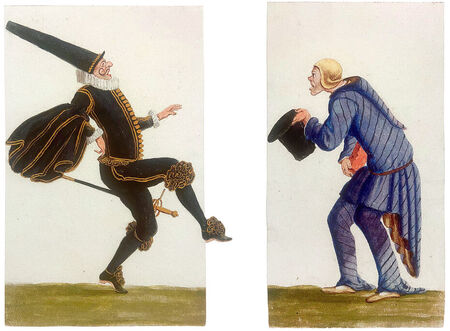
T. G. Shovskaya, in her article «Mask in Motion: Interpreting the Images of Commedia dell’arte in the Sketches of Ludovico Ottavio Burnacini, ” reflects on the collection of the Vienna Theater Museum, which houses files containing the sketches of set designer and architect Ludovico Ottavio Burnacini. Burnacini worked at the Habsburg court in the latter half of the 17th century. A significant portion portrays him as a costume designer. In the author’s opinion, these costumes originated from the annual carnival celebrations at court, and their repertoire is highly varied—ranging from carnival outfits representing different peoples, created based on Roman attire and intended for court members, to grotesque garments for court dwarves. The article thoroughly examines the Burnacini cycle of sketches associated with Commedia dell’arte: the context of their creation, the trends they incorporate, their artistic characteristics, and finally, their influence on the further development of Italian comedy imagery.
Ludovico Ottavio Burnacini. Twelve Figures. Sheet from the «Dwarves and Funny Masks» section of the «Masks» series. Late 17th Century. 24,7 × 37.9 cm. Pencil, watercolor, paper. Theater Museum, Vienna
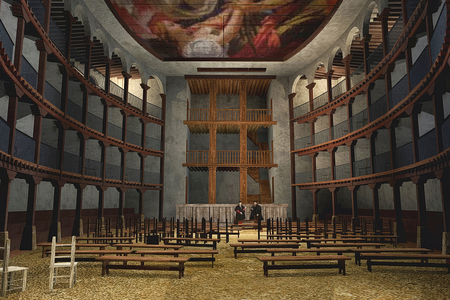
Article by E. A. Artamonova, «In the Shadow of the Greats: Juan Bautista Diamante and 17th-Century Spanish Theatre, ” is dedicated to the life and work of Juan Bautista Diamante (1625–1687)—an author who achieved success in the second half of the 17th century but remains largely overlooked by contemporary scholarship. According to the researcher, reconstructing the biographical and historical context of Diamante’s life as a playwright is crucial for understanding the history of Spanish theatre, which was shaped not solely by the works of popular authors. Particular attention is given to his comedies, characterized by virtuosic intrigue, witty dialogue, and complex character psychology. The article examines the influence of the era’s literary traditions and theatrical practices on the formation of Diamante’s dramatic style, arguing for his significant contribution to the development of Spanish drama.
Anonymous artist. Miracle of the Virgin of Atocha during the construction of the Casa de la Villa (Milagro de la Virgen de Atocha en las obras de construcción de la Casa de la Villa). 17th century. Canvas, oil. 85 × 120 cm. Madrid History Museum, Madrid. Inv. No. MHM 1456.
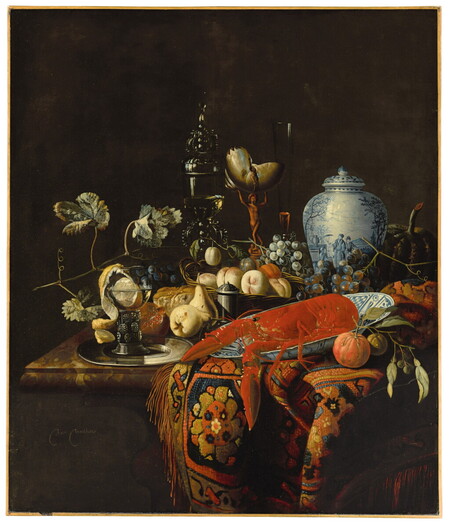
P. K. Antiferova, in her article «Still Life in the City of Utrecht: Paths and Specifics of Development in the 17th Century, ” reflects on the specific development of the Dutch still life in the provincial city of Utrecht, a large portion of the population of which adhered to Catholicism. This influence is reflected in the „Utrecht School“ of painting („Utrecht Caravaggism“), which was strongly influenced by Italian art and focused on genre scenes. The dramatic composition and expressive chiaroscuro characteristic of this movement can be indirectly seen in certain aspects of the still life genre. In the art of this city, torn between two religions, the impact of the Italian artistic environment, which resonated with Catholic culture, was distinctly evident. The influence of „Utrecht Caravaggism“ permeates the genre, particularly the hunting still life, through the Utrecht artist Jan Baptist Veniks (1621–1659), the father of the famous author of „hunting“ still lifes, Jan Veniks the Younger (1641–1719).
Jan Baptist Venix. Dead Birds and a Glass on a Cushion. 1650–1659. Canvas, oil. 64,8 × 54.8 cm. Private Collection // Jan Baptist Venix. Still Life with a Dead Swan. c. 1651. Canvas, oil. 184,5 × 187.3 cm. Detroit Institute of Arts, Detroit
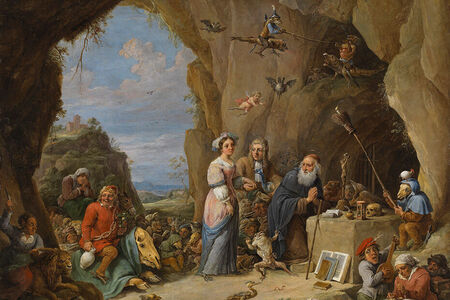
The article by V. O. Statkevich, «Reminiscences of the Demonic Motifs of Hieronymus Bosch in the Paintings of David Teniers the Younger: A Question of the Specificity of the Spoockerij Genre in 17th-Century Flemish Painting, ” is dedicated to investigating the genre specificity of a number of works by the outstanding Flemish painter David Teniers the Younger (1610–1690). In his work, he repeatedly addresses depictions of the temptation of saints, the Last Judgment, witchcraft, and other scenes filled with images of demonic beings. Such subjects formed a distinct genre in the art of both the Northern and Southern Netherlands during the 17th century, termed Spoockerij in sources. Using the paintings of David Teniers the Younger as an example, the author delineates the boundaries of this genre as perceived by the master’s contemporaries and also examines its kinship with the preceding tradition of depicting similar scenes. The researcher notes in the works of David Teniers the Younger belonging to the Spoockerij genre direct references to Hieronymus Bosch (c. 1450–1516), who had a colossal influence on the popularity and widespread dissemination of demonic motifs and similar subjects in general.
Follower of A. Brueghel. The Temptation of Saint Anthony. 1630s. Wood, oil. 27,2 × 21 cm. State Museum, Berlin.
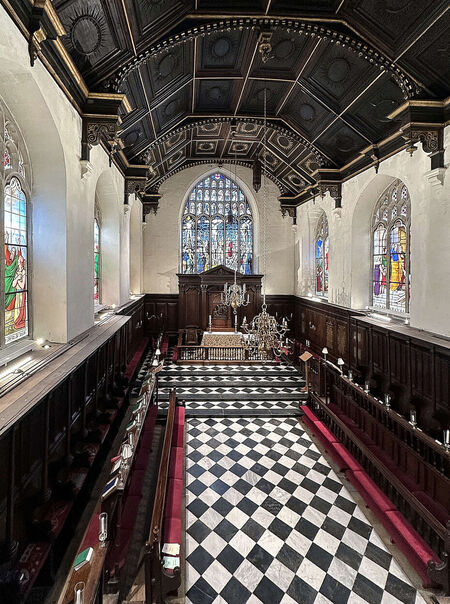
At the center of M. V. Sokolova’s research attention in the article «Christopher Wren’s Church Architecture: Gothic Revival or Gothic Survival?» is the problem of receiving and interpreting national medieval heritage, specifically Gothic church architecture, within the work of Christopher Wren. According to the author, the complexity of studying this topic lies in the fact that during the architect’s career, the Gothic tradition had not entirely faded into the past; it continued to exist to some degree, particularly in ecclesiastical architecture. Thus, the question of the Gothic tradition’s «revival or survival» becomes quite acute. The author seeks to determine what position Christopher Wren held regarding national architectural heritage and to what extent consciously he studied and utilized «Gothicisms» in his projects.
St. Catherine’s Church, Cri, Oldgate. 1628–1630. London
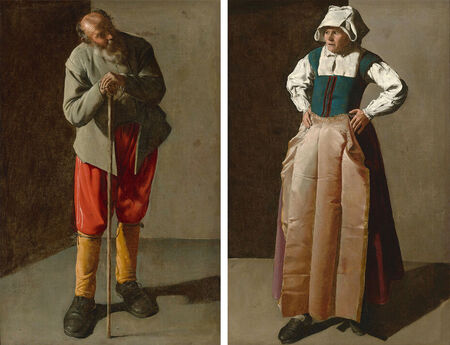
The issue concludes with the article by M. A. Demidova, «On the Theatrical Nature of Some Works by Georges de La Tour, ” in which the author analyzes the specifics of the artist’s creative method, noting the theatrical quality of his paintings. The author argues that Georges de La Tour’s method resembles the creative approach of Dutch masters and Caravaggisti. Despite the prevalence in Paris and Lorraine at the turn of the century and the early decades of the 17th century of the fashion for Bruegel-esque subjects, La Tour offered his own original interpretations of scenes related to everyday life. His compositions, which addressed themes typical of the Caravaggisti—gambling and fortune-telling—are not of a specific genre but are transformed into concise, monumental generalizations, the seriousness of which is concealed behind superb and richly ornamented pictorial execution. The artistic technique identified—the use of conventional composition to convey a vividly realistic situation—allowed La Tour to focus on the interpretation of specific characters. The theatrical nature of his paintings, which some scholars have noted, should be understood, in the author’s view, in a broader sense: as an indirect manifestation of the idea of the Theatrum mundi.
Georges de La Tour. Brawl of Musicians. c. 1620–1625. Canvas, oil. 86,4 × 141 cm. The Getty Museum, Malibu
The authors' engagement with 17th-century Western European art in the tenth, anniversary issue of the HSE Journal of Art and Design is not merely a historical retrospective; it is a territory of surprising discoveries and the formation of new meanings. Traditional visual narratives are replaced by creative experimentation and a new way of understanding the world. The artist began to recognize themselves as a Creator, rather than merely a craftsman. Art significantly expanded its boundaries and shaped the reflexive position of European self-awareness. Thus, the «first modern century”—which is familiar and understandable to us today—was formed.