Concept
«I don’t like talking about beauty. In general, I have a complicated relationship with beauty. For me, accuracy matters much more» (Ikonnikov, 2011). Dmitry Ikonnikov’s painting is precise in conveying personal feelings and sense of the material. This is not about vision; it reveals an understanding of the subject. Dmitry writes that we all see the same things, but we understand them differently—the artist is defined by their personal relationship to form, color, and texture…
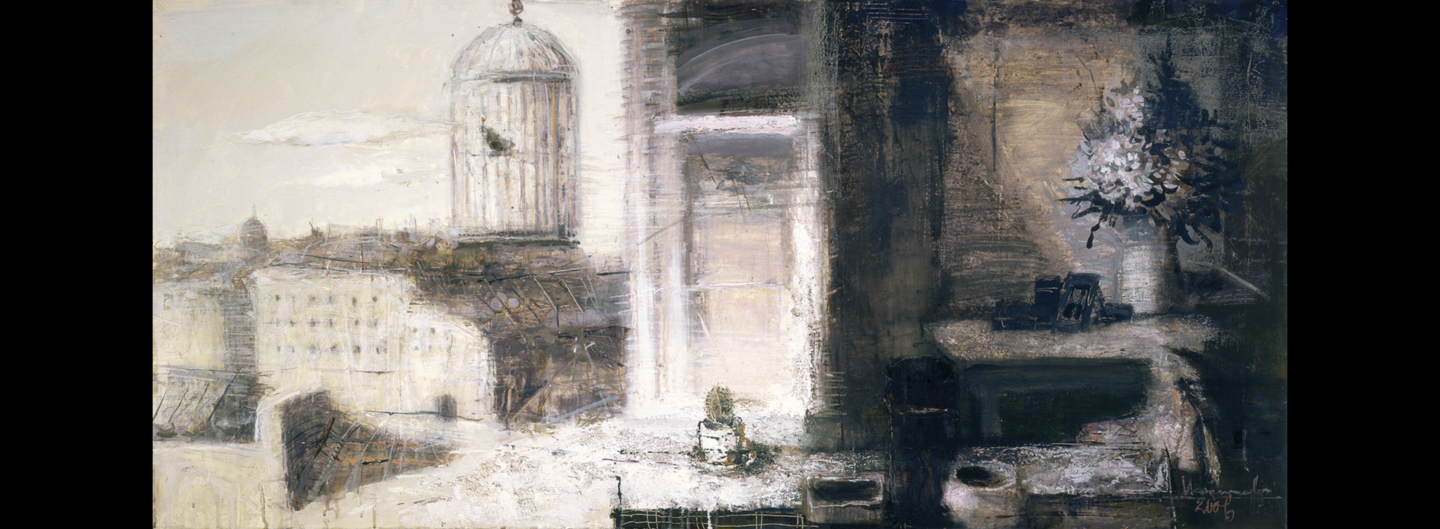
D. Ikonnikov, «View from the Window,» 2006
Ikonnikov’s work involves transferring the space and conditions surrounding a subject onto the canvas—it is the gesture of conveying a personal understanding and attitude. «To truly understand how the homeowners live, you have to go out to the backyard, look into the workshop, go into the kitchen; only then will you know what they breathe, whether they are neat or messy, whether their culture is merely external or a fundamental principle of their lives, what they are truly interested in, not just what they want to show you» (Ikonnikov, 2011). The theme of the yard, as a place where people gather in their true form, is often addressed by the artist. Dmitry himself grew up in a yard—first in Murmansk, absorbing the customs of a port city and existing in a «self vs. other» dynamic—and then in Moscow, with friends who dreamed of grabbing the last coin.
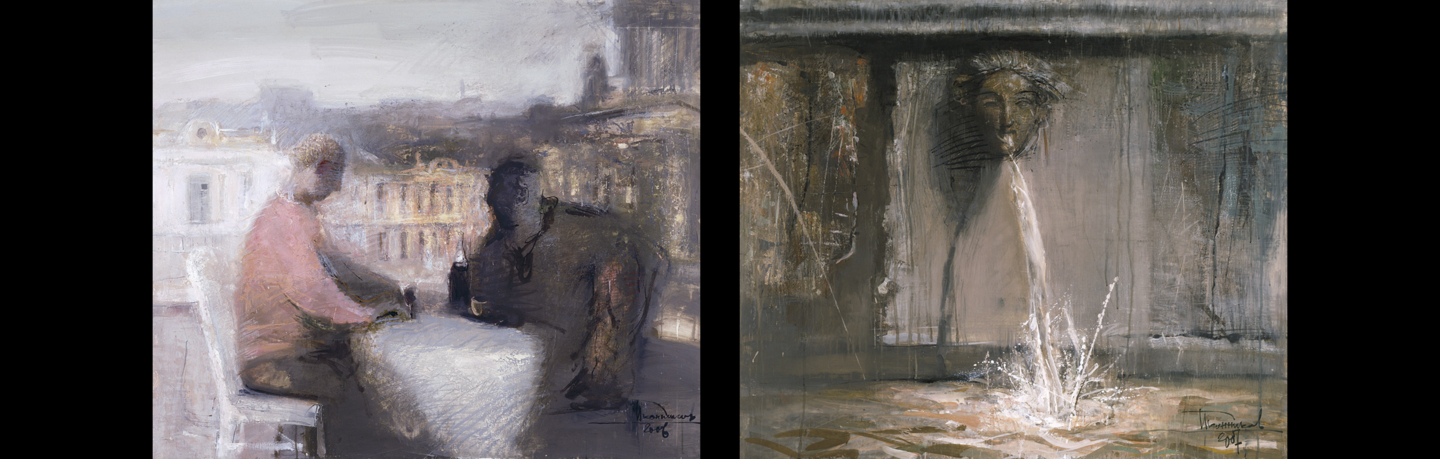
D. Ikonnikov, «At the Hour of Early Spring Sunset…, ” 2006; „Leaking Water, ” 2007
The theme of searching for a place is conveyed in the artist’s paintings. For me, they are about wandering people who circle around without seeking to claim anything, because everything will change. Detachment and purity generate precision. By moving and changing studios, the artist fixes the objects and people around them, thereby connecting themselves to the location.
Working in the 1990s and 2000s, Dmitry also succeeds in portraying the daily life of that era: what people eat and drink, how they spend their time, what they believe, and how they decorate the corners of their rooms. He paints winged angels sitting at the same table as men drinking alcohol, and fish invariably appear in his still lifes of everyday life. The intersection of daily life, a somber and far-from-righteous existence, and faith interests the artist. It is the truth of existence, revealed from the courtyard.
D. Ikonnikov, «Confucius: ‘A noble man lives in peace and contentment…’», 2006
City, courtyard, room, corner—these are the images upon which Ikonnikov’s painting is based, and they form the foundation of the work. To investigate the city as a place of dwelling and the formation of memories and ideas, Gaston Bachelard’s text, «The Poetics of Space» (1958), is helpful. Dmitry’s paintings were taken from the artist’s personal website. The goal of this visual study is to trace how the artist paints the space around him and what means he employs. Is it possible to depict the essence of places you have once visited?
Phenomenologist Gaston Bachelard phrases this question as follows: «There is a kind of attractive force that concentrates images around the home. Can we derive a certain intimate, concrete essence from memories of all the houses where we found shelter, from the advantages of all the homes where we dreamed of settling, that would confirm the special value of all the images of coziness and security known to us?» (Bachelard, 1958)
City
Ikonnikova’s city is devoid of inhabitants; the paintings show only shadows or traces of their lives. In the canvas «Scream, Don’t Scream…», the artist gives the residents a space for communication—a way to vent—by painting a wall adorned with drawings, slogans, and excerpts of poetry.
D. Ikonnikov, «Shout, don’t shout…, ” 2000
D. Ikonnikov, «Anichkov Bridge, ” 2008
D. Ikonnikov, «City. Left Panel of Diptych 'St. Petersburg'», 2007; «Over the City. Cathedral», 2006
D. Ikonnikov, «Metropol, ” 2006
D. Ikonnikov, «White Bridge on Pyatnitskaya, ” 2006; „Udarnik Embankment, ” 2006
D. Ikonnikov, «Two Trees and a Bench, ” 2002
D. Ikonnikov, «Interrupted Flight, ” 2015; „Flight in an Updraft, ” 2015
The image of a city as a plaza with towering buildings overwhelms the human figure, often becoming a place of ascent—a peak of pleasure. In such moments, the hero, situated in a room, gains wings and rises above the city himself.
Courtyard
The courtyard is a space for open living. It is a place where you don’t have to be self-conscious about your position, where you can dance. In Ikonnikov’s paintings, the courtyard is a space opposite to the city. Here, the character’s individuality takes center stage, and a passing wanderer is immediately noticed.
D. Ikonnikov, «Glass of Wine on the Roof of the World No. 2, ” 2009; „Let’s go fly around Europe in airplanes…“, 2009
D. Ikonnikov, «Confucius: ‘The noble husband is happy everywhere…, ’» 2008
«Grez is facilitated by 'vast expanses of silence outside the city.' In that space, 'the moral world opens up to him with huge prospects, full of new insights'» (Bashlar, 1958). I believe that the courtyard in Ikonnikov’s paintings could be such a place of boundless silence outside the city. The artist finds his characters in a vulnerable state, but he does not condemn them; rather, he presents the reality surrounding them—foreign currency, newspaper headlines, airplanes, and letters—things that worried the Moscow resident of the 90s and 00s.
D. Ikonnikov, «This is all rock and roll, ” 2002; „The Young Lady and the Hooligan, ” 2013
D. Ikonnikov, «Park of Culture and Leisure,» 2006; «Sunlit,» 2006
D. Ikonnikov, «House No. 5, ” 2003; „Luke (Summer on the Asphalt), ” 2003
D. Ikonnikov, «What’s in our yard…», 2003
D. Ikonnikov, «Wayfarer,» 2006; «Bearer,» 2003