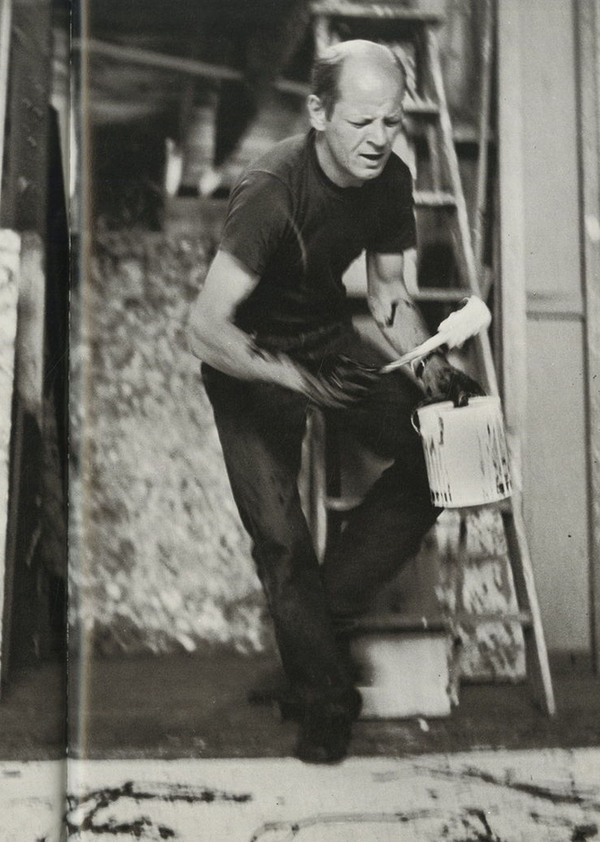
How does the «action painting» technique shape the visual structure of Jackson Pollock’s works and influence the viewer’s perception of his art?
Concept
The paint application technique developed by Jackson Pollock determines not only the appearance of his works but also the very logic of the visual structure’s formation. The properties of the paints used—their viscosity, fluidity, drying speed, and how they interact with the canvas surface—become active participants in the artistic process. In Pollock’s painting, the artist’s gesture and the physical characteristics of the material are inseparable: the movement of the arm, the body’s trajectory, the distance from the canvas, and the force of the paint toss shape the rhythm of the image, its layering, its spatial depth, and the direction of perception. This is why analyzing his work demands attention not only to composition but also to how the paint lies, spreads, crosses, and interacts with all the layers.
The chronological principle of work selection allows us to trace the evolution of the method: from early splatter experiments in 1943 to the mature period of «dripping» between 1947 and 1952. During this time, Pollock’s technique reaches maximum expressiveness, and the structure of his canvases becomes the most complex and multilayered. Later works after 1953 are excluded from the analysis because the artist shifts to darker, monochromatic compositions, reflecting a different stage of his artistic search.
The «action painting» method radically transformed the global perception of the painting creation process. Pollock shifted the emphasis from the finished product to the act itself—the process of creating the artwork: the body’s movement, rhythm, and the artist’s interaction with space became integral parts of the piece. The painting ceased to be a static object and evolved into a trace of action, into material energy. This is precisely why the selection of the research topic is driven by the desire to understand how the artist’s physical action transforms into visual structure, how gesture becomes a formative element, and how chance becomes part of the compositional logic.
Pollock’s action painting became one of the most radical gestures of the 20th century, fundamentally altering the very understanding of the painting process. His drip technique is not merely a technical innovation but a profound shift in perceiving the canvas as an event. Pollock dismantled traditional composition, replacing it with dynamism. The interest in this subject is heightened by the fact that the visual structure of his canvases continues to spark debate: some scholars view it as chaos, while others perceive a hidden mathematical pattern rooted in the recurrence of gestures and fractal organization.
Thus, the central question of this study is how the technique of action painting forms the visual structure of Pollock’s works and how that structure affects the viewer’s perception.
The hypothesis suggests that the visual structure of his paintings is not chaotic: on the contrary, it represents an organized system emerging from the interaction of gestural rhythm, repetitive movements, and the material properties of paint and canvas. Randomness in his work does not destroy order; rather, it becomes a means of forming it, transforming into a tool for creating a complex yet internally consistent composition.
Categories
- Concept
- Historical Context
- Analysis of Pictures from the Drip Period
- Comparison of Paintings
- Performativity of the Process
- Conclusion
- Bibliography and Image Sources
Historical Context
Pollock’s artistic context cannot be separated from the post-war environment of New York in the late 1940s and early 1950s.
After World War II, the center of world art shifted from Europe to the United States, and New York emerged as the new artistic capital—the birthplace of the first major American movement to achieve international recognition: Abstract Expressionism. Its emergence was tied to the war’s aftermath, a sense of instability, and the search for new artistic forms capable of expressing the human condition during an era of global upheaval. Artists sought to move beyond traditional representation of the world, viewing painting instead as a space for expressing personal experience, emotional tension, and psychological depth.
Abstract Expressionism lacked a singular visual method: some artists developed color abstraction based on large color fields, while others focused on expressive gesture and the dynamics of movement. Jackson Pollock belonged to the latter group and became a central figure in the action painting movement. For artists in this circle, the freedom of gesture, the rejection of narrative subject matter, and traditional composition were of particular importance. The large formats of the canvases amplified the viewer’s immersion in the pictorial space, transforming the painting into an environment rather than an image.
Although Pollock became a symbol of American art, his artistic thought was shaped by the European avant-garde of the first half of the 20th century. Early works show mythological and symbolic motifs, reflecting the artist’s interest in the collective unconscious and archetypes. Gradually, these motifs transformed into non-objective compositions, where gesture became the primary means of expressing internal psychological processes.
In the mid-1940s, Pollock abandoned figuration and shifted to a technique involving the free movement of paint. This represented a crucial stage, reflecting the broader explorations of the New York School. It marked a move beyond traditional composition and the transformation of painting into a direct expression of inner impulse. Amid an atmosphere of political tension, rising individualism, and interest in psychoanalysis, artists sought a way to convey internal states without conventional narratives. Pollock, who underwent psychotherapy and studied Jungian archetypes, viewed painting as a direct discharge of psychic energy, making his method both an artistic and psychological experiment.
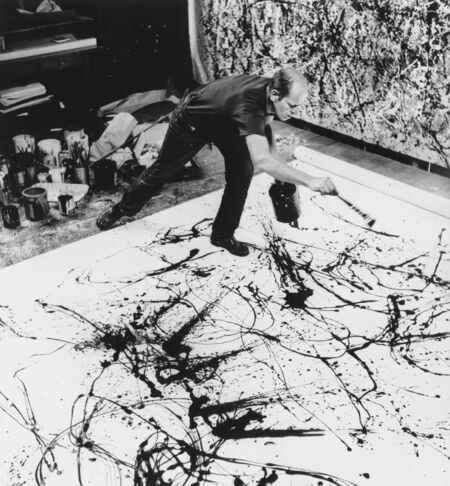
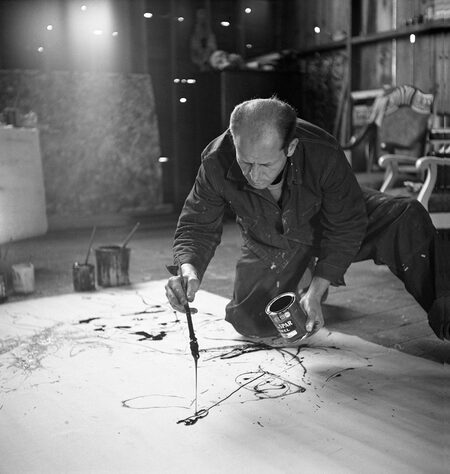
Jackson Pollock
Pollock introduced the technique of «action painting»: he abandoned the easel, spread the canvas on the floor, and freely moved around it from all sides. Using sticks, rods, stiff brushes, and flowing enamel paints, he created complex interweavings of lines and splatters. This shattered the traditional compositional center—the image was distributed evenly across the surface, allowing the viewer’s gaze to freely glide within the visual field.
The material properties of paint played a vital role in shaping the structure of his works. Pollock experimented with viscosity, drying time, and how the paint behaved on canvas, allowing him to create multi-layered structures unattainable within the framework of classical oil painting. His method emerged from the intersection of psychological and technical factors, reflecting the era’s drive toward new forms of artistic expression and transforming painting into a space of action, energy, and inner freedom.
Analysis of Impressionist Paintings
Jackson Pollock’s works represent an example of a fundamentally new approach to painting, where the focus is not on depicting an object, but on the artistic process itself.
«Full Fathom Five»
Jackson Pollock, «Full Fathom Five, ” 1947
One of the key works from Pollock’s early period of drip painting is «Full Fathom Five.» In this painting, the core characteristics of the artist’s distinctive method are already evident: the absence of a clear compositional center, the dense intertwining of lines, and the use of various materials. Although Pollock began painting this piece on an easel, he finished it on the floor. Pollock incorporates sand, cigarette butts, coins, and other elements into the canvas surface, creating a complex texture. Ultimately, he removed the canvas from the easel, laid it on the floor, and coated the entire surface with black and silver enamel.
The painting is perceived as a single energetic field where the viewer’s gaze does not fixate on one point but constantly moves across the surface. The effect of depth, achieved through the layering of lines and varying paint density, is particularly important here. This is one of the first paintings in which he used the «drip» painting technique.
«Number 1A»
Jackson Pollock, «Number 1A, ” 1948
In the work «Number 1A,» the painting technique becomes more confident and organized. The composition is built upon the intersection of long lines and abrupt gestures, creating a rhythmic structure. Despite its apparent randomness, the painting possesses an internal balance: the lines are distributed across the surface to maintain a sense of even tension.
The traces of the artist’s hands and palm prints hold particular significance, transforming the act of creation into part of the visual content. Pollock effectively fixes the presence of his own body within the painting, underscoring the connection between movement and image.
Jackson Pollock began numbering his paintings instead of giving them expressive titles. This shift, according to his wife Lee Krasner, was intended to render the works neutral so that viewers could see them as pure art.