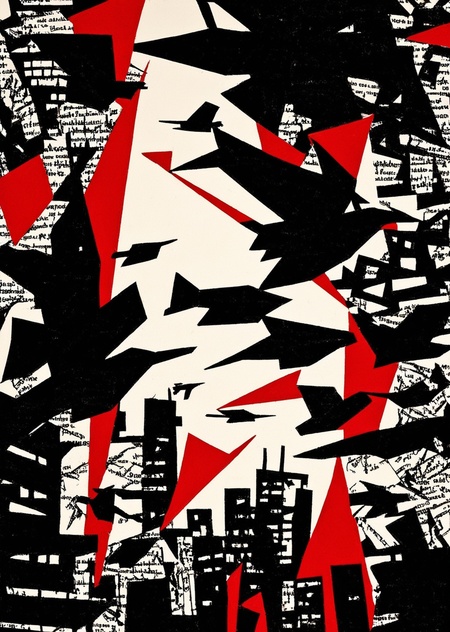
The original series was conceived as a visual interpretation of Ray Bradbury’s novel, Fahrenheit 451. In the collages, I utilized a red-and-black palette, fragments of printed pages, large angular forms, and handmade paper appliqué.
In this project, I decided to extend this visual world beyond the book’s narrative. To achieve this, I trained a LoRA on my own collages to test whether the model could translate their visual language onto new objects and scenarios.
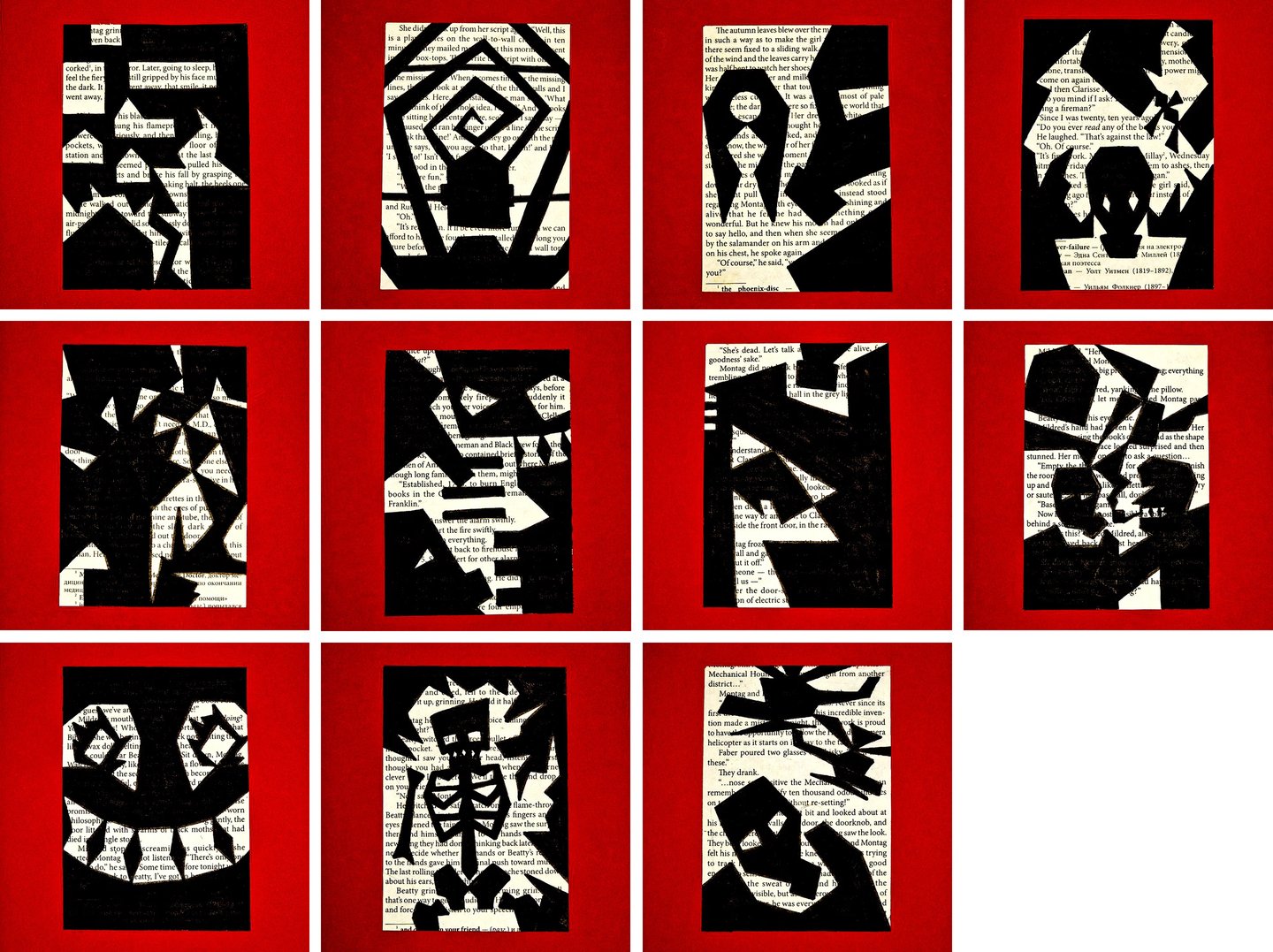
Original Series
What happens if the visual language of «Fahrenheit 451» continues to exist after the story concludes?
Visual Language of the Series
Before training, I identified recurring characteristics in the source collages: red fields, large black angular shapes, fragments of printed text, high contrast, and the sense of manual paper collage.
Furthermore, most of the works feature human or anthropomorphic figures. I was curious to test whether the model would perceive them as separate subjects or if it would begin to count them as part of the visual language.
page texture / black shapes / red background / figure
Description of the Learning Process
01. Environment Preparation
The training was conducted on Kaggle using a GPU. First, I verified CUDA availability and ensured that the platform correctly recognized all 11 images in the original dataset.
code snippets
02. Environment Setup
For this project, I utilized the official Diffusers training script for SDXL LoRA. Before launching, I set up the working environment and integrated the necessary libraries.
code snippets
03. Preparing Captions
For each image, I prepared a separate text description. A common trigger, «abrocollage style, ” was used in all captions; this denoted the visual language of the series and helped unify the images into a single trainable style.
Code snippets
04. Check train_dataset
code snippets
05. Launching LoRA Training
After validating the dataset, I trained a LoRA model based on Stable Diffusion XL. The model trained for 500 steps at a resolution of 512 × 512 px. Individual captions and the general trigger «abrocollage style» were used for the training.
code snippets
06. Learning Outcomes
Training was completed after 500 steps. The model was trained on 11 images, after which the LoRA weights were saved in .safetensors format. I used the resulting model for further generations and to test the transfer of visual language.
code snippets
07. Base SDXL vs. LoRA Comparison
To verify whether the LoRA has truly absorbed the visual language of the original series, I compared the results from the base Stable Diffusion XL and the same model after integrating the trained LoRA. To ensure a fair comparison, I used identical prompts and seeds across three subjects: a city, a flower, and a cat.
After connecting LoRA, the images became notably closer to the original series: a red-and-black palette, print texture, large black silhouettes, and the feeling of a handmade paper collage emerged. The base SDXL barely reproduced these features.
08. Final Series