Navigation
— Concept — Material Subordination — Material Resistance — Material Participation — The Relationship Between Authorial Control and Independent Expression — Sources
Concept
Against the backdrop of digitalization, mass production, and the proliferation of artificial materials in art, there is a renewed interest in natural matter. Therefore, wood was selected for analysis: it preserves the traces of time, growth, and change, and it allows us to illustrate the connection between humanity, nature, and the artistic process.
The study analyzes three levels of interaction between the author and the material: — submission (using the material as a plastic foundation); — resistance (the material’s influence on the working method and composition); — co-participation (a more active influence in shaping the artwork). The study contrasts submission and co-participation, setting the intermediate level (resistance) aside for a more nuanced analysis, since it cannot be assumed that wood in art exists only as a passive object or only as an active «subject.» The relationship between the artist’s control and the material’s inherent expressiveness becomes the central focus of the research.
The main research question
How is the relationship between the artist’s control and the inherent expressiveness of the natural material manifested in wooden artworks?
Hypothesis
The artistic expressiveness of wooden works arises not only from the author’s control over the material but also from the preservation of its natural properties—texture, form, growth patterns, and the marks of time.
As material for visual research, works by Louise Nevelson, Tadashi Kawamata, Giuseppe Penone, and David Nash are utilized. The selection of materials is based on the fact that their practices demonstrate different levels of interaction between the artist and wood.
Textual sources examined include project descriptions from museum and gallery websites, curatorial texts, artist interviews, and articles and publications dedicated to land art, sculpture, installation, and working with natural materials. The analysis of these textual sources aims to identify how the artists and curators themselves describe the role of wood in the creation of the artwork.
Content Submissions
When the tree functions as a subordinate object, the artist uses the wood as a plastic foundation. They cut, sand, and construct—meaning they maximize control over the final result. The material’s natural properties are important, but they ultimately serve the author’s vision.
Luisa Nevelson
Unknown artist. Luisa Nevelson in front of her work. 1960s–1970s.
Luiza Nevelson is an American sculptor renowned for her large-scale assemblages made from found wooden objects. She gathered fragments of furniture, wooden parts, crates, slats, and other elements, and then combined them into large wall or spatial compositions.
«I create my work almost like a poet, except instead of using words, I use plastic form, ” says Luiza Nevelson.
Nevelson perceived the found wooden elements not as random debris, but as components of a future composition. For her, the wood adheres not to natural logic, but to an authorial order: individual fragments become «words» from which a unified image is constructed.
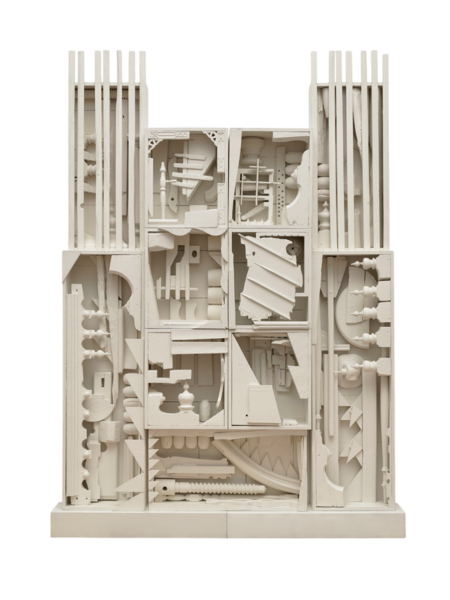
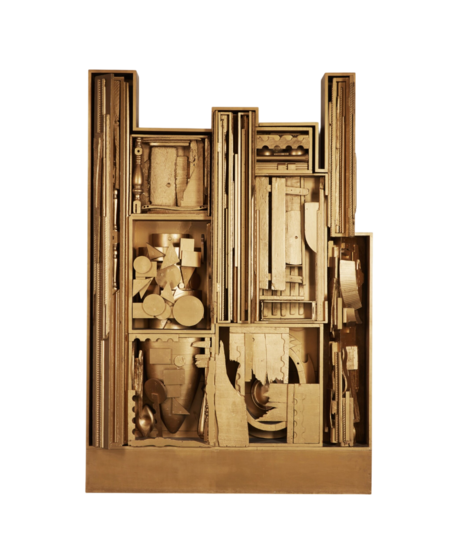
Luiza Neveson. «Dawn Wedding Chapel II.» 1959. Luiza Neveson. «Golden Gates.» 1960–1967.
A key feature of her method is coloring the entire piece in a single tone, most often black, white, or gold. In the work «Golden Gates, ” the color amplifies the sense of value and monumentality. Because of this, the found fragments begin to be perceived not as mundane remnants, but as part of a ceremonial, almost altar-like structure.
Luiza Nevelson. «Black Zigzag C.» 1968.
For Nevelson, the color black was often perceived by critics as a means of concealing the history of the discovered wooden objects. However, for the artist herself, using black did not signify the erasure of memory.
«It wasn’t a denial of color, but an acceptance of it: black encompasses all colors. Black is the most aristocratic of all colors. It can remain reserved and silent, yet hold everything within it, ” said Luisa Nevelson.
Luiza Neveson. «Shining Journey / Mirror Image.» 1969–1977.
Material Resistance
In it, the wood is not yet a «participant» in the full sense—as in works dealing with growth, time, or biological processes—but it is no longer neutral raw material. The artist retains control, yet the material’s density and scale, along with the traces of time upon it, inform their decisions.
Giuseppe Penone
Timothy O’Connell. Giuseppe Pennone in his studio. 2026.
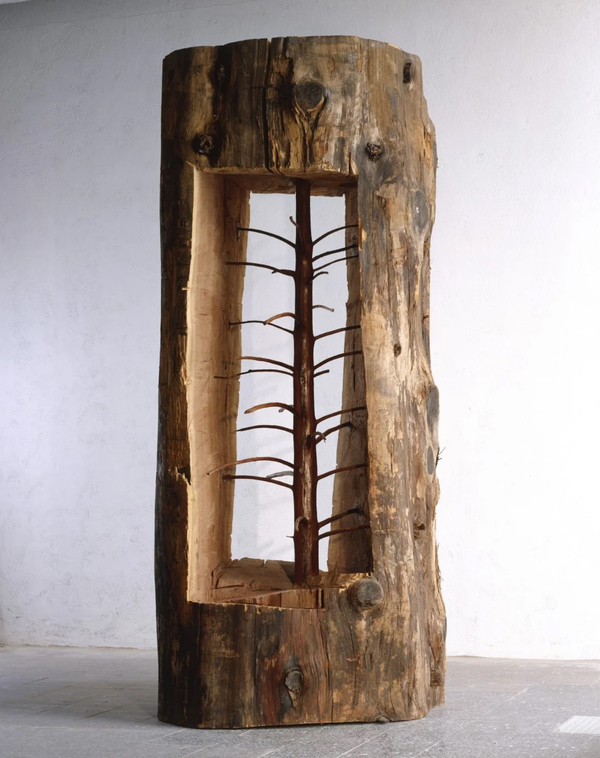
Giuseppe Penone is an Italian artist and sculptor, one of the representatives of the Arte Povera movement. In his practice, wood holds a special place: it is viewed not only as the physical foundation of the sculpture but also as a carrier of nature’s memory.
Giuseppe Penone. «Versailles Cedar.» 2000–2003.
In his work, «Versailles Cedar, ” Giuseppe Penone approaches the tree as a material already imbued with its own history. For this piece, the artist used a cedar trunk that was felled by a storm in Versailles in 1999.
Giuseppe Penone. «Versailles Cedar.» Working Process. 2000.