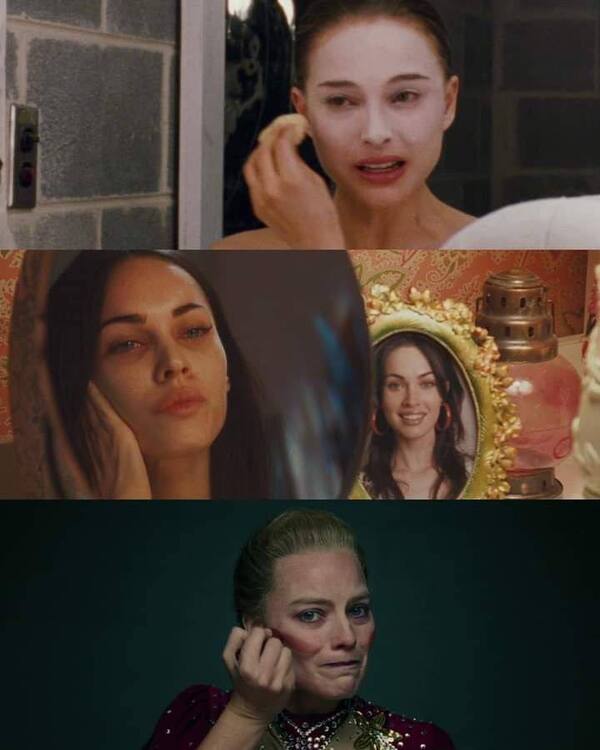
The paradox of representing women in the frame…
It has always seemed obvious to me, or at best, provoked a feeling of confusion. This phenomenon intersects psychological patterns in individuals subject to gender socialization, historical facts, and technological issues. The objectification of women in art, film, and photography has always existed, and this theme requires detailed analysis—which I intend to do, drawing upon the works of Teresa de Lauretis, Griselda Pollock, and Laura Mulvey.

Vision is a profoundly political act, as Griselda Pollock argued. Through the structure of vision—which is a part of the social hierarchy—gender inequality is cemented, and visual culture operates as a complex coding system. A person views paintings, photographs, or films through a system of codes imprinted in their memory that has constructed their current «self.» This means there is no innocence, symmetry, or, good heavens, equality between the position of the viewer and the object being viewed. Perception is always dictated by our experience, and our experience has been shaped within patriarchal conditions that subjugate women in art.
Pollock connects this to her concept of «vision and difference, ” which emphasizes that visual perception is never separate from one’s social standing, race, or gender. Difference, in this sense, is the fact that vision itself constructs identity and entrenches class divides. Women in cinema, for example, are never creators or viewers—no, instead, they are objects and the ones who are looked at. This stems from the depths of history, dating back to the Renaissance.
Teresa de Laurentis posits that language is a code, and cinematic language is bound to cultural codes that, in turn, reflect a masculine view of the world rather than a feminine one. Consequently, the woman in film culture is an absence—she has no place behind the scenes; she is merely an object of desire, a stepping stone that propels the plot. Her presence is necessary for the narrative, but only as a lever to influence the male protagonist, never as a complete individual. She is something absent from the system.
De Laurentis connects objectification to psychoanalytic mechanisms of desire. In her view, desire is a structural property of narrative, not simply an emotional state. She argues that desire is inherently masculine—it is the impetus for narrative movement. The woman, conversely, functions as a «prize» for the hero’s quest, thereby normalizing her representation as an object. This applies to all forms of art, not just film.
When we watch a film, we experience an illusion of control over the characters—we identify with them and project a wholeness that doesn’t actually exist. However, this illusion functions differently in male and female experiences. A man can easily identify with the on-screen hero, but a woman finds herself in a conflicted position: she can either objectify herself by identifying with the female protagonist (the cinematic object), or she can betray her gender by associating with the male protagonist.
Laura Malvi also offers several astute ideas on this subject. Drawing from the psychoanalysis of Freud and Lacan, she argues that the pleasure experienced by the viewer is never innocent or natural. Instead, it is dictated by the symbolic order of patriarchy and structured by unconscious schemas. In this context, cinema functions as something that shapes or counterfeits reality to serve the male ego. A singular viewpoint results from the convergence of the viewer, the subject, and the camera—with the center of subjectivity always being the male protagonist, the one who controls, sees, and interprets, while the woman functions as a sign of vulnerability and a subject to be controlled.
According to Freud, men perceive a threat in women due to the perceived absence of a phallus, thus experiencing an unconscious fear of castration. This is reflected in cinema: the woman is not a character but a sign carrying the burden of castration anxiety. This is precisely why the woman is transformed into an object that elicits attraction and anxiety from the viewer (who is always presumed to be heterosexual male). This necessitates a «processing"—a fetishistic and voyeuristic-sadistic move. These two strategies are capable of soothing anxiety while simultaneously stimulating the narcissistic ego of the male «self.» In the first tactic, the female body becomes fetishized and aestheticized to such an extent that feelings of anxiety dissipate; in the second, the woman is subjected to investigation, judgment, and symbolic punishment to reassert the power of the male subject. The woman’s body becomes the surface upon which the symbolic order reaffirms itself. The viewer is not looking at the woman; through her, they view their own superiority, thereby cementing the asymmetry between the beholder and the beheld.
Malvi connects scopophilia with Lacan’s «mirror stage.» The viewer sees in the male protagonist their ego-ideal—a whole, competent, active subject who does not suffer from the fragmentation and lack experienced in daily life. Through this optic, the viewer assumes the position of an active gaze, thereby reinforcing patriarchal subjectivity. The pleasure becomes twofold: being the one who acts and watches, while simultaneously possessing the one who is the object of the gaze.
Malvi believes that one cannot simply add something new to the patriarchal system; instead, the focus must be on deconstructing the structure of pleasure. There must be a rejection of smooth identification, of the viewer’s seamless immersion into an illusory world where the power of the gaze remains invisible. This is her attempt to understand film as a space for a possible rupture of the established order. When the camera ceases to be a transparent window and reveals its own position, when the narrative fractures, and when identification fails, the viewer is forced to confront not only the representation of women but also their own complicity in the patriarchal regime.
This approach allows for analysis not only of Hollywood but of popular culture as a whole. Advertising, social media, TV series—all of it repeats the same pattern: the active and passive position, the right to view and the obligation to be seen.
The rise of the selfie marked the beginning of another form of control. It seemed, this time, to be a democratization of the female image: look, the woman is holding the camera herself! And she is also the creator! That’s great, isn’t it? But it isn’t.
In reality, it further intensifies self-objectification. The woman must look at herself and consider how she is perceived by the male sex; she must make herself appealing in the frame, thereby dissociating herself. Her body is no longer her own; it is a tool, a prism through which she looks at herself through a man’s eyes and adjusts to his standards.
Teresa de Lauretis helps explain the reason. Her theory on coding shows that a person is inextricably linked to their own code—that is, their gender, class, race, and so on. Consequently, when a girl takes a selfie, she cannot simply step out of the system; she cannot hack her code. Years of pressure from beauty standards, fashion, and femininity influence self-perception, and this will and must be reflected in the image. Therefore, when a woman photographs herself, the creator is not her—the creator is the men who will look at that photograph.
This is a paradox. The woman remains an object in every situation, just as men and beauty standards remain the creators. It doesn’t really matter who is behind the lens. In any case, the creator will filter through standards, stereotypes, and mass culture, and this will be reflected in the outcome. A woman taking a selfie is always political because both the selfie and the world in which she takes it are political.
Studies show that women most often take selfies to post them on social media and receive likes, which itself is a longing for social approval. And this feedback loop—like a hamster on a wheel, where the woman is the hamster, the wheel is patriarchy, and the endless chase is a predetermined failure to fit into impossible, contradictory standards of femininity. Thus, the selfie even worsens the situation: where girls were once hostages to the male gaze, selfies make women hostages to themselves. Because of selfies, women are now obliged not only to perceive themselves as an object but also to transmit their desire to conform to unhealthy criteria.
One of De Laurentiis’s core ideas is that in language and cinema, the position of women is unstable and absent. Under these conditions, a girl cannot speak for herself or be her authentic self because language has already objectified her. When she says «I, ” that „I“ has already passed through a filter—the position society assigns to women. This applies not just to verbal language. The languages of cinema, painting, and even selfies all operate through signs and codes that have historically oppressed women. When she adopts a specific pose or a particular expression for the camera, she is acting from the position of an object, and even if she is conscious of and working through this, it is impossible to completely excise social norms and standards from herself. It is impossible to erase oneself from modernity and time.
De Laurentiis sees this not as a destiny that limits women’s personhood, but as a foundation for future political analysis. Because by recognizing the instability of the female image within society, it is possible to redefine their role and resist. Of course, this does not mean depicting women in a „positive“ light, because doing so would only cause people to bend further to patriarchal values. No—the goal must be to dismantle the very structure of image creation.
In what is termed postfeminism, there is the notion of a practice so deeply entrenched that women who take sexual selfies and alter themselves under masculine influence are viewed not as individuals objectifying themselves in a world that offers them no real choice, but rather as being forced to adopt this very illusion of choice. People loudly proclaim this as «the freedom to do with your body whatever you want, ” when in reality, it is the internalization of a distorted perception of womanhood. That is, the world now compels women to believe they are simply „uninhibited“ and that this is „their choice, ” when in fact, the woman is once again taking on the role of an object.
Choice is always made from options that have already been presented. When a young woman takes a selfie, she may be creative and conscious in her choice of pose and angle, but she exists in a world where women have historically been objects in cinema, and it is impossible to break free from these constraints. Postfeminist discourse labels this „freedom, ” even though the structural reality is perpetual confinement to unattainable standards.
Therefore, when examining visual representation, one must understand that it will never be merely a visual presentation. First and foremost, it is a political act. When we see a woman in a photograph, we are also witnessing an entire historical chain of choices regarding how to present a woman in the frame and the lens—what meaning to assign to her image.
The significance of the work of de Lauretis, Pollock, and Malvi does not lie in them providing a solution to the problem (because such a solution cannot exist, as language is never entirely neutral), but rather in providing tools to analyze the structure of power embedded within visual codes. Pollock, de Lauretis, and Malvi demonstrate that a woman’s passivity in art is not the end of her role or an inevitability, but rather the result of centuries of oppression—and that this can change.
It seems to me that…
Woman has always been, and will continue to live, in oppression. The problem of inequality has always existed, and people are such a species that they must structure and organize everything around themselves. In media culture, this thrives as it always has: first in fairy tales and fables, later in classic literature and the image of the romantic hero, and now in a neo-patriarchal society. Society must promote the idea of a «strong» and «weak» gender because, it seems to me, it is afraid. For example, recent statistics have shown that women are more effective workers even amid perpetual demotivation and denial of access to certain aspects of education, professions, and so on. Women have had to evolve to mature faster than men because they need to take responsibility for their future children at an early age. Men play a psychological war: they sow discord among women, force them to compete, tear apart sisterhoods, and compel them to doubt themselves and obey. To be convenient, prone to compliance, and to fit within standards and boundaries. This happens in every aspect of the current world. It is most clearly visible through the lens of a camera.