
MEDIA CONCEPT
«The Green Code» is a Russian-language popular science media outlet about the hidden life of plants.
The project portrays plants not merely as decorative backdrops or objects of care, but as active organisms that perceive their surroundings, react to changes, defend themselves, interact with other life forms, and adapt to living conditions.The media’s primary goal is to make botany accessible and engaging for a broad audience through unconventional questions, scientific discoveries, and visual explanations of natural processes.Slogan: «Plants are smarter than you think.»
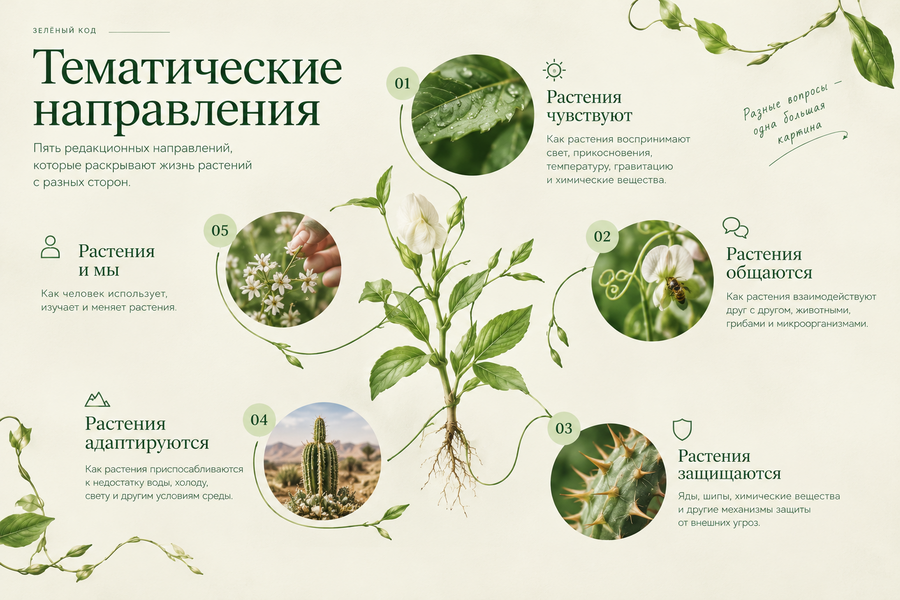
THEMATIC DIRECTIONS
TARGET AUDIENCE
The media is designed for individuals without a specialized background in botany who are interested in learning new things about nature.
Key audience segments:
Curious about nature — interested in unusual facts and popular science content.
Visual observers — enjoy photography, the microscopic world, natural phenomena, and aesthetically presented information.
Students and young professionals — seek clear explanations of scientific phenomena and visual materials for study and creative work.
Urban plant enthusiasts — want to understand plant life more deeply than just through watering and care instructions.
The audience’s main need is to receive new knowledge in an accessible format, satisfy their curiosity, and gain a better understanding of the world around them.
CONTENT FORMATS
«The Green Code» utilizes several complementary formats.
Popular science posts offer explanations of unusual facts and natural phenomena. Cards and infographics provide visual representations of scientific mechanisms. Photography and macro shots focus on details that often go unnoticed. Research compilations introduce students to scientific papers and their findings.
The primary platform is Telegram. VK is used to distribute visual materials, YouTube hosts more detailed video analyses, Pinterest features botanical diagrams and visual collections, and the website provides full articles and an archive of sources.
SEMESTER PLAN
Publications are released across five editorial themes. Each month features a unifying theme that allows for a sequential exploration of various aspects of plant life.
Month 1.
Sensing Without Senses
How plants perceive touch.
Why seedlings reach for light.
How plants respond to gravity.
What happens to a plant when the temperature changes.
Month 2.
Secret Communication
How plants respond to chemical signals.
What happens when an insect damages a leaf.
How fungi interact with plant roots.
Can plants warn each other about danger?
Month 3.
Survival Strategies
Why do plants have thorns?
Why are some plants poisonous?
How does the Venus flytrap work?
How do plants protect themselves from herbivores?
Month 4.
Life in Extreme Conditions
How cacti conserve water.
How plants survive winter.
Why do some plants grow in poor soil.
How plants adapt to low light.
Month 5.
Plants and Humans
How coffee affects the human body.
How plants are used in medicine.
What makes a plant a weed.
How the urban environment affects vegetation.
Month 6.
Invisible Processes
How plant growth is organized.
How water moves from roots to leaves.
How plants react to damage.
What can be seen with a microscope but is impossible to notice with the naked eye.
CONTENT SAMPLE #1
Format: Short popular science text
Topic: Why does a sprout reach for the window?
It seems that the plant is simply searching for the sun. However, there is an entire mechanism behind this movement.
When light strikes the sprout from one side, the distribution of the hormone auxin in its tissues changes. In the shoot, this can lead to more intense cell elongation on the shaded side. As a result, the sprout bends toward the light source.
This phenomenon is called phototropism.
The plant does not move toward the window like an animal; it changes the direction of its own growth.
This means that even a familiar houseplant is constantly reacting to its environment—it just does so much more slowly than we are used to noticing.
CONTENT SAMPLE #2
Format: Cards
Topic: Can a plant sense touch?Card 1. A plant cannot pull its hand away. But that doesn’t mean it doesn’t react to touch.Card 2. Stimulus. When an insect touches a Venus flytrap, it interacts with sensitive hairs on the leaf surface.Card 3. Signal. The mechanical impact generates electrical signals within the plant’s tissues.Card 4. Response. If the necessary signals occur within a specific timeframe, the trap quickly closes.Card 5. Why is this necessary? Closing the trap helps hold the prey, which the plant then digests to obtain nutrients.Card 6. Key takeaway. A reaction to touch does not mean the plant feels it the same way a human does. Plants operate with different perception and response mechanisms.
CONTENT SAMPLE #3
Format: popular science post
Topic: Why do plants have thorns?Thorns seem like simple protection: try eating the plant if it stings.But plant spines are structured in different ways. In some plants, they develop from leaves; in others, they form from shoots or other tissues. In everyday conversation, we often refer to them with a single word, even though from a botanical perspective, they can be different structures.One of their functions is to deter animals from eating the plant. Furthermore, some spines help create shade or influence air movement near the plant’s surface.Also, not all plants have thorns, nor do all plants need protection. Other species utilize chemical compounds, hardened leaves, or other methods to reduce the likelihood of damage.A plant does not possess a single, universal survival strategy.
CONTENT EXAMPLE #4
Format: Interactive post
Topic: What happens to a plant when its leaf is damaged?Imagine: an insect chews a hole in a plant leaf.What might happen next?A. The plant will not react at all.
B. Defense mechanisms may be triggered in the tissues.
C. The plant will immediately shed all its leaves.Correct answer: B.When tissues are damaged in some plants, signaling processes are initiated. These processes can lead to changes in gene expression and the production of protective compounds. In some cases, the chemical composition of the substances released by the plant also changes.The reaction depends on the plant species, the nature of the damage, and environmental conditions. Not every injury elicits the same response.A plant cannot run away from danger, but it has ways to react to it.
CONTENT SAMPLE #5
Format: long popular science text
How Do Plants Perceive the World Without a Brain?We are accustomed to viewing plants as stationary organisms that simply grow, absorb water, and reach toward the sun. However, behind their outward stillness lies a constant interaction with the environment. Plants perceive light, touch, temperature, and gravity; they react to damage and even exchange chemical signals.How do they manage this without a brain or a nervous system?
Light as a Signal
If you place a houseplant near a window, its stem will gradually bend toward the light after some time. This phenomenon is called phototropism.
Plant cells perceive light using specialized proteins—photoreceptors. The resulting signal alters the distribution of the hormone auxin, which influences cell growth. Consequently, different sides of the shoot elongate at unequal rates, causing the stem to gradually curve toward the light source. The plant does not move toward the sun like an animal; it changes the direction of its own growth.Touch That Initiates Movement
Some plants are capable of reacting to touch with surprising speed. For instance, the shy mimosa folds its leaves upon mechanical stimulation, and the Venus flytrap snaps its trap shut when an insect touches its sensitive hairs.
In both cases, the mechanical stimulus triggers signaling processes. In the mimosa, the movement of ions and water within the cells changes, whereas in the Venus flytrap, electrical signals arise that participate in closing the trap. These reactions demonstrate that a nervous system is not necessary for interaction with the environment.Can Plants Communicate?
When damaged, some plants release volatile chemical compounds. These substances disperse in the air and can influence the defensive responses of neighboring plants.
This is sometimes referred to as a warning signal, but plants do not converse in the human sense. Rather, it involves chemical signals that other organisms are able to perceive and utilize.The Life We Don’t Notice
Plants also orient themselves relative to gravity, adapt to water scarcity, and modify their growth depending on environmental conditions. Their reactions are mediated by the interaction of cells, hormones, electrical signals, and chemicals.
CONTENT EXAMPLE #6