Research The Concept of the Alexander Zelenko Children’s Museum
Zelenko developed a structure for a children’s museum designed to allow every child to conduct their own investigation of the real world, find their place within it, and develop.
«If an art museum wants to give children an art education, it must first and foremost create an artistic impression on the viewer—present a work that inspires a sense of harmony—and—to make the interest more personal—simultaneously provide the children with enough information about the artist, their era, and their views on art.»
Zelenko’s ideas introduced new requirements for the children’s museum environment. The exhibition space for young visitors must be open and, crucially, psychologically ready for change and experimentation. The surrounding space should be mobile and dynamic, suitable for constant rearrangement and testing. The collection of exhibits must consist of objects that can be handled for examination and study through tactile sensation. To enhance visual impact, technological tools are now being actively integrated—multimedia installations designed to engage various senses.
Neurobiological Basis of Multisensory Perception in Exhibition Seasons
The brain processes information integratively: Perception is not divided into separate «compartments» for sight or hearing. When viewing a painting or object, the brain automatically «adds» tactile sensation, sound, and smell, drawing upon past experience.
The Embodied Cognition Effect: We comprehend the world not only with our minds but with our entire bodies. Physical interaction (gesture, movement, touch) activates the motor cortex and deepens understanding.
The Link Between Senses, Memory, and Emotion: Olfaction and tactile sensation have direct neural pathways to the limbic system, which is responsible for emotion and autobiographical memory.
Memory and emotion are closely linked to multisensory experiences. The more sensory organs engaged, the stronger the neural connections and the more vivid the experience.
Kids Exhibition Season
The GES-2 Cultural Center traditionally serves as a space for experimentation and dialogue between art and the viewer. Its primary mission is to use the child’s experience of perception as a starting point for exploring questions about the nature of thought, memory, and imagination.
The exhibition project is a kind of «garden, ” where each exhibition is a separate part reflecting a specific aspect of the development of a child’s consciousness. Thus, four exhibitions this season will form chapters of a single study: How is a worldview formed? How do we learn to see, hear, remember, and imagine?
Each exhibition is constructed as an interactive environment where the artifacts demand not so much looking as participation. The approach is rooted in learning through action. Throughout the season, the GES-2 space will transform into a continuously operating laboratory where children aged 6–8 will investigate the mechanisms of their own perception. These exhibitions are, in essence, a „school of deep looking.“ Not in the sense of instruction, but in the sense of creating conditions where a child learns to notice, differentiate, and feel.
We are accustomed to thinking that reality exists «out there.» Something objective, given, independent of us. We enter the world as if into a furnished room, and all we have to do is look around. But what if this reality becomes a kind of garden—a space for our imagination and sensory experience?
The «Where Time Grows» season is an attempt to construct such a garden. Four exhibitions, four states of perception: from a world of pure sensations through movement and encounter to creativity, which always turns out to be a new beginning. Perception is not something granted to a person permanently. It grows—like a garden. It needs soil—primary sensations. It needs light—an impulse directed outward. It needs an encounter with another. And it needs time to mature.
Author Olivia Lang, in her book The Garden Against Time, calls the garden an «unexpected teacher, a powerful model for looking closely, filtering, and being in the world.» Her book has been the compass for this season. Her ideas about «a different understanding of time”—time that moves in a spiral—have defined how the four exhibitions are structured and how they relate to one another.
Each exhibition is a separate chapter in a conversation about how a child assembles the world from fragments of sensation, from movement, from encounters, from creative impulses. About how reality is not given ready-made, but is created every second, with every touch, with every movement.
GAFA Architectural Bureau
Mirrored Labyrinth
Nature in the City
To create the exhibition space, two architectural firms—GAFA and UTRO—have been invited, and their approaches complement each other. GAFA’s methodology is based on creating environments that engage the full spectrum of human perception, from tactility to emotional resonance. The architecture for the entire season is structured around the principles of a garden.
UTRO Architectural Bureau
The core idea of UTRO, articulated by architect Olga Rokal, is this: children do not need instructions on how to play. If the play space offers pre-set scenarios, the child’s imagination operates within the narrow confines of a given theme. However, if the space is abstract—if it offers imagery rather than instructions—children infuse it with meaning themselves—and this cultivates imagination in a fundamentally different way. This approach brings to light how children interact with space without prescribed narratives. As an architect-integrator, UTRO transforms artistic sketches into volumetric, tactile, and safe forms. UTRO can serve as the chief architects of the entire space. Their mission is to create a cohesive environment where each zone flows seamlessly into the next, where the path is intuitively understood, and where textures and forms operate in unified harmony.
Atelier GES-2
UTRO is responsible for the landscape, topography, tactile surfaces, natural materials, «abstract forms, ” and safety.
GAFA is responsible for lighting scenarios, kinetic elements, interactive systems, and technological infrastructure.
«My feelings were open, and my thoughts flowed freely, given over to myself, sometimes finding unexpected parallels or drifting far into the past.»
The season’s inaugural exhibition, «Time Grows Here, ” is dedicated to what often slips beyond the threshold of our attention—the world of pure sensations. It is what happens before we name something, before we recognize it, before it integrates into the familiar tapestry of reality. In a culture saturated with visual stimuli, we have almost forgotten that even scents can be the most precise carrier of lived experience; smell and sensation become a conduit to childhood. And sound can be unheard yet deeply felt. Leaving this first exhibition, a child takes away not so much knowledge as a state of being: a state of heightened feeling, acute awareness, and physical sensitivity. This will become the foundation for the entire season’s journey. The season is structured as a series of immersions into various sensory environments. In this first exhibition, we enter a space where we can capture a feeling at the very moment it is born.
Synesthesia
The theme of synesthesia—the blending of senses, where one sensation flows into another—runs throughout the entire exhibition. It explores how sound can possess color, how color can carry scent, and how touch can generate sound. It is precisely where the eye stops dictating its terms that synesthesia ceases to be a rare phenomenon and becomes a normal mode of perception. Wassily Kandinsky and Paul Klee are two artists who made synesthesia the foundation of their work. They were not merely depicting the world; they sought to create «visual music”—painting that could be „heard.“ Kandinsky dreamed that his paintings would be perceived like musical compositions—through the pure vibrations of color and form, bypassing objecthood. Klee, who was a musician by training, structured his compositions according to the laws of polyphony, where each color element sounds like an independent voice.
Both artists were also interested in children’s perception. Kandinsky and Klee collected children’s drawings, seeing in them that very „untainted“ capacity for pure expression that they aimed to restore to adult art.
Wassily Kandinsky
«Do you know what synesthesia is? It’s when one sense wakes up another. When you hear a sound and see a color. When you look at a color and smell it. Little Vasily Kandinsky had this special trait. When he held paints, they sounded to him! Yellow sang like a trumpet, blue hummed like a cello, and red chimed like a fanfare. Kandinsky invented abstract painting—pieces that don’t feature people, houses, or trees, but only colors, lines, and patches. Because he understood: color can speak on its own. Color is the music you see with your eyes. Kandinsky wrote the book Point and Line on the Plane. In this book, he explained that a sharp triangle sounds entirely different from a soft circle. A yellow triangle is an explosion, while a blue circle is a deep silence. The exhibition has a corner where you can see Kandinsky’s paintings. Try listening to them—what sounds do you hear? Perhaps the yellow patches are playing a trumpet, and the blue lines are singing in the bass?»
Integration: Near the paintings, there is an audio station where visitors can listen to synesthetic interpretations of the artwork. Interactive version: By touching different elements of the painting, a child hears corresponding sounds (programmed based on Kandinsky’s research and synesthetic descriptions). A series of abstract sculptures (in collaboration with UTRO) that reproduce basic forms from Kandinsky’s treatise. Touching different parts of the sculpture produces a sound corresponding to a specific pitch/timbre. The sculptures can be «played» like musical instruments, allowing users to create their own compositions.
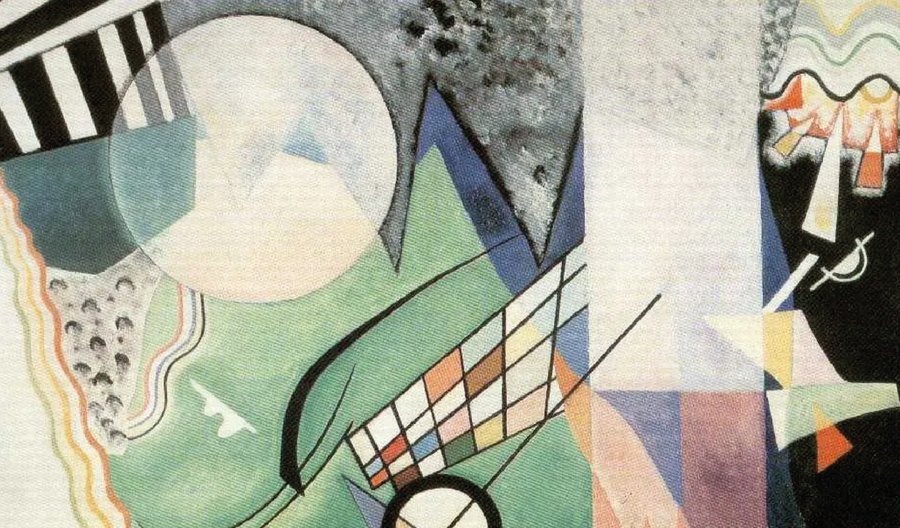
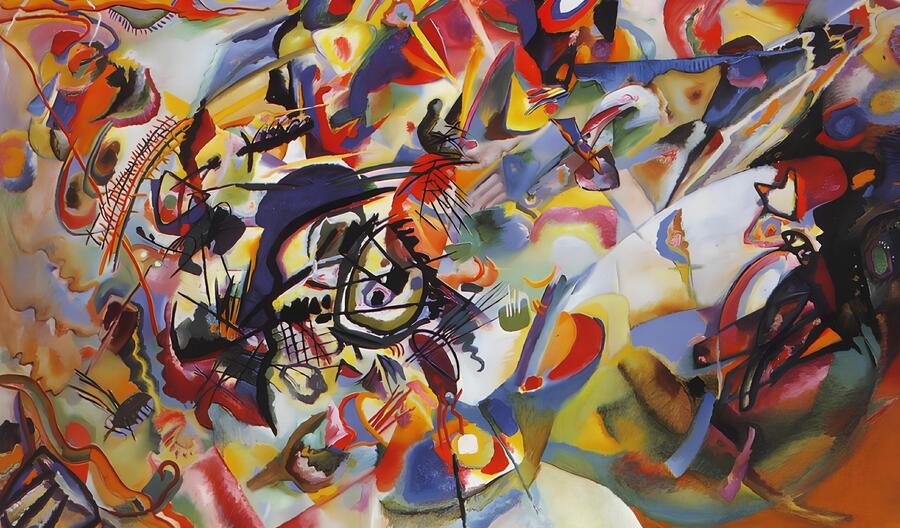
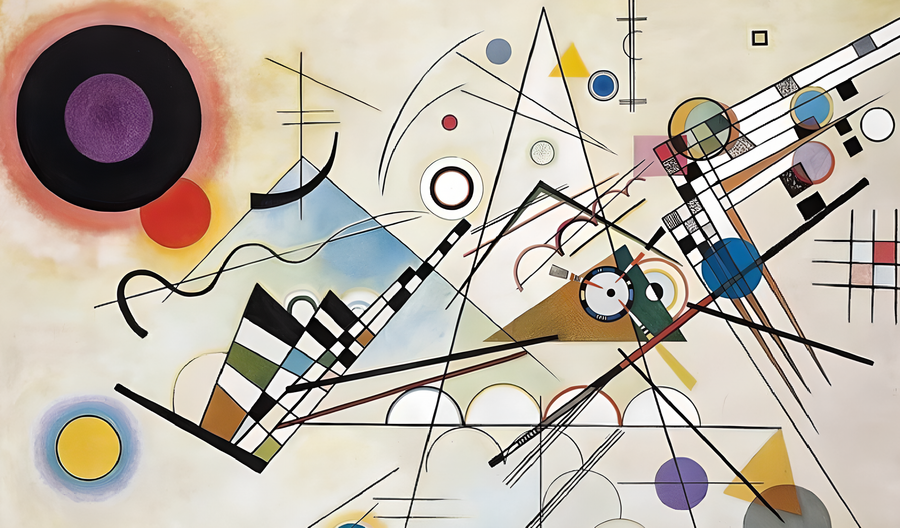
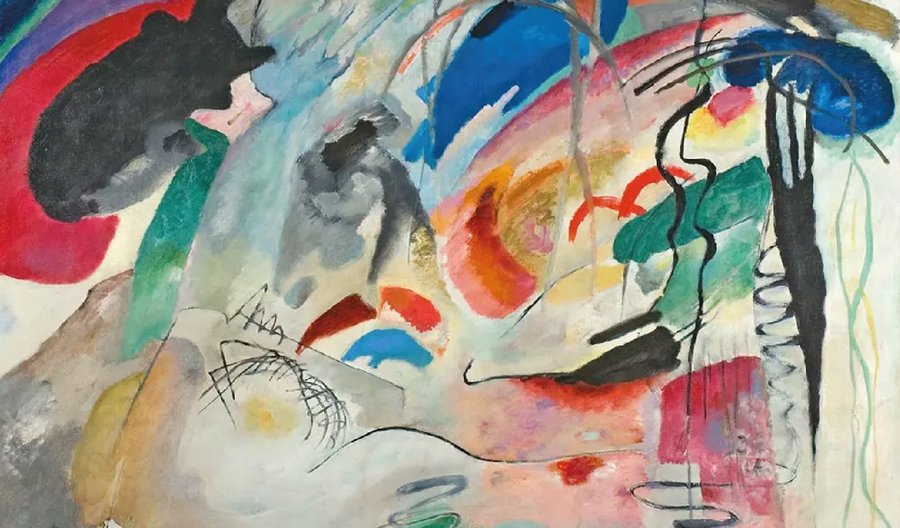
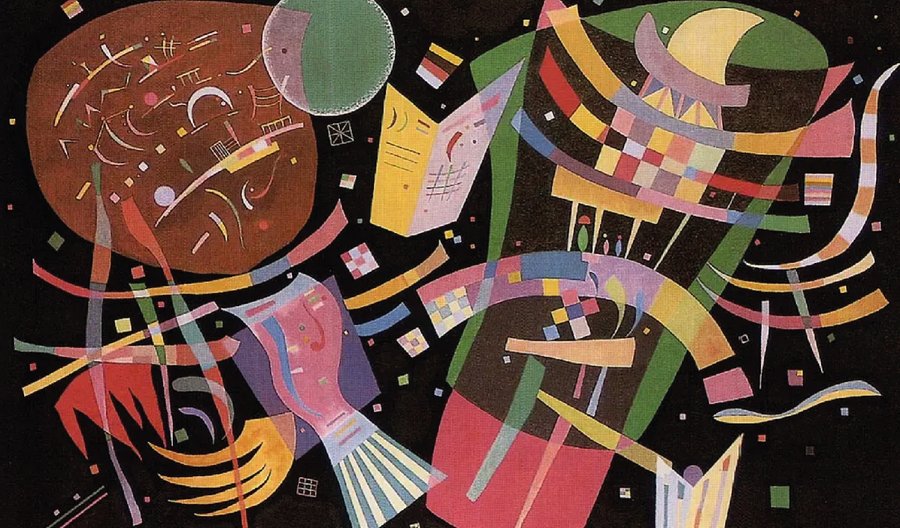
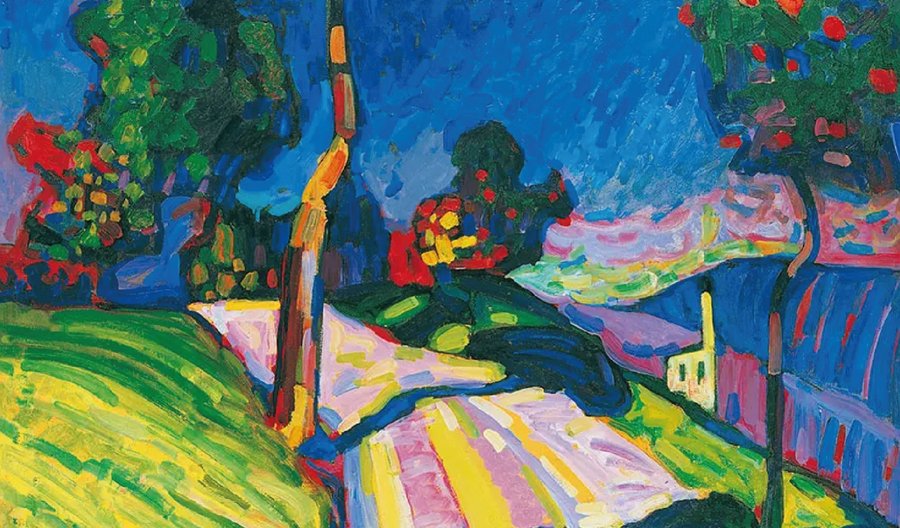
Works of Vasily Kandinsky
Composition VII, 1913 Composition VIII, 1923 Improvisation, 1913 Murnau, 1908 Composition X, 1939 Green Composition, 1923
Sound
Composer Anton Batagov has a profound interest in the theme of synesthesia. In an interview, he discussed the phenomenon of synesthesia in detail—the ability of Kandinsky to «hear the music of paintings.» Batagov is known for his long, evolving compositions that create a space for meditation and immersion—precisely what is needed for an exhibition on perception.
Example: «Composition VIII» Large circle, upper left — Trumpet + cello Sharp lines on the right — Steel strings Triangles — Xylophone Semi-circles — Bells Grid lines — Harp