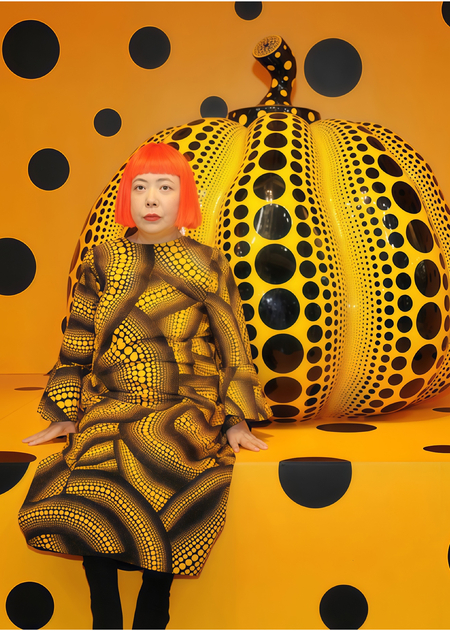
«I draw pumpkins again and again because they reflect my emotions. In every point, in every line, I erase the boundary between myself and the object. The pumpkin is me, and I am the pumpkin.»
Concept
The pumpkin in Yayoi Kusama’s work is more than just a motif—it is her reflection, her double. Born in Japan in 1929, Kusama saw the world through a net of hallucinations from childhood: dots and patterns overlaid reality, blurring the lines between objects and herself. The pumpkin became her first safe object—as a child, she hid among pumpkin patches, feeling how these «round beings» breathed and whispered. Later, in New York during the 1960s, fleeing psychosis and loneliness, she returned to this image as if it were a sanctuary. Examining the pumpkin as an alter ego reveals how personal trauma transforms into a universal visual language, and hallucinations into iconic sculptures recognized worldwide.
How does the pumpkin transform into an alter ego—not simply an image, but a reflection of the artist, through which she voices themes of madness, corporeality, and survival?
The hypothesis is that the pumpkin materializes a hallucination—this pattern is a specific ritual, an attempt to master trauma through scaling and reproduction. «By repeating the same image endlessly, I destroy its power over me, ” Kusama explains in one interview. „A pumpkin drawn a thousand times stops being frightening. It becomes my own.“
Categories
In this case, the primary focus is on three key aspects that, in my view, most fully reveal the essence of the work. The first is the ribbed, imperfect form, which serves as the main expressive quality, lending the piece a distinct tactility and dynamism. The second aspect is the contrasting combination of black and orange, which in itself generates a powerful visual impulse, immediately capturing the gaze and setting the emotional tone. Furthermore, the recurring pattern, which acts as a kind of rhythmic foundation unifying the individual elements, is important to note. Finally, the installations themselves—they become the space where all these techniques converge and begin to interact with one another, giving rise to a cohesive statement.
Principles for Selecting Materials and Textual Sources for Visual Research
I curated the visual component based on the principle of «biographical intensity»: this includes early works from the Japanese period created during a health crisis; installations from the American period where Kusama first scaled up the pumpkin to room size; and her most renowned works from the last few decades—the giant yellow pumpkin on Naoshima Island. The main criterion for selecting textual sources was their relevance to the theme of «autobiographical narrative in art,» as the concept of her creative work is intrinsically tied to her personal history. I relied on the autobiographies «Infinity Net» and «Manhattan Suicide Addict,» online essays from the Tate Modern and MoMA, and various interviews.
I. Form and Contour: The Ribbed Sphere as Self-Portrait
In art history, spherical forms were often used to denote completeness (sphere, globe, head). However, Kusama selects not the ideal sphere, but a ribbed sphere—a pumpkin with vertical wrinkles. This silhouette is repeated across drawings, paintings, soft sculptures, ceramics, and light installations. The pumpkin shape is a skeleton that remains consistent when transitioning between mediums.
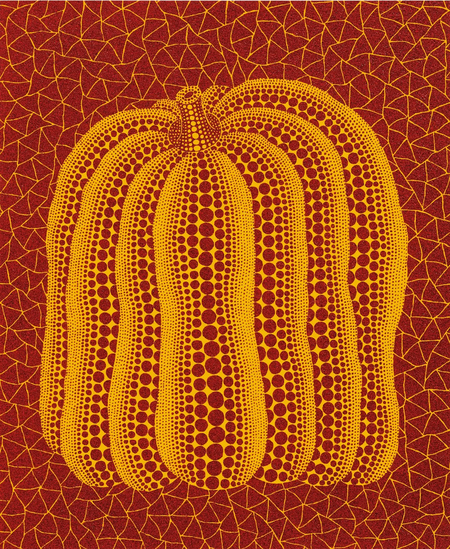
The ribs serve two functions:
- Plastic—they divide the surface, creating rhythmic verticals that visually «hold» the convex shape, preventing it from blurring.
- Symbolic—the ribs resemble the folds of fabric wrapping around the body. Kusama described the pumpkin as soft and cozy, like a «woman in a dress.»
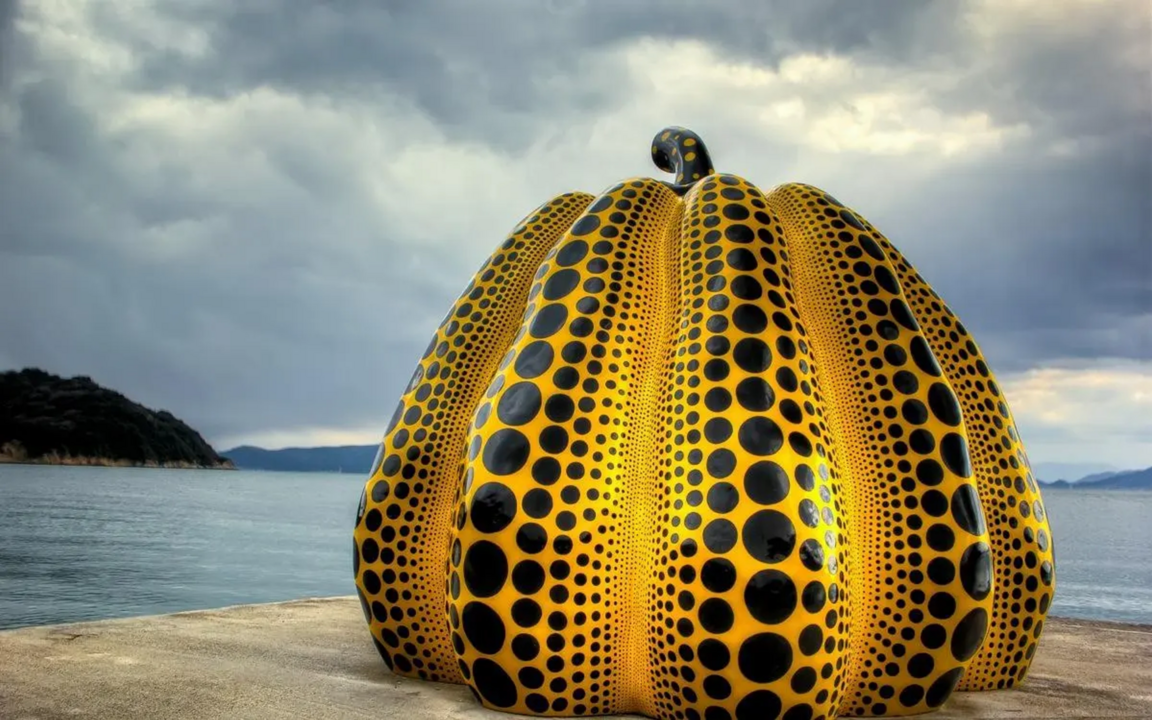
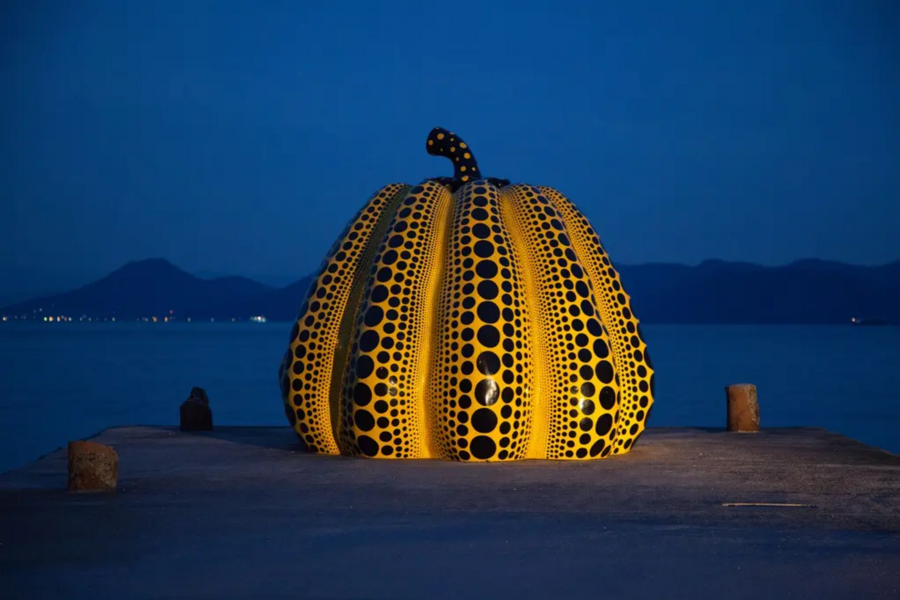
Yayoi Kusama, «Yellow Pumpkin» on the shore of Naoshima Island, 1994
This sculpture is a canonical example. Its form is a truncated sphere with two distinct indentations (top and bottom). The ribs establish a vertical rhythm that organizes the viewer’s gaze as they circulate around it. The sculpture rests directly on the ground, without a pedestal—it is «rooted, ” much like a body.
II. Color Palette: Yellow-Orange and Black as an Optical Impact

In most of Kusama’s pumpkin works, she uses yellow and black—colors that have the highest contrast in brightness (pure yellow is one of the lightest, black is the darkest). This pair creates an optical impact that forms the basis of the visual effect. Yellow and black represent the most physiologically intense contrast, which, upon prolonged viewing, induces afterimages: black dots begin to «float» on the retina.
In her installations featuring endless mirrors, Kusama uses other colors (red, blue), but for the pumpkin, yellow and black remain dominant. For Kusama, color does not convey emotion; rather, it functions as a stimulant—it compels the retina of the eye to react.
Yellow—a color Kusama associates with the «scream» and the painful intensity of hallucinations (she wrote that yellow «pierces the eyes»). The black dots are a tool of control: through the systematic application of dots, she visually «stitches up» anxiety and organizes pulsation.
Yayoi Kusama, «Infinity Mirrored Room, ” since 1965
The yellow-and-black pairing is a crucial mechanism for transforming a pumpkin into an alter ego. It shifts the pumpkin from an object of contemplation to an optical paradox: the boundaries between the interior and exterior, between the body and the environment, collapse through the vibration of color. The pumpkin ceases to be an object and becomes a perceptual process that Kusama shares with the viewer. Through this optical impact, the artist compels the viewer to experience her own state—thus, the pumpkin becomes a «living doppelgänger, ” not merely a symbol.
III. Repetition and Pattern: Peas as a Pulsating Code of Personality
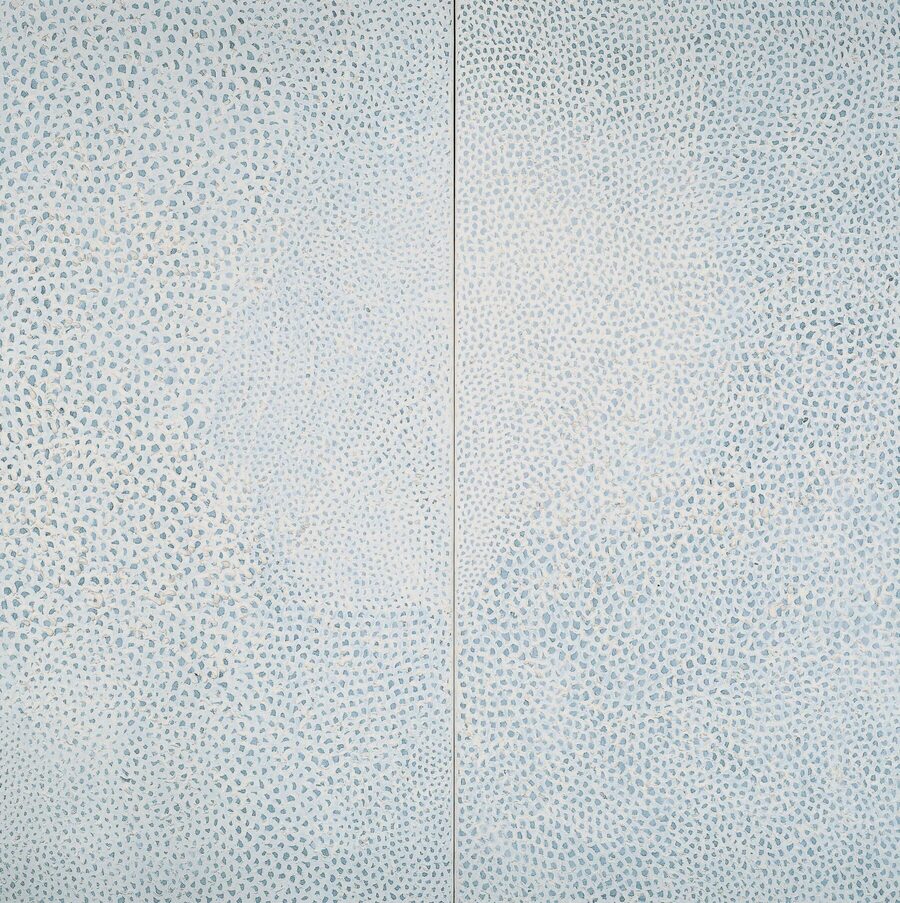
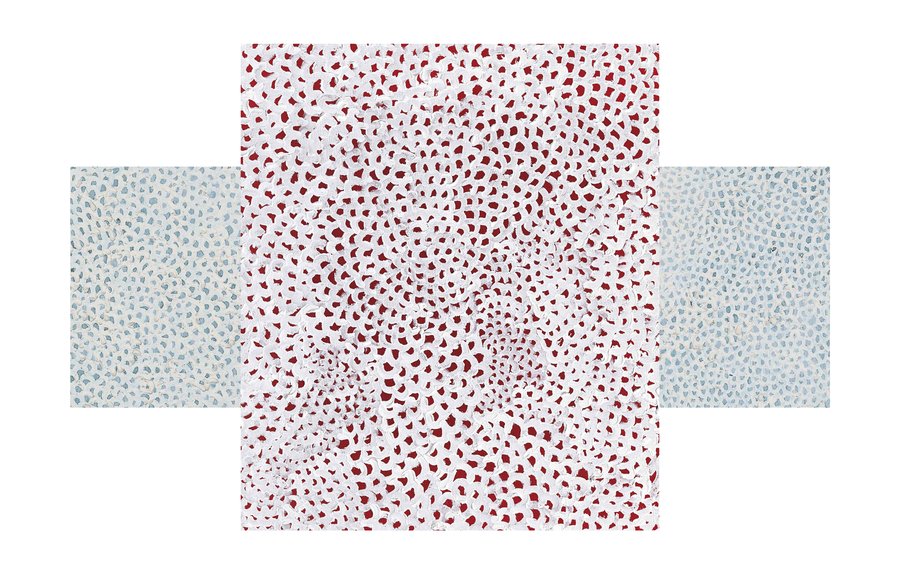
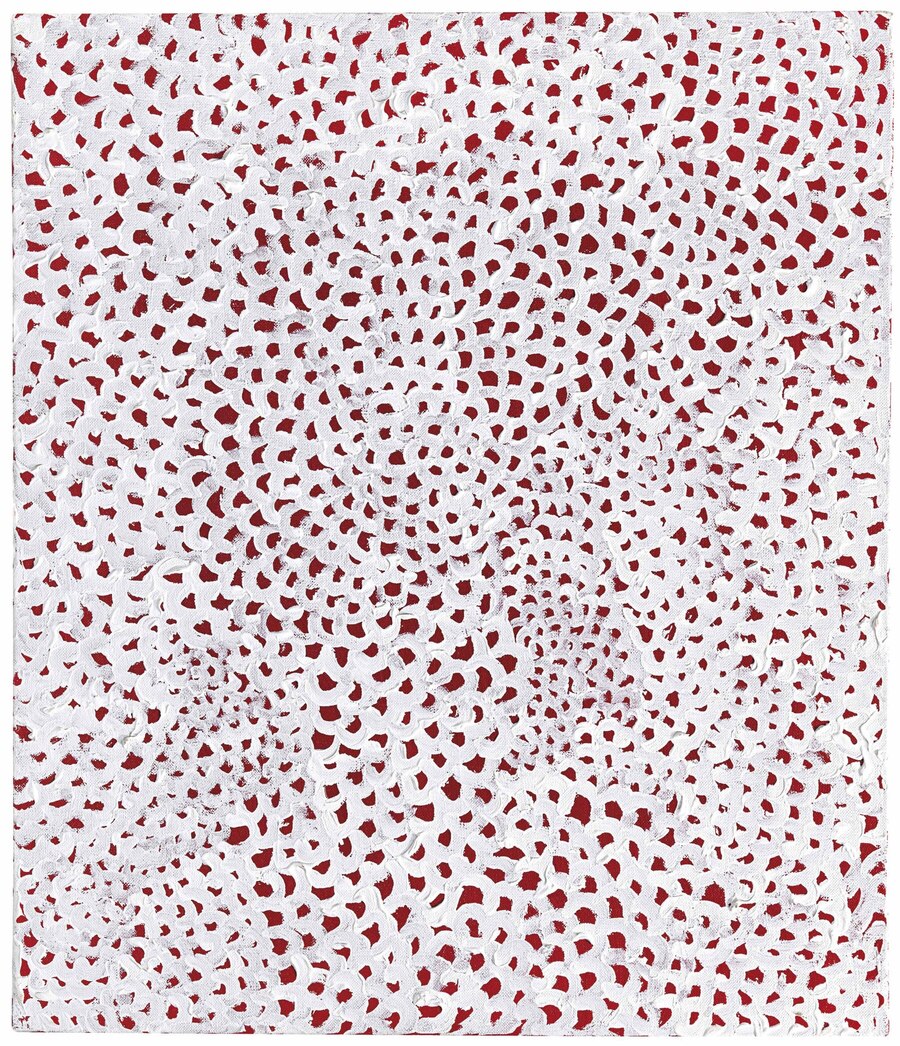
Yoko Ono, first piece from her «Infinite Nets» series, late 1950s; the second piece is «Pacific Ocean, ” 1960.
The dot—a fundamental element of Kusama’s visual language. It appears long before the pumpkins: in her early «Infinity Nets» (1960s), dots cover the entire canvas, dissolving the distinction between figure and ground. When this pattern is transferred to the pumpkin’s surface, it ceases to be mere ornamentation. The dot becomes the foundation of identity: the pumpkin is composed of countless identical units, and its individuality lies not in a unique shape, but in the way these units are organized.
Yayoi Kusama, New York Studio, 1958–59
The question, «How does the pumpkin become an alter ego here?» is answered here: through the simplification of the subject into a recurring gesture.
Yayoi Kusama, «Pumpkin, ” 1981
The process of drawing dots for Kusama is a form of obsessive repetition, which she describes as «meditation» and «control over perception.» By applying the same dot thousands of times, she «erases» her individual «self» and transforms it into a uniform mass. The pumpkin covered in dots is herself, «dismantled» into the smallest repeating units, yet assembled into a recognizable silhouette.
The repetition of dots transforms the pumpkin into a pulsating code of identity. Kusama’s individuality is not expressed through facial features or posture, but is encoded through the rhythm, density, and scale of the pattern. The pumpkin becomes an alter ego because it is composed of the infinite repetition of the same gesture—just as the artist herself daily paints dots.