Pt 1: Introduction

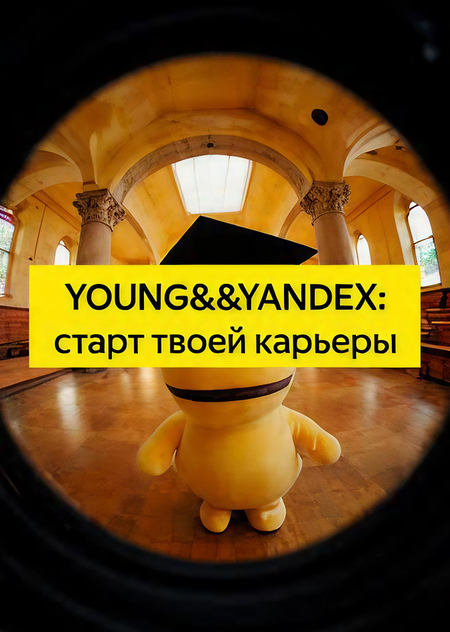
3D dino mascot / Young&Yandex wordmark
YOUNG&YANDEX Starting your career feels less like a job—and more like an adventure. A communication analysis through the Elaboration Likelihood Model and Uses & Gratifications Theory.
Young&Yandex is Yandex’s early-career ecosystem: featuring paid internships, summer schools, olympiads, championships, lectures, contests, events, and merchandise, all connected by a dedicated landing site and a Telegram channel. It is not a consumer-product brand, nor is it just a job listing page—it is an employer brand and an educational communication platform.
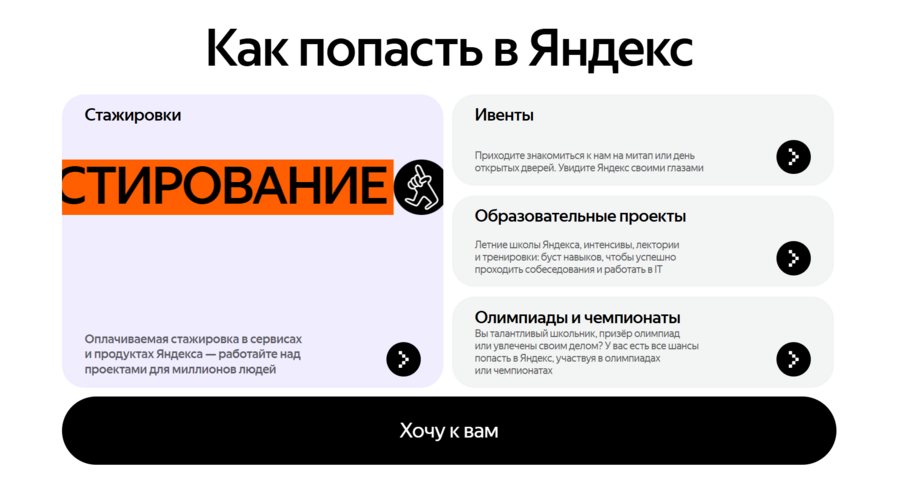
«How to Join Yandex» section + the «I Want to Join» button
The main «product» is career opportunity, and the brand communicates this on two levels. Functional level: information about internships, career paths, applications, schools, and events. Symbolic level: access to «big IT, ” professional growth, mentorship, real-world products at scale, and belonging to an intelligent community. The emotional promise is that the audience isn’t just applying for a job—they are entering a world.
The defining feature of the audience strategy: the funnel opens far upstream of hireability. Yandex begins building affiliation when a person is a student and harvests the application years later, as a graduate. Three segments sit on one continuous path.
audience diagram — three levels: school students $\rightarrow$ students/graduates $\rightarrow$ early-career
Olympiad circles, math and CS preparation, and contests for teens. At this stage, the focus isn’t on offering a job—the communication sells a future self, not a specific position. The strategic logic is this: by the time these students are ready to be hired, they already identify with the brand and have been trained on its own tasks. Effective hiring starts in school.
The core conversion segments include paid internships, summer schools, ambassador programs, campus events, and the University Battle. This is where the curiosity cultivated earlier transforms into applications.
Specialists looking to change careers, join a larger firm, or test their skills through contests and events—across all disciplines: development, ML, analytics, testing, security, management, business, marketing, and design. «All Stacks, Non-IT» is a literal event tag.
Pt 2: Communication Channels
collage of channels
Young&Yandex utilizes a multi-channel system, with each channel serving a distinct function: the website structures the ecosystem; internship pages convert interest into applications; events build community; Telegram facilitates daily contact; YouTube delivers long-form video; contests operate as selection-and-training infrastructure; olympiads and schools feed the school-age pipeline.
The site presents the ecosystem as a map of entry points—internships, events, educational projects, olympiads, summer schools, CodeRun, and Young Con. It makes the brand feel less like a vacancy page and more like a complete career environment.
screenshot of yandex.ru/yaintern
The internship page is highly practical. It features paid internships within Yandex services, emphasizes hands-on work on products with large user bases, and outlines various career paths. It directly answers the audience’s main question: «Where can I apply and what exactly will I be doing?»
The Telegram channel maintains consistent, informal communication between events—offering tips, calls for participation, behind-the-scenes glimpses, and interview preparation advice. It integrates natively into the platform the audience already uses.
Events allow the brand to engage with potential candidates before they formally apply, thereby lowering psychological distance: first attend, listen, observe—and then decide whether to enter the selection process. Young Con, a festival centered on career and technology, transforms Yandex from an abstract employer into a tangible, social environment where young people can connect.
Lectures, training sessions, and summer schools position Yandex as a company that invests in development, rather than simply one that selects already prepared candidates. A school format implies a serious learning trajectory and deeper immersion. For school-aged and early audiences, this is the channel that minimizes distance long before any internship becomes a realistic possibility.
Yandex campus coworking interior HSE / MFTI with branding
Yandex has introduced branded coworking spaces within universities—starting at ITMO (2023), then MFTI, and HSE (2025)—designed to mirror Yandex’s own offices: featuring comfortable seating, soundproof booths for virtual meetings, a Yandex Station equipped with Alice and smart-home devices, and a shelf of programming and science books curated by Yandex Education experts.
On-site events are hosted by Yandex experts in collaboration with the Computer Science Faculty. As a channel, the space’s role is ENVIRONMENTAL: it embeds the brand into students' daily routine right on their campus. Scope note: these spaces sit at the intersection of Young&Yandex and Yandex Education (the university-partnership sub-brand)—treat them as part of Yandex’s broader student engagement presence, rather than as a purely internal property.


Battle of Universities
The PR strategy is continuous community-building rather than seasonal recruitment: an always-on event calendar, peer advocacy (ambassadors), earned attention (championships, the ₽1M University Battle prize), and owned media (Telegram, the documentary film). The relationship is maintained year-round, so the eventual «apply» feels like a next step, not a cold start.
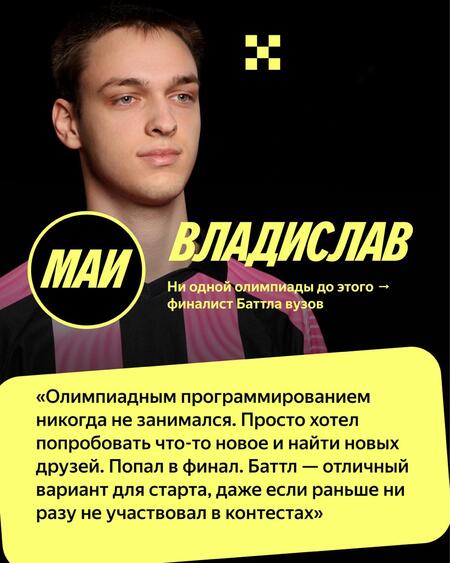
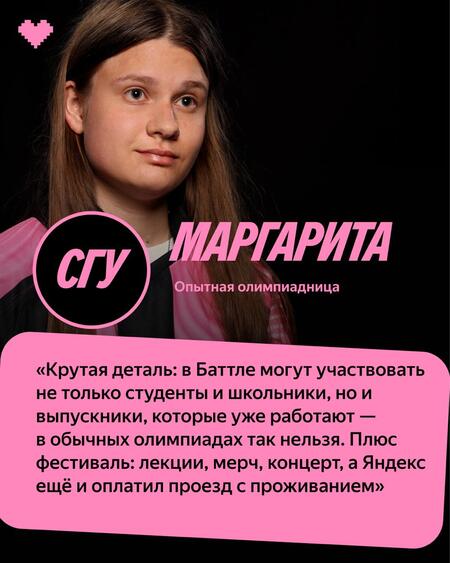
Real Stories of University Battles
Part 3: Theoretical Framework
An employer brand must fulfill two functions: persuade people to want to join, and keep them engaged for years across a long funnel. We employ one theory for each aspect. — Elaboration Likelihood Model (ELM) — HOW the communication persuades. — Uses and Gratifications Theory (UGT) — WHY the audience continues to choose engagement.
two theories
ELM describes two routes to attitude change. The CENTRAL route works through careful processing of strong arguments and evidence—it requires motivation and the ability to think. The PERIPHERAL route works through cues—emotion, attractiveness, mood, identity signals—when motivation or the ability to elaborate is low. Most communication utilizes both, targeting different audiences.
UGT treats the audience as ACTIVE: people choose media to satisfy specific needs. The classic gratifications (McQuail, Blumler & Brown, 1972) are: SURVEILLANCE / information; PERSONAL IDENTITY (modeling and reinforcing who you are); INTEGRATION & SOCIAL interaction (belonging, shared talking points); and DIVERSION / entertainment.
The two theories interlock. The ELM explains the brand’s persuasion architecture—strong arguments for serious candidates, attractive cues for everyone else. The UGT explains its longevity—the audience returns because each visit yields a payoff in information, identity, belonging, or fun. Together, they describe a system that moves a 14-year-old’s curiosity to a graduate’s application.
Part 4: Analysis
For highly motivated candidates (such as a graduating developer), the brand provides compelling, verifiable arguments: paid internships, «real work on products used by millions,» named tracks and concentrations, and transparent selection processes. This is central-route persuasion—attitude change earned through substance that the reader actively evaluates.
The documentary film, open lectures, and contests offer high-elaboration users even more to process: in-depth validation, expert speakers, and measurable challenges. Depth itself becomes an argument that this is a serious environment for growth.